 Semiahmoo Siding
 Siding Installation Built for Sumas' Wet, Mossy Climate
Homes in Sumas deal with a specific combination of weather stress that most siding products simply weren't designed to handle indefinitely. Salt-laden air drifts in and settles on exterior surfaces, wind-driven rain finds every gap and seam it can, and a moss season that stretches across most of the year keeps north-facing and shaded walls damp for weeks at a time. This isn't occasional bad weather — it's the year-round baseline for exterior siding in this part of Whatcom County.
That combination matters because siding failure is almost never about one bad storm. It's about repeated, low-grade moisture exposure that a product either sheds and dries out from, or slowly absorbs and holds. Over years, the difference between those two outcomes is the difference between a wall system that lasts decades and one that needs boards replaced, repainted, or torn off and redone well before it should.
When we talk about "siding installation for Sumas," we're not describing a generic service. We're describing a specific set of material and installation decisions made because of what this climate actually does to a house.
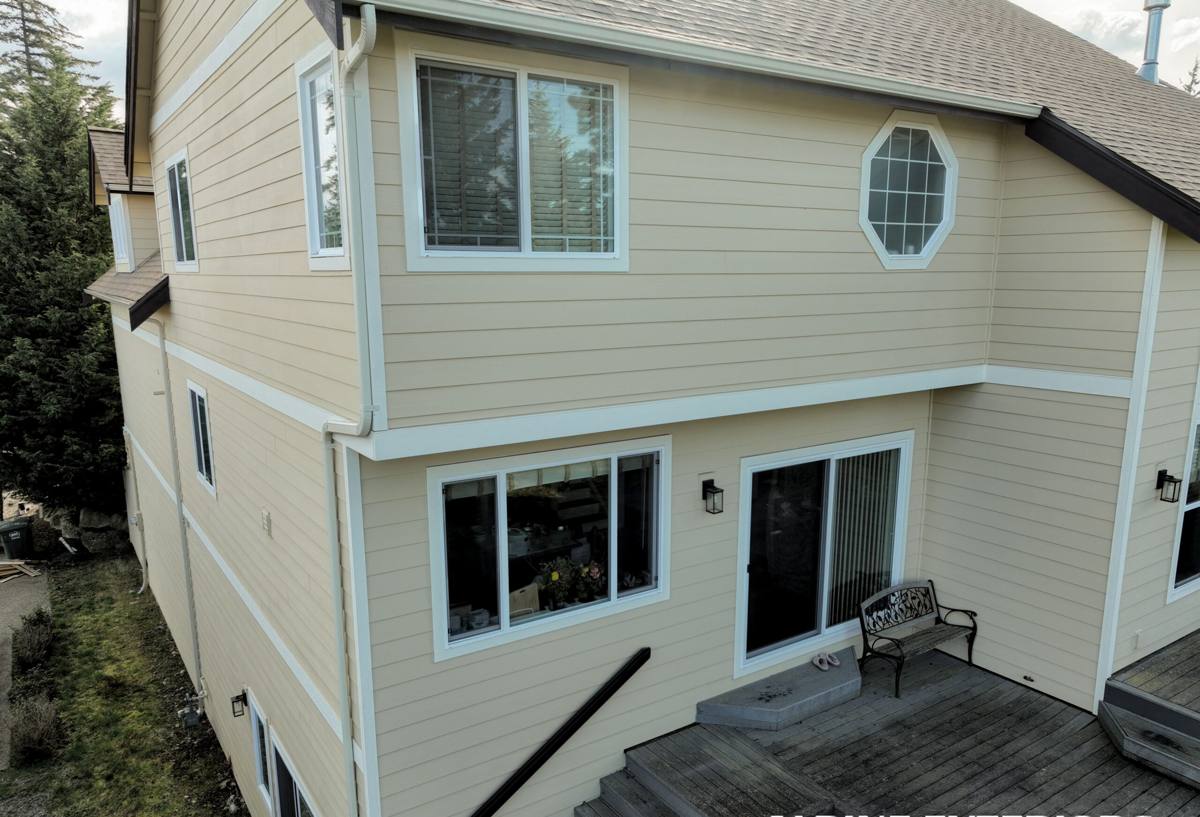
What Sumas Homes Are Actually Up Against
Salt Air and Moisture
Salt-carrying air accelerates corrosion on fasteners, flashing, and any exposed metal, and it also holds moisture against exterior surfaces longer than dry inland air would. Siding materials that rely on paint film or surface coatings to stay watertight are put under constant, low-level stress in this kind of environment.
Driving Rain
Rain that comes in sideways, rather than straight down, is a different engineering problem than a light vertical shower. Driving rain pushes water into laps, seams, and fastener penetrations that a wall system might otherwise never see moisture reach. This is why water management behind the siding — not just the siding itself — is often what actually determines whether a wall stays dry.
Long Moss Season
Shaded and north-facing walls in this region can stay damp for extended stretches, which is exactly the environment moss and algae need to take hold. Once organic growth establishes itself on a wall, it holds even more moisture against the surface, which is where you start seeing paint failure, soft trim, and swelling on materials that aren't dimensionally stable.
What Correct Siding Installation Involves
A good siding job is mostly invisible once it's done — which is exactly why it's so often done poorly. The visible board is the last five percent of the work. Everything that actually determines whether the wall stays dry for the next thirty years happens underneath it.
Water-Resistive Barrier and Drainage Plane
Every wall needs a continuous water-resistive barrier behind the siding, installed shingle-style so water sheds downward and out rather than working its way behind the material. In a climate with as much driving rain as Whatcom County sees, a drainage gap between the barrier and the siding — rather than siding installed tight against the wrap — gives incidental moisture somewhere to go instead of sitting against the substrate.
Flashing at Every Penetration
Windows, doors, hose bibs, light fixtures, and any other penetration through the wall plane need proper flashing integrated with the water-resistive barrier, not just caulked over afterward. Caulk is a maintenance item, not a waterproofing strategy — it degrades, and when it fails silently behind the siding, the damage is often well underway before anyone notices from outside.
Fastening and Clearances
Fiber cement siding has manufacturer-specified nailing patterns, fastener types, and minimum clearances from grade, roofing, and decks. Skipping or shortcutting these details doesn't show up as a problem on installation day — it shows up as trapped moisture, splitting, or premature paint failure years down the road, often after the installer is long gone.
Caulking and Sealant Details
Butt joints, trim intersections, and terminations need the right sealant, applied correctly, and only where the manufacturer actually calls for it. Over-caulking a fiber cement installation can trap moisture just as easily as under-caulking it — this is a detail that separates a crew that knows the product from one that's treating it like generic lap siding.
Why We Install Only James Hardie Fiber Cement
We made a decision to install exclusively James Hardie fiber cement siding, and we don't install vinyl, LP SmartSide, cedar, primed spruce, or other fiber cement brands. That's not a marketing position — it's a standard we hold because of what we've seen these products do, and not do, in exactly this kind of climate over time.
Fiber cement is non-combustible and dimensionally stable, meaning it doesn't expand, contract, warp, or absorb water the way wood-based products can. James Hardie's HZ product lines are specifically engineered for different moisture and temperature zones, which matters in a region where wall assemblies deal with sustained dampness rather than occasional exposure. The ColorPlus factory-applied finish is baked on under controlled conditions, which gives it better adhesion and UV resistance than field-applied paint — a real advantage on a home that's going to see a lot of gray, damp days between repaints.
Hardie also backs the product with a strong transferable limited warranty, which matters to homeowners who may sell before the siding's functional life is over. None of this means other products are without merit — vinyl is inexpensive and low-maintenance in mild climates, cedar has genuine natural appeal, and engineered wood has a real following. But when we weigh moisture behavior, maintenance burden, and long-term performance against what this specific climate demands, fiber cement is what we're willing to put our name on.
Comparing Siding Materials in Whatcom County's Climate
| Material | Moisture Performance | Maintenance | Longevity in This Climate |
|---|---|---|---|
| James Hardie fiber cement | Dimensionally stable, doesn't absorb and swell | Occasional wash, repaint on a long cycle | Decades when installed to spec |
| Vinyl siding | Sheds water but can warp under heat/cold cycling and doesn't manage trapped moisture | Low, but can't be repainted if faded | Variable; seams and fasteners are common failure points |
| Cedar/wood | Absorbs moisture; needs consistent sealing to perform | High — regular staining/sealing required | Shorter without diligent upkeep |
| LP SmartSide / engineered wood | Treated to resist moisture but remains wood-based | Moderate to high, edge sealing critical | Depends heavily on installation and upkeep |
This isn't a claim that other materials can't perform — it's a reflection of how much they depend on perfect maintenance discipline to do it in a climate this consistently wet.
How Our Installation Process Works
- On-site assessment: We look at the existing wall assembly, current siding condition, moisture damage if any, and the specific exposure each elevation of the home gets.
- Tear-off and substrate check: Old siding comes off and we inspect the sheathing underneath for rot or damage before anything new goes on — covering up a compromised wall never ends well.
- Water-resistive barrier and flashing: We install the drainage plane and flash every window, door, and penetration before a single piece of siding goes up.
- Hardie installation to manufacturer spec: Correct fastening, clearances, and joint treatment, following James Hardie's published installation requirements for this climate zone.
- Trim, caulking, and finish details: The details that determine how the home actually looks and performs at seams, corners, and terminations.
- Final walkthrough: We go over the finished work with the homeowner before calling the job done.
Signs a Sumas Home May Need New Siding
- Visible moss or algae growth that returns shortly after cleaning
- Soft, spongy, or discolored sections when pressed
- Paint that's peeling, bubbling, or failing faster than expected
- Warping, cupping, or gaps opening between boards
- Rising energy bills that suggest the wall assembly is no longer performing as insulation
- Visible rot or staining around window and door trim
- Siding that's original to a home built more than 20-25 years ago
Why Local Installation Experience Matters
Siding installed to a generic national standard doesn't automatically account for what a Whatcom County wall actually experiences over a year. A crew that regularly works in Sumas and the surrounding area has already seen which details fail first in this climate — which flashing shortcuts show up as rot in five years, which wall orientations need the most attention to moss and moisture, and which installation habits hold up against sustained damp weather versus just looking fine on a dry install day.
That local pattern recognition is hard to substitute for. It's the difference between a crew following a manual and a crew that understands why the manual says what it does.
Caring for Hardie Siding After Installation
Correctly installed fiber cement siding is low-maintenance, not no-maintenance. A periodic gentle wash removes surface grime and discourages moss before it establishes itself. Keeping gutters clear and grading water away from the foundation reduces splash-back moisture at the base of the wall. Repainting, when eventually needed, is on a much longer cycle than with field-finished materials thanks to the factory-applied ColorPlus finish — but it's still worth an occasional visual check, especially on shaded elevations where moss season lingers longest.
If your siding is showing its age or you're planning ahead for a replacement, we're happy to take a look and give you an honest, no-pressure assessment of what your home actually needs. Reach out through the form below to schedule a free estimate.