 Semiahmoo Siding
 A Standard, Not a Sales Pitch
Every siding contractor has to draw a line somewhere on what they'll put their name behind. Ours is simple: we install James Hardie fiber cement siding, and we don't install anything else. That's not a marketing angle — it's a decision we made after years of watching how different siding materials actually hold up on homes here in Semiahmoo and across Whatcom County, where salt air off Semiahmoo Bay, driving winter rain, and a long moss season put real, sustained stress on an exterior.
This page explains why we standardized on one product line instead of offering the usual menu of vinyl, engineered wood, and fiber cement options. If you're comparing siding materials for a home near the water or anywhere in this region, the reasoning below applies to your decision too.
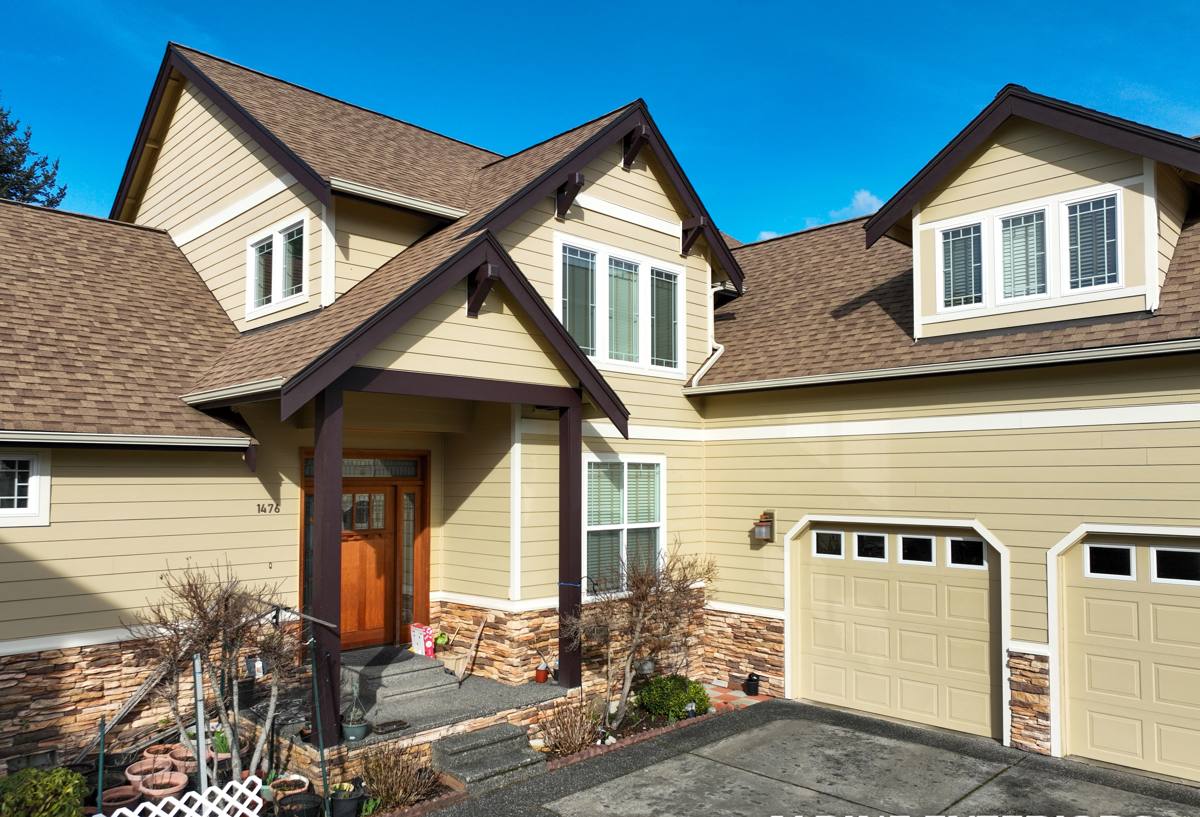
What Our Climate Actually Does to Siding
Semiahmoo sits right on the water, and that proximity matters more than most homeowners realize until they've lived with it a few years. Salt-laden air corrodes fasteners and finishes faster than inland exposure. Constant damp air combined with mild temperatures creates ideal conditions for moss and algae growth on north-facing and shaded walls. And the region's wind-driven rain doesn't just fall straight down — it gets pushed sideways into seams, laps, and trim joints that a drier climate would never stress-test.
Any siding product can look fine in a showroom or on a sunny install day. The real test is what it looks like after five winters of that combination. That's the lens we use when we evaluate materials, and it's why we stopped installing several products that perform reasonably well elsewhere but struggle under sustained coastal Pacific Northwest conditions.
The Three Stressors We Design Around
- Moisture cycling — repeated wetting and drying that causes swelling, warping, or paint failure in moisture-sensitive substrates
- Salt exposure — accelerated corrosion of fasteners and degradation of certain finishes near the shoreline
- Biological growth — moss, algae, and mildew that thrive in our shaded, damp microclimates for much of the year
Why We Don't Install Vinyl
Vinyl siding is inexpensive and easy to install, and for a lot of the country it's a perfectly reasonable choice. In our climate, we see two recurring problems. First, vinyl expands and contracts significantly with temperature swings, and over time that movement works fasteners loose and opens gaps at seams and corners — gaps that our wind-driven rain finds. Second, vinyl's color is baked through the material itself, but its surface fades and chalks under UV and salt exposure, and unlike a factory-applied finish, there's no way to refresh it without full replacement. It's not a bad product; it's a product built for a different set of conditions than the ones right outside a Semiahmoo window.
Why We Don't Install LP SmartSide
LP SmartSide is engineered wood — strand board treated and coated to resist moisture better than raw lumber. It has real advantages: it's lighter than fiber cement, easier on cutting tools, and holds paint well when installed correctly. The trade-off is that it's still a wood-based product, which means its long-term performance depends heavily on flawless caulking, flashing, and edge-sealing at every cut and joint. In a climate with our level of sustained moisture exposure, any breach in that seal — a missed caulk line, a cut edge left unsealed — gives water a path into the substrate. Once moisture gets into engineered wood siding, swelling and delamination follow, and by the time it's visible from the outside, the damage is often already done underneath.
Why We Don't Install Cemplank or Allura
Cemplank and Allura are both fiber cement products, technically in the same material family as James Hardie. We get asked about this distinction often, so it's worth being direct: the raw material category being similar doesn't mean the products perform identically. Our decision to standardize on Hardie comes down to consistency of manufacturing, the maturity and coverage of their factory-finish system (ColorPlus), and the strength and clarity of their warranty terms. We've chosen to build our entire installation process, crew training, and warranty backing around one manufacturer's system rather than splitting our expertise across several similar-but-different product lines.
Why We Don't Install Primed Spruce or Cedar
Solid wood siding — primed spruce, cedar — has a real appeal, especially for homeowners who want a natural, traditional look. We understand that appeal. But solid wood is the most maintenance-intensive option available, requiring recurring painting or staining, careful moisture management, and vigilant upkeep to prevent rot, cupping, and insect damage. In a region with our humidity and rainfall totals, that maintenance burden isn't occasional — it's a standing commitment. Cedar in particular is also prone to accelerating moss and algae growth in shaded, damp wall sections, which is exactly the microclimate a lot of Semiahmoo lots have thanks to mature tree cover near the water.
What James Hardie Gets Right for This Climate
James Hardie fiber cement siding is made from cement, sand, and cellulose fibers, engineered specifically to resist the failure modes above:
- Non-combustible — fiber cement doesn't burn, which matters for wildfire-adjacent insurance considerations even in a wet coastal climate
- Dimensionally stable — minimal expansion and contraction means fewer opened seams over time compared to vinyl or wood
- Factory-applied ColorPlus finish — baked-on finish resists fading and chipping far longer than field-applied paint, and touch-up product is available to match it
- Climate-engineered HZ product lines — Hardie manufactures HZ5 formulations specifically for regions with freeze-thaw and moisture exposure like ours, rather than a one-size-fits-all board
- Resistant to moss and mildew growth — the cement-based composition doesn't feed biological growth the way wood-based products can
Where Hardie Still Depends on Installation Quality
No siding product installs itself, and Hardie is not an exception. Correct installation means proper clearance from grade and roof lines, correct fastener spacing and type (especially given salt-air corrosion concerns), properly lapped and caulked joints, and correct flashing at every window, door, and penetration. A great product installed poorly will still fail. That's a large part of why we limit ourselves to one system — it lets our crews install the same details correctly every time rather than switching install standards from job to job.
Comparing the Options Side by Side
| Material | Moisture Resistance | Maintenance | Coastal Salt-Air Durability | Finish Longevity |
|---|---|---|---|---|
| Vinyl | Moderate (seam-dependent) | Low | Fair — fasteners and seams vulnerable | Fades over time, not renewable |
| LP SmartSide | Good if sealed perfectly | Moderate | Fair — depends on sealing integrity | Good if maintained |
| Cemplank / Allura | Good | Low | Good | Varies by manufacturer finish system |
| Primed Spruce / Cedar | Fair, moisture-sensitive | High — recurring paint/stain | Fair — prone to moss/rot without upkeep | Requires repainting on a cycle |
| James Hardie Fiber Cement | Excellent | Low | Excellent | Factory finish, long-rated durability |
Warranty and Long-Term Value
Part of what drew us to standardizing on Hardie is the strength and transferability of their warranty structure, which gives homeowners real backing rather than a thin manufacturer disclaimer. A transferable warranty also matters for resale — buyers touring a home in Whatcom County's damp climate increasingly ask what the siding is and how it's warrantied, and "James Hardie, professionally installed" is a straightforward answer that doesn't require further explanation.
Cost is a legitimate factor in this decision too. Hardie fiber cement typically costs more upfront than vinyl and is often comparable to or somewhat above engineered wood, largely reflecting material weight, factory finishing, and installation labor. We think the calculation still favors Hardie for coastal homes once you weigh in reduced repainting, lower repair frequency, and the avoided cost of moisture-related repairs down the road — but we'd rather lay out the honest math with you directly than make blanket promises here.
Questions to Ask Any Siding Contractor
- What siding products do you install, and why did you choose them?
- What warranty backs the material, and is it transferable if I sell the home?
- How do you handle flashing and sealing at windows, doors, and penetrations?
- What fastener type and spacing do you use, especially given salt-air exposure?
- Can you walk me through your install process detail by detail, not just the finished result?
If you're weighing siding options for a home in Semiahmoo or elsewhere in Whatcom County, we're glad to walk through what we see on homes in this specific area and give you a straightforward estimate — no pressure, no upsell script, just an honest look at what your house needs.