 Semiahmoo Siding
 Siding in Lynden: What Whatcom County Weather Actually Does to a House
Lynden sits inland in Whatcom County's Nooksack Valley, a few miles from the Canadian border, in an agricultural community shaped by dairy farms, berry fields, and a long, wet Pacific Northwest winter. It doesn't get hit with the same coastal spray you'd find right on Semiahmoo Bay, but it shares the same marine-influenced climate that defines this whole corner of the state: months of low-intensity rain, heavy overnight dew, limited direct sun in the winter, and humidity that rarely lets an exterior wall fully dry out between storms.
That combination is hard on siding in a specific way. It's not one dramatic event that damages a house here — it's the slow, cumulative effect of moisture sitting against wood, seams, and fastener points for months at a time. Add in wind-driven rain during winter storms, and any weak point in a home's exterior envelope — a gap at a trim joint, a caulk line that's given out, a panel that's swelled at the bottom edge — becomes an entry point for water that has nowhere to evaporate to.
Moss and algae are the visible symptom. On north-facing walls, under eaves, and anywhere shaded by mature trees or a neighboring structure, organic growth takes hold on siding that stays damp longer than it stays dry. On some products that's cosmetic. On others, particularly wood-based siding, it's a sign that moisture is being held against the substrate and the material underneath is starting to lose integrity.
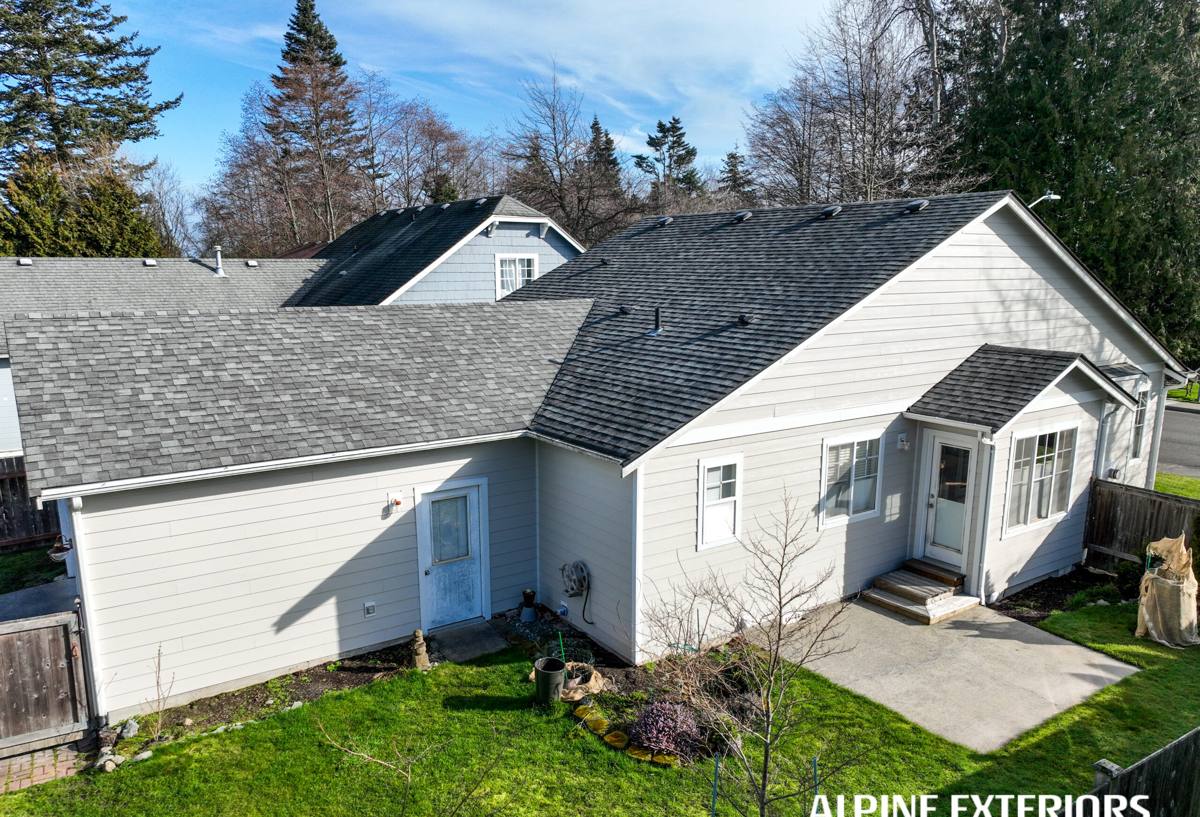
Why a Local Crew Matters for a Lynden Project
Whatcom County covers a lot of ground and a lot of microclimates — the difference between a farmhouse in the Nooksack Valley and a home closer to the water isn't huge, but it's real, and it affects decisions like which siding line to spec, how much rainscreen gap to build in, and where to prioritize flashing detail. A crew that works this county regularly knows the difference between a house that needs standard detailing and one that needs extra attention at grade level, around irrigation, or near mature landscaping that keeps a wall shaded and damp.
Local also means accountability. We're not driving in from out of the area for a one-time job — we're doing exterior work throughout Whatcom County, which means our workmanship and our warranty follow-through have to hold up to people who live nearby and talk to each other. That's a different incentive structure than a traveling crew that's moved on to the next county by the time a problem shows up.
Why We Only Install James Hardie Fiber Cement
We made a deliberate decision to install one siding system: James Hardie fiber cement. We don't install vinyl, LP SmartSide, Cemplank, Allura, primed spruce, or cedar. That's not a marketing position — it's a standard we hold because of what we've seen these products do over a full Pacific Northwest weather cycle, year after year.
Wood-based products, including engineered wood siding like LP SmartSide and traditional cedar, depend heavily on an intact factory or field-applied coating to keep moisture out. In a climate where siding stays wet for extended stretches, any breach in that coating — a scratch, a poorly sealed cut edge, a fastener that wasn't sealed correctly — gives water a path into a substrate that swells, softens, and eventually needs replacement. Cedar in particular looks excellent when it's new and well-maintained, but it asks for a maintenance commitment (staining, sealing, inspection) that most homeowners don't keep up with on the schedule it actually needs.
Vinyl siding avoids the rot problem because it isn't organic, but it brings different trade-offs: it can warp or distort in temperature swings, it's a thin material that's vulnerable to impact damage, and it relies on lap joints and J-channels that are only as good as the installation. It's also a product where the aesthetic ceiling is lower — it reads as vinyl, and that shows up in how a home is perceived.
Fiber cement products like Cemplank and Allura are chemically similar to James Hardie's material, and we don't have a complaint about the category. Our decision comes down to manufacturing consistency, factory-finish quality, and warranty structure, all of which we've found to be more dependable with Hardie specifically — plus it gives us one system to install to a consistent standard rather than switching specs between jobs.
James Hardie is non-combustible fiber cement, engineered specifically for climates like ours through its HZ5 product line, which is formulated for the freeze-thaw cycles and moisture exposure of the Pacific Northwest. Its ColorPlus finish is baked on at the factory under controlled conditions, rather than field-painted, which gives it better fade and chip resistance than a coating applied on-site. It carries a strong transferable warranty on both the material and, when we install it, on our workmanship. None of that matters if the installation is sloppy, which is why correct installation — proper clearances, sealed cut edges, correct fastening pattern, flashing integrated the right way — is as much a part of what we sell as the product itself.
What This Means in Practice
If a Lynden homeowner wants LP SmartSide, vinyl, or cedar, we're not the right contractor for that job, and we'll say so directly rather than take the work and cut corners on a product we don't stand behind. If a homeowner wants a siding system that's built to shrug off a Whatcom County winter with minimal upkeep, that's exactly the job we're set up to do well.
What a Siding Project Looks Like, Start to Finish
- Initial walk-around to assess the current siding, look for moisture damage, check trim and flashing condition, and identify problem areas like shaded walls or low-clearance spots.
- Written estimate that spells out the Hardie product line, color, trim package, and scope — no vague allowances.
- Removal of existing siding and inspection of the sheathing and wall assembly underneath, since siding problems often mean there's something to address before new material goes up.
- Weather barrier and flashing work at every window, door, and penetration — this is the step that actually keeps water out, more than the siding itself.
- Installation of the Hardie panels or planks to manufacturer spec, including correct fastening, clearances at grade and roofline, and sealed joints.
- Final walkthrough so the homeowner sees the finished work and understands what was done and why.
Beyond Siding: Roofing, Windows, and Decks
Siding doesn't work in isolation — it's one piece of a home's exterior envelope, and problems in one area often show up as damage in another. A roof that's shedding water onto a wall instead of away from it will accelerate siding wear no matter what material is installed. Windows with failed seals or old flashing let moisture behind the wall assembly regardless of how good the siding is. And a deck that's attached to the house without proper flashing at the ledger board is one of the more common sources of hidden rot we find on older homes.
Because we handle roofing, windows, and decks in addition to siding, we look at a Lynden home's exterior as one connected system rather than a single line item. That matters most at transition points — where a roof meets a wall, where a deck ledger attaches to the house, where a window is set into a siding cutout. Those are the details that determine whether an exterior actually performs over a Whatcom County winter or just looks good until the first hard rain finds the gap.
Cost Factors for a Lynden Siding Project
Every home is different, and we don't publish blanket prices because square footage alone doesn't determine cost — the condition of what's underneath the existing siding, the amount of trim and detail work, and the home's accessibility all move the number. That said, these are the factors that most affect a project's scope and cost:
| Factor | Why It Matters |
|---|---|
| Existing wall condition | Rot or moisture damage found after tear-off adds sheathing repair before new siding can go on |
| Home size and stories | More surface area and taller walls mean more material, labor, and equipment needs |
| Trim and architectural detail | Corner boards, window trim, and decorative elements add labor time beyond flat wall panels |
| Product line and profile | Lap siding, panel siding, and shingle-style Hardie profiles carry different material and install costs |
| Access and site conditions | Landscaping, fencing, or tight clearance around the home can slow tear-off and installation |
| Color and finish choice | ColorPlus factory finishes vary in cost slightly by color and line compared to primed-for-paint options |
Maintenance Checklist for Lynden Homeowners
James Hardie siding is genuinely low-maintenance compared to wood-based alternatives, but "low-maintenance" isn't "no-maintenance." A short annual routine goes a long way in this climate:
- Rinse siding once or twice a year, focusing on shaded, north-facing walls where moss and algae tend to establish first
- Check caulking around windows, doors, and trim joints for cracking or separation, especially after a hard winter
- Keep gutters clear so overflow isn't running down the wall face during heavy rain
- Trim back landscaping and tree limbs that are keeping any section of wall shaded and slow to dry
- Walk the exterior after major storms and look for anything visibly damaged, loose, or displaced
- Address small issues — a gap, a soft spot, a stain — before the next wet season rather than after
Choosing a Siding Contractor in Lynden
Whatcom County has no shortage of contractors who'll install whatever product a homeowner asks for. That's not a knock on them — it's just a different business model than ours. A few things worth checking with any contractor before signing a contract:
- Are they licensed and insured to work in Washington, and will they show you documentation without being asked twice?
- Do they specify the exact product line, not just "fiber cement" or "premium siding"?
- Is the estimate written with specific scope, or does it leave room for change orders on things that should have been caught during the walk-around?
- Do they talk about flashing and moisture barrier detail, or only about the siding panels themselves?
- Can they explain, specifically, why they recommend the product they're proposing for your home?
If a contractor can't answer the last question with something more substantial than "it's what we usually use," that's worth noting.
Get a Free Estimate for Your Lynden Home
If your siding is showing moss buildup, soft spots, or trim that's starting to separate, or if you're planning ahead for a home that's due for new exterior siding in the next year or two, we're happy to take a look. A walk-around and written estimate cost nothing and come with no pressure to commit on the spot — just a straight assessment of what your home needs and what it would take to do it right. Reach out through the form below to schedule a visit.