 Semiahmoo Siding
 Siding a Ferndale Home Is Different From Siding a House Inland
Ferndale sits close enough to the water — Bellingham Bay, the Strait of Georgia, and the Semiahmoo waterfront are all a short drive away — that homes here deal with a version of Pacific Northwest weather that inland Whatcom County doesn't get as heavily. Salt-laden air moves in off the water, driving rain comes sideways during winter storms, and the overcast, wet stretch that runs from fall through spring gives moss, algae, and mildew months to establish themselves on anything that stays damp. None of this is exotic weather. It's just relentless, and relentless is what wears exterior materials down over the years, not any single dramatic event.
A siding product that performs fine in a dry climate can struggle here. Wood-based products absorb moisture at seams and cut edges and can swell, cup, or rot if that moisture doesn't dry out between rain events. Vinyl can hold up dimensionally but tends to look tired faster under UV and grime cycles, and it has real limits in wind exposure near open water. When we talk to Ferndale homeowners about siding, the conversation almost always starts with moisture management, because that's the variable that determines how a house looks and performs ten or twenty years down the road.
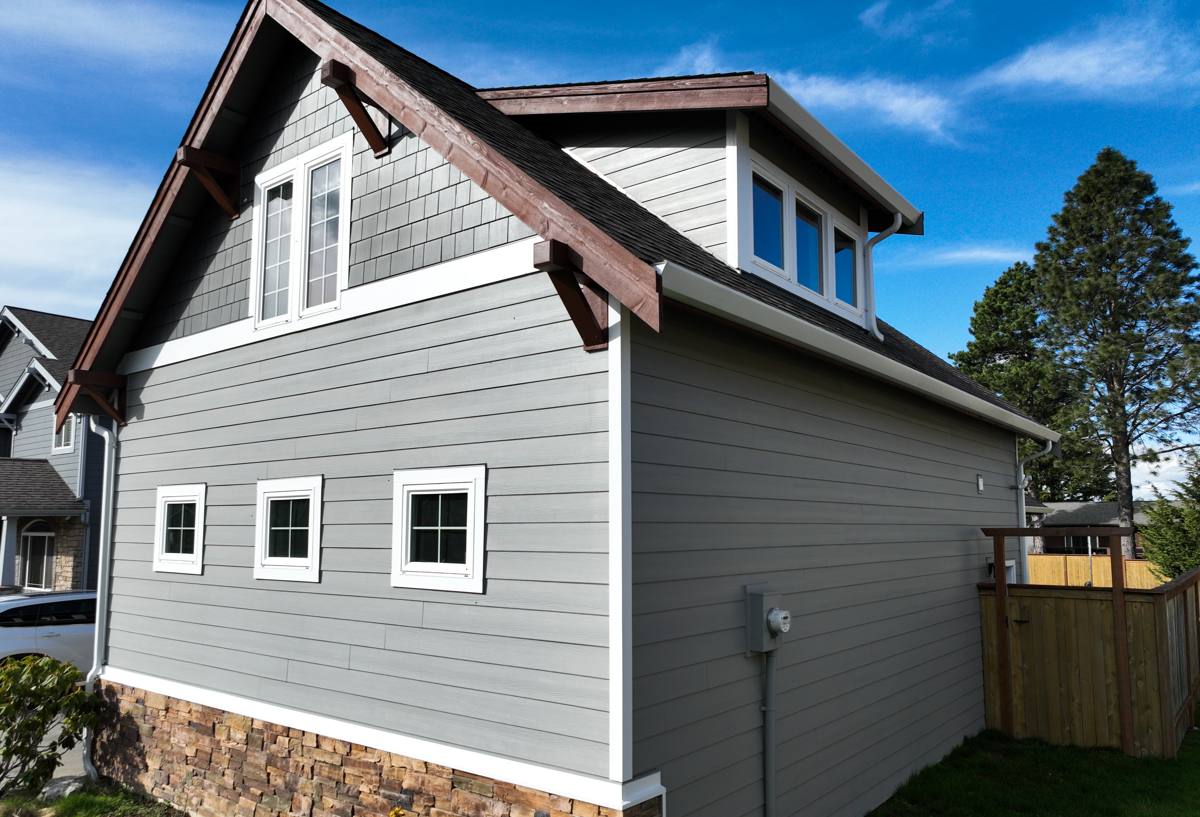
What Salt Air, Rain, and Moss Actually Do to a House
Salt Air
Airborne salt is corrosive to exposed metal — fasteners, flashing, trim accessories — and it accelerates the breakdown of finishes that aren't formulated to resist it. Over years, homes closer to the water tend to show more fading, chalking, and finish failure on their siding than homes just a few miles inland, simply because the air itself is more aggressive.
Driving Rain
Rain that comes straight down is manageable for almost any siding system. Rain that's pushed sideways by wind off the water finds every gap, seam, and poorly lapped joint. This is why installation detail — proper overlaps, correctly flashed windows and doors, and a functioning water-resistive barrier behind the siding — matters as much as the siding material itself. A great product installed loosely will still leak.
Moss and Organic Growth
Whatcom County's long wet season, combined with tree cover common in and around Ferndale, keeps north-facing walls and shaded siding damp for extended stretches. Moss, algae, and mildew don't just look bad — sustained organic growth holds moisture against the siding surface, which is exactly the condition that leads to rot in wood-based products and premature finish failure in lower-grade coatings.
Why We Install Only James Hardie Fiber Cement Siding
We made a decision as a company to install one siding system: James Hardie fiber cement. We don't offer LP SmartSide, vinyl, Cemplank, Allura, primed spruce, or cedar, and that's worth explaining rather than glossing over, because each of those products has real strengths — we're not claiming otherwise.
- LP SmartSide and primed spruce/cedar are engineered or solid wood products. They can look excellent and install quickly, but wood-based siding depends on an intact factory or field-applied coating to keep moisture out. In a climate with a long wet season and salt air accelerating coating wear, that dependency is a maintenance burden we don't want to hand a homeowner.
- Vinyl siding is affordable and low-maintenance in mild climates, but it's a thin material that can distort in heat, become brittle in cold, and rattle or pull loose in sustained wind — a real consideration for homes with open exposure toward the water.
- Cemplank and Allura are also fiber cement products and share many of fiber cement's core advantages. Our reason for standardizing on James Hardie specifically comes down to their HZ5 climate-engineered formulation for wet, marine-influenced regions, the factory-applied ColorPlus finish, and the strength of their transferable warranty when the product is installed to their specification.
Fiber cement as a category resists moisture, insects, and fire in ways wood products can't, and it holds a factory finish far longer than field-painted materials. James Hardie is what we've chosen to put on homes because of how it's engineered for exactly the conditions Ferndale sees every winter.
James Hardie Product Lines and What Fits Ferndale
James Hardie makes several siding profiles, and the right one depends on the home's style and exposure, not a one-size-fits-all default.
| Product | Profile | Best fit |
|---|---|---|
| HardiePlank | Lap siding, several width and texture options | Most Ferndale homes — the standard, versatile choice |
| HardiePanel | Vertical panel | Modern builds, accent walls, gable ends |
| HardieShingle | Staggered or straight-edge shingle profile | Craftsman and cottage-style homes |
| HardieTrim | Trim boards for corners, fascia, window surrounds | Paired with any of the above for a finished look |
All of these are available with ColorPlus Technology, a factory-baked, multi-coat finish that resists fading and chipping far better than field-applied paint — an advantage that matters more here than in a drier climate, since repainting siding on a wet-heavy schedule is not something most homeowners want to plan around.
HZ5 Formulation
James Hardie engineers its siding in different formulations for different climate zones. The HZ5 line is built for regions with freeze-thaw cycles and higher moisture exposure, which describes Whatcom County's winters reasonably well. We spec HZ5 products for Ferndale installs rather than a generic formulation meant for milder or drier regions.
What Correct Installation Involves
Fiber cement performs the way it's rated to perform only when it's installed correctly, and that's where a lot of the real-world difference between a good siding job and a problem siding job actually shows up.
- Proper water-resistive barrier installed and lapped correctly behind the siding, not just stapled up as an afterthought
- Correct flashing at every window, door, and roof-to-wall intersection — the spots where driving rain finds its way in
- Manufacturer-specified fastening pattern and nail placement, since under- or over-driven fasteners compromise the siding's performance
- Proper clearance at grade and at horizontal surfaces like decks and patios, so the bottom edge of the siding isn't sitting in standing moisture
- Caulking and sealant only where James Hardie's install guide specifies it — not as a substitute for correct flashing
This is also why we don't treat siding as an isolated trade. Roofing, window flashing, and siding all interact at the same transitions on a house, and a mistake at one of those junctions can undermine the other two. Because we handle siding, roofing, windows, and decks, we can look at a Ferndale home's exterior as one connected system rather than a stack of separate contracts.
Roofing, Windows, and Decks in the Same Coastal Conditions
The same salt air, rain, and moss pressure that affects siding affects the rest of a home's exterior too. Roofing takes the brunt of driving rain and needs flashing details that match up with whatever siding sits beneath it. Windows are a common leak point when their flashing wasn't integrated properly with the surrounding wall assembly — something we check closely on every siding project, whether or not the windows themselves are original to the house. Decks in this climate deal with the same moss and moisture cycle as siding, and material choice there matters for the same underlying reasons: what stays dry, and how well, over years of wet winters.
Handling all four trades means fewer seams between contractors, and fewer chances for a detail to fall through the gap between "that's the siding guy's job" and "that's the roofer's job."
Cost Factors for a Ferndale Siding Project
Every home is different, so we won't quote a number without seeing the house, but the variables that move a project's cost are consistent.
| Factor | Why it matters |
|---|---|
| Home size and wall complexity | More corners, gables, and cutouts mean more labor and material waste |
| Existing siding removal | Tear-off adds labor; some re-siding jobs can build over sound sheathing, others can't |
| Underlying moisture damage | Rot found during tear-off needs repair before new siding goes on — common on older wet-side walls |
| Product line and profile | Lap, panel, and shingle profiles carry different material and labor costs |
| Trim and accessory scope | Full trim replacement looks better and lasts longer than working around old trim |
| Site access | Tight lots, tree cover, or difficult grading can affect setup and staging time |
Vetting a Contractor for Coastal-Climate Work
Whatcom County has plenty of siding installers, and not all of them install fiber cement to the manufacturer's specification. Since so much of fiber cement's long-term performance depends on installation quality, the contractor matters as much as the product.
- Ask whether the crew has specific James Hardie installation experience, not just general siding experience
- Ask how they handle flashing at windows, doors, and roof intersections — a vague answer is a red flag
- Confirm they carry current licensing and insurance for work in Washington State
- Ask what warranty applies to the labor, separate from the manufacturer's product warranty
- Get a written scope that specifies the product line, profile, and finish — not just "Hardie siding"
A local crew that works this specific stretch of coastline regularly will have already seen what does and doesn't hold up on homes exposed to Whatcom County's salt air and rain patterns, which is a different body of experience than a crew that mostly works drier inland areas.
Living With Fiber Cement Siding in Ferndale
James Hardie siding with a ColorPlus finish is not a zero-maintenance product, but it asks for far less than wood-based siding in this climate. Periodic rinsing to keep moss and grime from building up, especially on shaded or north-facing walls, is the main upkeep task. Because the finish is factory-applied and warranted, homeowners aren't on a repainting cycle the way they would be with field-finished wood siding — which, over a house's lifetime in a wet climate, is a meaningful difference in both cost and effort.
If you're planning a siding, roofing, window, or deck project on a home in the Ferndale area, we're glad to come take a look and talk through what your house actually needs — no pressure, no obligation. A free estimate is the easiest way to find out what the right approach and real cost range looks like for your specific home.