 Semiahmoo Siding
 Blaine's Exterior Homes Are Working Harder Than They Look
Blaine sits right where Puget Sound meets Semiahmoo Bay and the Canadian border, and that location shapes everything about how a house exterior ages here. Homes on or near the water get a steady dose of salt-laden air, while homes set back a few blocks still deal with the same driving rain, high humidity, and shaded, moss-friendly conditions that define Whatcom County's exterior climate. It's a different set of stresses than what a house in Spokane or even Seattle proper deals with, and it's why we treat Blaine as its own service area rather than a generic Pacific Northwest job.
Salt air is corrosive to exposed metal fasteners and can accelerate the breakdown of coatings that aren't built for it. Driving rain — wind-driven, not just falling straight down — pushes water sideways into laps, seams, and trim joints that a calmer climate would never test. And the long gray stretch from fall through spring gives moss, algae, and mildew months of shaded, damp surface to establish themselves on north-facing walls, fascia, and anything under tree cover. None of this means Blaine homes are doomed to fail early. It means the materials and installation details matter more here than they do in drier parts of the state.
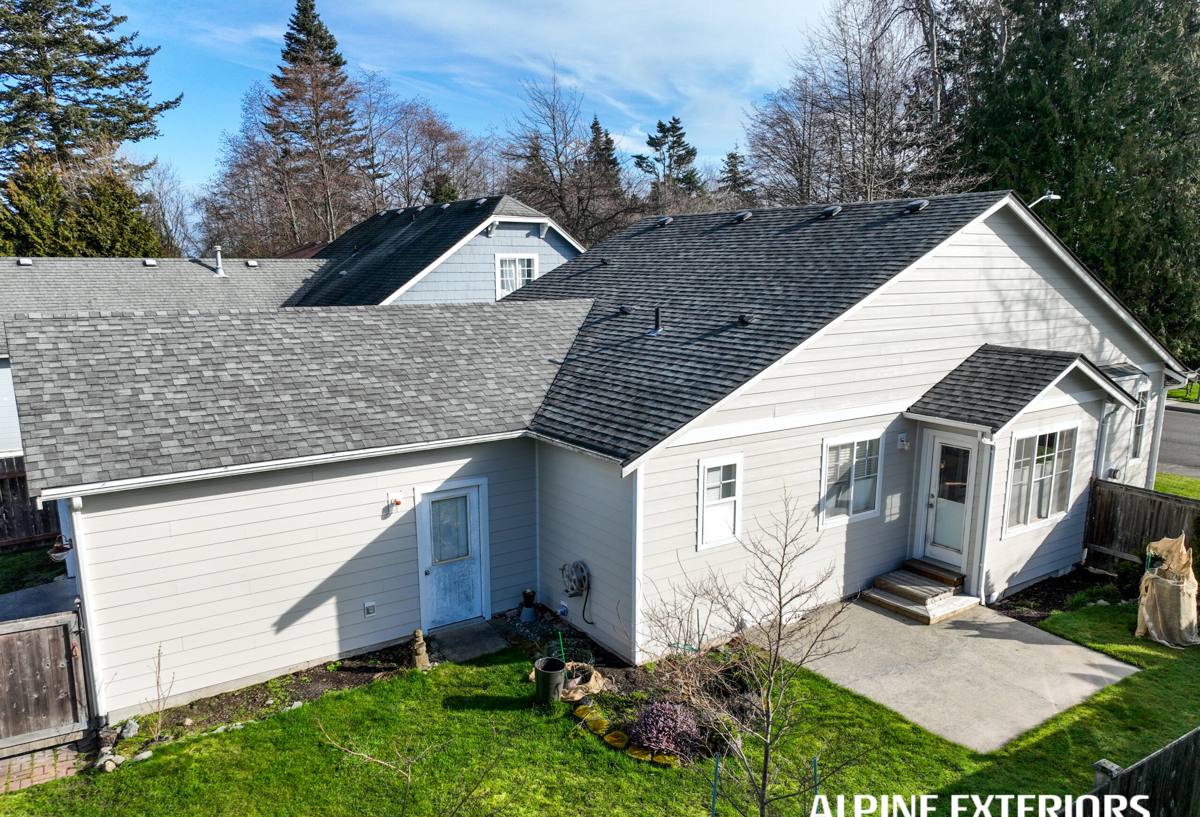
What We See on Blaine Homes
Across the exterior work we do in this area — siding, roofing, windows, and decks — a few patterns show up again and again:
- Moss and algae staining on shaded siding, especially north and east walls and anywhere near mature trees
- Paint failure and swelling at butt joints and trim on wood-based or engineered wood siding that wasn't sealed or maintained on schedule
- Corroded or streaking fasteners on older siding and trim, particularly closer to the bay
- Soft or discolored roof decking at eaves and valleys where moss holds moisture against shingles longer than it should
- Window seals and sills showing early wear from constant damp-dry cycling
- Deck boards and ledger connections that stay wet longer than they should because of shade and drainage patterns
Individually, these are common issues. Together, they're a pretty clear signature of what a coastal Whatcom County climate does to an exterior over time — and they're the reason we're picky about what materials go on a house here.
Why We Install James Hardie and Nothing Else
We install James Hardie fiber cement siding exclusively. We don't install vinyl, LP SmartSide, Cemplank, Allura, or primed spruce or cedar siding, and that's a deliberate standard, not a limitation of what we know how to work with. In a climate like Blaine's, the material you choose has to hold up to sustained moisture exposure and salt air without constant babysitting, and that's where the differences between products really show up.
Vinyl siding is affordable and low-maintenance in the sense that it doesn't need painting, but it's a thin material that can warp in temperature swings, and its seams and J-channels give wind-driven rain places to work its way behind the panel over time. LP SmartSide and similar engineered wood products perform reasonably well when the factory coating and caulking are maintained on a strict schedule, but any breach in that coating exposes wood strand material to moisture — and in a climate with this much sustained dampness and moss pressure, that's a maintenance commitment we don't think most homeowners want to sign up for indefinitely. Primed spruce or cedar puts the entire moisture-management job on paint and caulk from day one, which is a tough ask in a region where the siding rarely gets a long, dry stretch to fully cure and dry out between rain events.
James Hardie fiber cement is cement, sand, and cellulose fiber — it doesn't rot, it isn't attractive to insects, and it's non-combustible. Its ColorPlus factory finish is baked on and warranted separately from the substrate, which matters in a climate where UV and salt air both work against a field-applied paint job. Hardie also engineers regional HZ5 product formulations specifically for wetter, colder climates like ours, which is a level of climate-matching the other products on this list don't offer. That combination — durability, a factory finish built to hold up without constant repainting, and a product line actually engineered for Pacific Northwest weather — is why it's the only siding we put on a house.
How the Products Compare
| Material | Moisture Behavior in a Coastal Climate | Maintenance Demand | Why It's Not Our Standard |
|---|---|---|---|
| Vinyl siding | Seams and panel edges allow wind-driven rain intrusion over time | Low, but limited repair options when damaged | Thin material, poor performance in temperature swings |
| LP SmartSide | Wood strand core is vulnerable once the coating is breached | High — strict caulk and paint schedule required | Long-term moisture risk in a wet climate |
| Cemplank / Allura | Fiber cement, generally sound, but without Hardie's HZ regional engineering or ColorPlus system | Moderate | We standardized on one system we know inside and out |
| Primed spruce / cedar | Relies entirely on paint and caulk for moisture protection | Very high — repainting on a tight cycle | Highest long-term maintenance burden in this climate |
| James Hardie fiber cement | Non-combustible, rot-resistant, HZ5 formulation for wet climates | Low — factory finish, no repainting for years | Our standard for every home we side |
Siding, Roofing, Windows, and Decks — Treated as One System
We do more than siding in Blaine, and there's a practical reason we handle all four trades. Siding, roofing, windows, and decks aren't separate systems on a house — they're all part of the same envelope that's keeping wind-driven rain and salt air out. A roof with poor drainage at the eaves will dump water onto siding it was never designed to shed. A window that isn't properly flashed will leak into the wall cavity no matter how good the siding around it is. A deck ledger board attached without the right flashing detail is one of the most common sources of hidden rot on a Pacific Northwest home.
When one crew is thinking about all four at once, those transition points — where roof meets wall, where window meets siding, where deck meets house — get the attention they need. That's a harder thing to guarantee when four different contractors each handled one piece of the house on their own schedule.
Roofing
In a climate with this much sustained moisture and moss pressure, roof drainage, ventilation, and moss-resistant detailing matter as much as the shingle brand. We look at how a roof sheds water at valleys and eaves, not just whether it looks good from the street.
Windows
Proper flashing and integration with the siding plane is what actually keeps a window from leaking — the window unit itself is only half the equation. This is especially true on a re-side, where getting the window-to-siding transition right is one of the most important details in the whole project.
Decks
Ledger attachment, flashing, and drainage underneath the deck structure are the details that determine whether a deck lasts fifteen years or shows rot in five, particularly in shaded, damp yards common around Blaine.
What a Siding Project Looks Like With Us
We start with an on-site look at the existing siding and the specific conditions your home faces — sun exposure, tree cover, proximity to the water, and any moisture damage already showing. From there we walk through the James Hardie product line and colors that fit the home, plan the tear-off and any sheathing repair needed, and install to manufacturer spec with attention to the flashing and fastening details that matter most in this climate. We're straightforward about scope and timeline before work starts, and we don't upsell products we don't stand behind.
Questions Worth Asking Any Siding Contractor in This Area
- Are you licensed and insured to work in Washington, and can you provide proof?
- What siding products do you install, and why did you choose them?
- How do you handle flashing at windows, doors, and roof transitions?
- What does your warranty cover — labor, materials, or both — and for how long?
- Will you address existing moisture or moss damage before installing new siding, or cover it up?
- Can I see the manufacturer installation instructions you follow?
A contractor who answers these clearly and specifically, without vague reassurances, is generally one worth trusting with your home.
Local Crew, Local Conditions
A crew that works Whatcom County regularly knows that a house three blocks off Semiahmoo Bay needs different attention at the flashing details than one further inland, and that moss on a shaded north wall isn't cosmetic — it's a sign of a moisture pattern worth addressing before it does real damage. That familiarity with local conditions shapes decisions on every project, from how we sequence work around the wet season to which details we double-check on a home with direct salt air exposure.
If you're in Blaine and thinking about siding, roofing, windows, or a deck — whether it's a full replacement or you just want an honest look at what shape your exterior is in — we're happy to come take a look. There's no pressure and no obligation, just a straightforward assessment and a clear estimate using our free estimate form below.