 Semiahmoo Siding
 An Honest Answer to a Question We Get a Lot
Homeowners in Semiahmoo ask us why we don't carry vinyl siding on the truck. It's a fair question — vinyl is the most common siding in the country, it's inexpensive, and plenty of installers will happily put it on your house. We're not going to tell you vinyl is a bad product across the board. We're going to tell you why, after years of working on homes along this stretch of Whatcom County's coastline, we decided it wasn't the product we wanted to stand behind here.
This isn't a knock on every vinyl installation everywhere. It's about what happens to vinyl siding specifically in a Semiahmoo microclimate — salt air off the water, driving wind-blown rain, and a moss season that can run half the year — and why we standardized on James Hardie fiber cement instead.
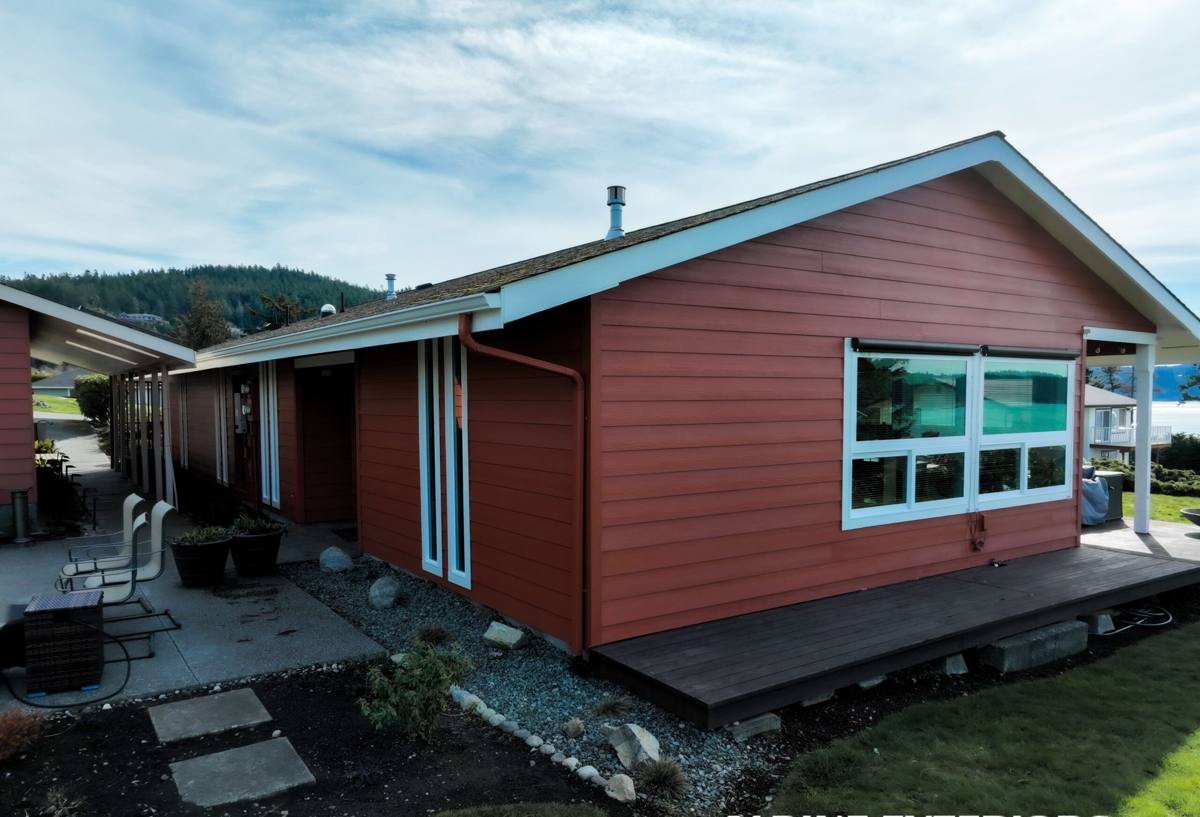
What Vinyl Siding Actually Gets Right
Credit where it's due. Vinyl siding is lightweight, relatively inexpensive to buy, and it doesn't rot or rust the way older wood or metal products could. It never needs painting, it comes in a wide range of colors and profiles, and for a lot of climates in the U.S. it performs fine for a couple of decades. There's a reason it's the best-selling siding material in the country.
If budget is the only factor and the home isn't sitting in a harsh coastal exposure, vinyl isn't an irrational choice. Our objection isn't to the material in the abstract — it's to putting it on homes in this specific environment and standing behind that installation with our name on it.
Salt Air Changes the Math
Semiahmoo sits right on the water, and homes here take on salt-laden air and wind-driven moisture in a way that inland Whatcom County properties simply don't. Vinyl is a petroleum-based product, and PVC formulations are engineered with UV stabilizers and pigments that break down over time — faster under sustained salt exposure and coastal sun reflection off the water. The practical result we see on older vinyl-clad homes near the shoreline is fading, chalking, and a plastic-y brittleness that shows up years earlier than the manufacturer's marketing implies.
Brittle vinyl doesn't just look tired — it becomes harder to work with. Panels crack more easily in cold snaps, and replacing a single damaged piece years later often means discovering the exact color and profile is no longer made, leaving a visibly mismatched patch on an otherwise uniform wall.
Driving Rain and the Water-Behind-the-Panel Problem
Vinyl siding is not a sealed water barrier — it's designed as a rain screen that relies on a correctly detailed drainage plane behind it (housewrap, flashing, laps, and weep paths) to manage the water that inevitably gets behind the panels. That system works when it's installed with real precision. The trouble is that vinyl is also one of the most commonly rushed installs in the industry, because it's fast and forgiving to hang badly and still look fine from the curb.
In a location that sees frequent driving rain off the water, sloppy J-channel work, under-lapped courses, or gaps at penetrations don't show up as a problem in year one. They show up in year eight or ten as trapped moisture, sheathing rot, and mold behind a wall that looked perfectly fine from the outside the whole time. Fiber cement isn't magically immune to bad installation either, but it's a far more forgiving material when it comes to moisture that does get through, and it doesn't warp or buckle under thermal expansion and contraction the way long vinyl runs can.
A Long Moss Season Adds Its Own Wear
Whatcom County's damp, mild winters mean moss and algae have a long growing season here, and shaded north walls and areas under overhangs stay wet longer than they would further inland. Vinyl's textured woodgrain surface gives organic growth plenty of places to take hold, and once moss establishes itself, cleaning it off means pressure washing — which is exactly the kind of force that can drive water behind panel seams, crack aging vinyl, or blow a panel loose if the water pressure is too high or the technique is wrong.
Fiber cement handles the same cleaning far better. It's a denser, more rigid material that tolerates routine washing without the same risk of physical damage, and James Hardie's factory ColorPlus finish is formulated to resist the fading and staining that make moss and algae growth so visually obvious in the first place.
Thermal Movement and Installation Sensitivity
Vinyl expands and contracts significantly with temperature swings, which is why every course has to be hung with proper nail slot clearance — never nailed tight — to let the panel float as it moves. It's a simple rule on paper, but it's also the single most common mistake in vinyl installation, and a tightly nailed panel doesn't fail on day one. It buckles, warps, or pulls away from the wall months or years later, usually right after the crew that installed it is long gone.
We'd rather not put our name on a product where the most common installation error is invisible at handoff and only shows up as a problem down the road. Fiber cement has its own installation requirements — proper fastening, clearances, and factory-finish touch-up standards — but it doesn't carry that same floating-panel tolerance that turns a small crew mistake into a visible defect years later.
Side-by-Side: What We're Actually Weighing
| Factor | Vinyl Siding | James Hardie Fiber Cement |
|---|---|---|
| Coastal / salt air durability | Fades, chalks, and becomes brittle faster near the water | ColorPlus factory finish engineered to resist fade and UV wear |
| Moisture behind the panel | Relies entirely on correct drainage-plane installation; forgiving to install badly | Less forgiving material to moisture intrusion when it does occur |
| Moss / algae cleaning | Textured surface traps growth; pressure washing risks cracking or dislodging panels | Denser material tolerates routine washing with less risk of damage |
| Thermal movement | Must float on fasteners; over-nailing causes buckling/warping later | More dimensionally stable once properly fastened |
| Fire resistance | Combustible, can melt or deform near heat sources | Non-combustible fiber cement |
| Warranty structure | Prorated after early years on most product lines | Strong transferable limited warranty on the substrate and finish |
| Upfront cost | Lower material and labor cost | Higher upfront investment |
Why We Standardized on James Hardie
We install exclusively James Hardie fiber cement siding, and it's a deliberate standard rather than a default. Hardie's HZ5 product line is specifically engineered for climates with year-round moisture exposure like ours, and the ColorPlus factory finish process bakes color into the product under controlled conditions rather than relying on field-applied paint that weathers unevenly. Fiber cement is non-combustible, it doesn't support moss and algae growth the way a plastic woodgrain texture can, and it holds up to the kind of pressure washing that coastal moss removal actually requires.
It's also a heavier, less forgiving material to install badly, which sounds like a downside until you think about what that means in practice: there's less room for a crew to cut corners in a way that won't show up for years. We'd rather install a product where quality workmanship is visibly required than one where a bad install looks identical to a good one until the warranty has already run out.
What Correct Fiber Cement Installation Involves
- Proper house wrap and flashing details at every window, door, and penetration before a single board goes up
- Correct fastener spacing and blind- or face-nailing per Hardie's published installation specs
- Factory-cut and field-cut edges sealed per manufacturer requirements to prevent moisture wicking
- Minimum clearance maintained between the bottom of the siding and grade, decks, or roof lines
- Caulking and touch-up limited to Hardie-approved products so the ColorPlus warranty stays intact
What This Means If You're Comparing Bids
If you're getting quotes for a re-side in Semiahmoo and one bid is vinyl and one is fiber cement, you're not comparing two versions of the same job — you're comparing two different long-term bets on how your home holds up against salt air, driving rain, and moss. Vinyl will usually win on upfront price. Whether it wins on total cost over 20 or 30 years, in this specific location, is the real question worth asking any contractor bidding the job.
We'd encourage you to ask any vinyl installer directly how they detail moisture management behind the panels, how they handle nail clearance for thermal movement, and what their warranty actually covers after the first several years versus what it covers on paper.
Questions Worth Asking Before You Decide
- How is the drainage plane behind the siding detailed at windows, doors, and corners?
- What does the warranty actually cover after year five or ten, not just in year one?
- Is the color factory-applied or field-painted, and how is fading handled going forward?
- How will the siding be cleaned when moss or algae inevitably shows up on shaded walls?
- What happens if a single panel needs replacement in ten years — will a matching color still exist?
If you're weighing your options for a Semiahmoo home and want a straight answer about what will actually hold up here, we're happy to walk your property and give you a free, no-pressure estimate — no hard sell, just an honest read on what your house needs.