 Semiahmoo Siding
 Why Blaine Harbor Homes Take a Different Kind of Beating
Blaine Harbor sits right where the Salish Sea meets the Semiahmoo Peninsula, and that location shapes everything about how a house ages here. Homes a few blocks from the water deal with a combination most inland Whatcom County properties never see: salt-laden air that never fully lets up, wind-driven rain that comes in sideways off the water, and a wet season that stretches long enough for moss and algae to take hold on anything that stays damp for more than a day or two. None of these are exotic problems. But stacked together, year after year, they wear down exterior materials faster than a typical Pacific Northwest climate would on its own.
Salt air is the piece people underestimate most. It doesn't just affect boats and railings — airborne salt settles on siding, trim, and fasteners, and it's mildly corrosive and hygroscopic, meaning it actually pulls moisture out of the air and holds it against the surface it lands on. Combine that with our rain patterns and you get siding materials that stay damp longer than they would even a mile or two inland.
What We Actually See on Homes Near the Harbor
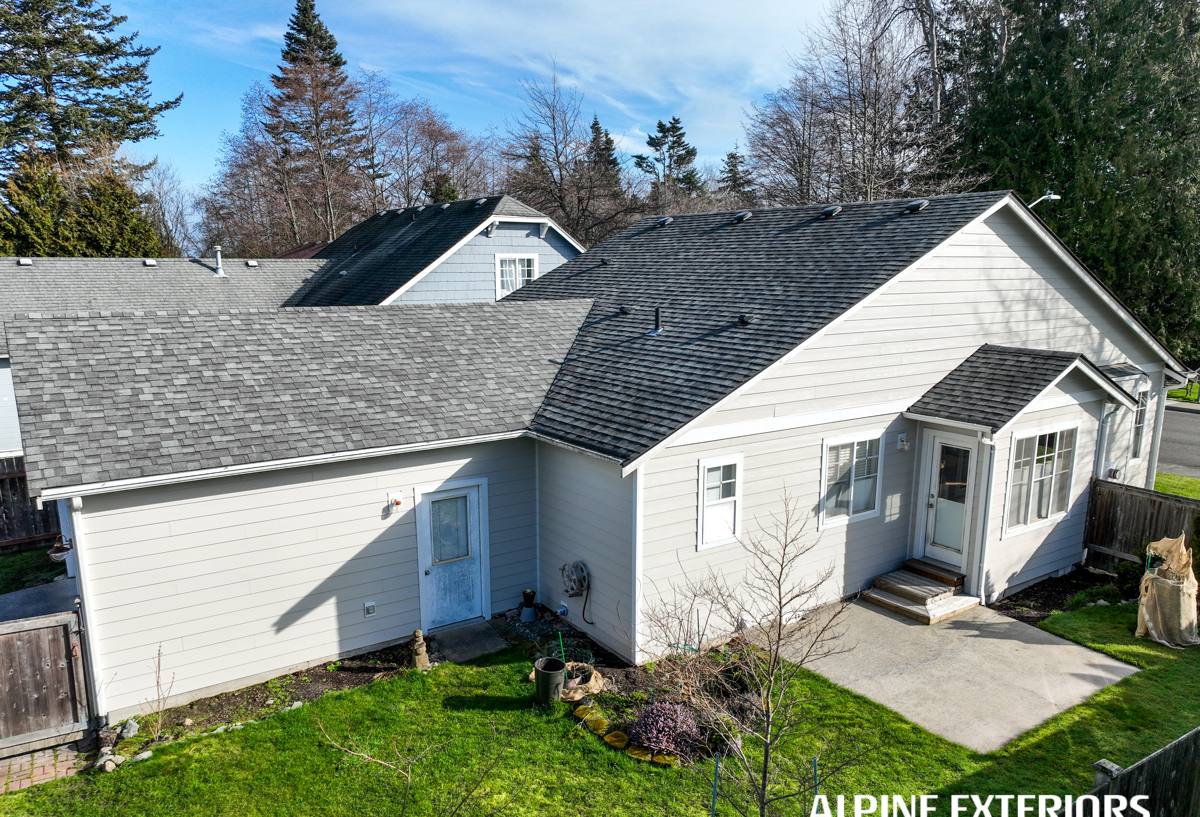
When we look at siding on Blaine Harbor properties, the failure patterns are pretty consistent. Paint on wood and composite siding tends to chalk and peel earlier than the manufacturer's estimate, especially on the west- and south-facing walls that catch the worst of the weather. Moss and dark streaking show up on north-facing walls and anywhere water sheets down without drying quickly — under eaves, behind shrubs, along ground-level trim. Fasteners that aren't corrosion-rated for coastal exposure will sometimes bleed rust stains through paint within a few years. And on any siding product with seams, joints, or butt ends that weren't properly sealed, we find moisture intrusion working its way behind the cladding long before it's visible from the curb.
None of this means a house near the harbor is doomed to constant repairs. It means the materials and installation details matter more here than they would somewhere drier and less exposed — which is exactly why we've been selective about what we put on these homes.
Why We Install Only James Hardie Fiber Cement
We get asked fairly often why we don't offer vinyl, LP SmartSide, or a cheaper primed wood option. The honest answer is that we've made a professional judgment call, based on what holds up in this specific climate, and we'd rather explain that reasoning than pretend every product is equally suited to a harbor-adjacent home.
Why Not Vinyl
Vinyl siding is inexpensive and easy to install, and in a lot of climates it does an adequate job. But vinyl expands and contracts significantly with temperature swings, and its seams and panels rely on overlap rather than a sealed, monolithic surface. In a salt-air, high-wind-rain environment, that means more opportunities for wind-driven moisture to get behind the panels over time. Vinyl also tends to look and perform its age faster under UV and salt exposure — it can go brittle and discolor unevenly on the sun-facing walls that take the worst of the exposure here.
Why Not Primed Wood or Cedar
Wood siding, whether it's cedar or primed spruce, is a beautiful, traditional choice, and we understand the appeal. But wood is organic material in a climate that gives it moisture, salt, and shade in exactly the combination that feeds rot and moss growth. Keeping painted wood siding looking good near the harbor means a maintenance cycle — repainting, caulking, spot-replacing damaged boards — that's more frequent and more expensive than most homeowners expect going in.
Why Not LP SmartSide or Similar Engineered Wood
Engineered wood products have improved a lot over the years, and they perform reasonably well in many parts of the country. Our concern is specific to sustained coastal moisture exposure: these are wood-based products with an engineered treatment, and their long-term performance depends heavily on caulking, flashing, and cut-edge sealing being done exactly right and maintained over the life of the siding. In a climate where damp conditions are the norm rather than the exception, we don't think that's the right risk profile for a harbor-facing home, so we don't install it.
Fiber cement, by contrast, is inorganic — it isn't food for rot, mold, or insects, and it doesn't swell and buckle with moisture the way wood-based products can. That's the baseline reason we standardized on it, and James Hardie specifically because of how they engineer for regional climate and back the product.
The James Hardie System We Install
James Hardie makes climate-engineered product lines, and for the Pacific Northwest that means their HZ5 formulation, built to hold up against the moisture and freeze-thaw cycling we get in this region. It's paired with their ColorPlus factory finish — a baked-on, multi-coat finish applied under controlled conditions rather than field-painted on site. That matters near the harbor specifically, because factory-applied finish is more consistent and more resistant to fading and chalking than a coat of paint applied on a ladder in variable weather.
James Hardie also backs the material with a strong transferable limited warranty, and the ColorPlus finish carries its own separate finish warranty. When it's installed correctly — proper clearances, correct fastening, sealed joints and penetrations — it's a system designed to be largely maintenance-free for decades, not just resistant to today's weather.
| Factor | James Hardie Fiber Cement | Vinyl | Wood / Engineered Wood |
|---|---|---|---|
| Moisture resistance | Inorganic, non-swelling | Panel seams can admit wind-driven rain | Organic; vulnerable without diligent maintenance |
| Salt air / coastal exposure | Formulated for regional climate (HZ5) | Can discolor and go brittle faster | Prone to moss, mildew, early paint failure |
| Finish | Factory-baked ColorPlus finish | Color molded in, can fade unevenly | Field-applied paint, needs recoating |
| Fire behavior | Non-combustible material | Combustible | Combustible |
| Typical maintenance | Periodic wash, no repainting | Occasional wash | Recaulk, repaint, spot repair on a cycle |
It's Not Just Siding — The Whole Exterior Has to Work Together
Siding doesn't do its job in isolation. On a Blaine Harbor home, the roof, windows, siding, and any exterior decking all interact with the same wind and moisture, and a weak point in one usually shows up as damage somewhere else. A roof that's shedding water improperly onto a wall, or a window that isn't flashed correctly into the siding plane, can undo the benefit of even the best-installed fiber cement.
Because we handle siding, roofing, windows, and decks, we look at the exterior as one connected system rather than a series of separate trades. That matters most exactly in conditions like these — where wind-driven rain finds every gap, and salt air accelerates the wear on anything that isn't properly protected. A deck near the harbor, for instance, needs corrosion-resistant fasteners and hardware for the same reason your siding fasteners do; a roof-to-wall transition needs flashing detail that accounts for the amount of rain this area actually gets, not a generic minimum.
What Correct Installation Actually Involves Here
Fiber cement siding performs the way it's supposed to only when it's installed to spec, and in a coastal environment the details matter more than usual. This isn't a product where "close enough" installation holds up over the long run.
- Correct clearance between siding and grade, decks, roofing, and other horizontal surfaces so water can't wick up into the material
- Properly lapped and sealed house wrap or weather-resistive barrier behind the siding
- Corrosion-resistant fasteners rated for coastal or high-moisture exposure, driven to the manufacturer's specified depth and pattern
- Sealed and flashed joints at windows, doors, and any wall penetrations
- Caulked butt joints and properly primed cut edges wherever field cuts expose raw material
- Adequate gap and sealant at inside and outside corners to allow for material movement without opening a moisture path
Skipping or rushing any one of these is usually invisible on installation day and becomes a problem years later — which is a big part of why we're careful about crew training and inspection, not just product selection.
Why a Local Crew Matters for a Job Like This
A crew that works around Semiahmoo and the Blaine Harbor area regularly gets a practical education that's hard to get anywhere else: which walls take the worst weather, how moss actually behaves on different exposures locally, and what a proper install needs to hold up against wind-driven rain off the water rather than a textbook rain event. That local pattern recognition shows up in the small decisions — where to add extra sealant, which corners need extra attention, how aggressively to plan for drainage — that a generic installation approach might miss.
It also matters for the long haul. A local company is the one you can actually reach five or ten years down the road if a question comes up about your warranty, a repair, or how a section is holding up.
Planning a Project: What Drives the Cost
Every home is different, but a few factors consistently move the price on a siding project near the harbor. We're glad to walk through specifics for your home, but here's the general shape of what affects cost.
| Cost Factor | Why It Matters |
|---|---|
| Home size and wall complexity | More corners, dormers, and transitions mean more cutting, flashing, and labor time |
| Existing siding removal | Tear-off and disposal of old material adds time versus a bare wall |
| Extent of moisture damage found | Rotted sheathing or framing discovered mid-project needs repair before new siding goes on |
| Trim and accessory profile | Corner boards, window trim, and fascia detail add material and labor |
| Access and site conditions | Waterfront lots, slopes, and tight setbacks can affect staging and scaffolding needs |
Ready When You Are
If you're weighing a siding project on a Blaine Harbor home — or you've got roofing, windows, or a deck that need attention alongside it — we're happy to take a look and talk through what your specific home needs. There's no pressure and no obligation. Use the form below to request a free estimate, and we'll walk the property, answer your questions honestly, and give you a straight assessment of where things stand.