 Semiahmoo Siding
 Cherry Point's Exposure Is Different From Inland Whatcom County
Cherry Point sits right on the water, facing open exposure across the Strait of Georgia into the Salish Sea. That position means homes here take a steadier, harder dose of what coastal Whatcom County weather can throw at an exterior than a house set back in Bellingham or Ferndale proper. Wind comes off the water with nothing to slow it down, rain arrives sideways more often than straight down, and the salt content in that air is a constant, low-level chemical stress on every exterior surface, whether it's siding, trim, window frames, or deck fasteners.
None of this is dramatic on any single day. It's cumulative. A siding product that performs fine for twenty years in a sheltered inland yard can start showing real problems in half that time on a lot with direct water exposure and prevailing wind. That's the standard we design against when we work in this area.
Salt Air and Metal Corrosion
Salt-laden air accelerates corrosion on anything metal — nails, fasteners, flashing, and hardware. It also settles into porous or absorbent siding surfaces over time. Products that rely on paint film alone for protection, or that have exposed wood fiber at cut edges, are more vulnerable to that slow chemical breakdown than a factory-finished fiber cement product with a sealed, engineered surface.
Wind-Driven Rain
Straight-down rain is manageable for almost any siding system. Wind-driven rain — rain pushed sideways and upward into laps, seams, and butt joints — is what actually tests an installation. Cherry Point's open water exposure means wind-driven rain events are more frequent here than in more sheltered parts of the county, which makes correct flashing, lap spacing, and butt joint treatment far more important than the siding brand on the label.
The Long Wet Season and Moss
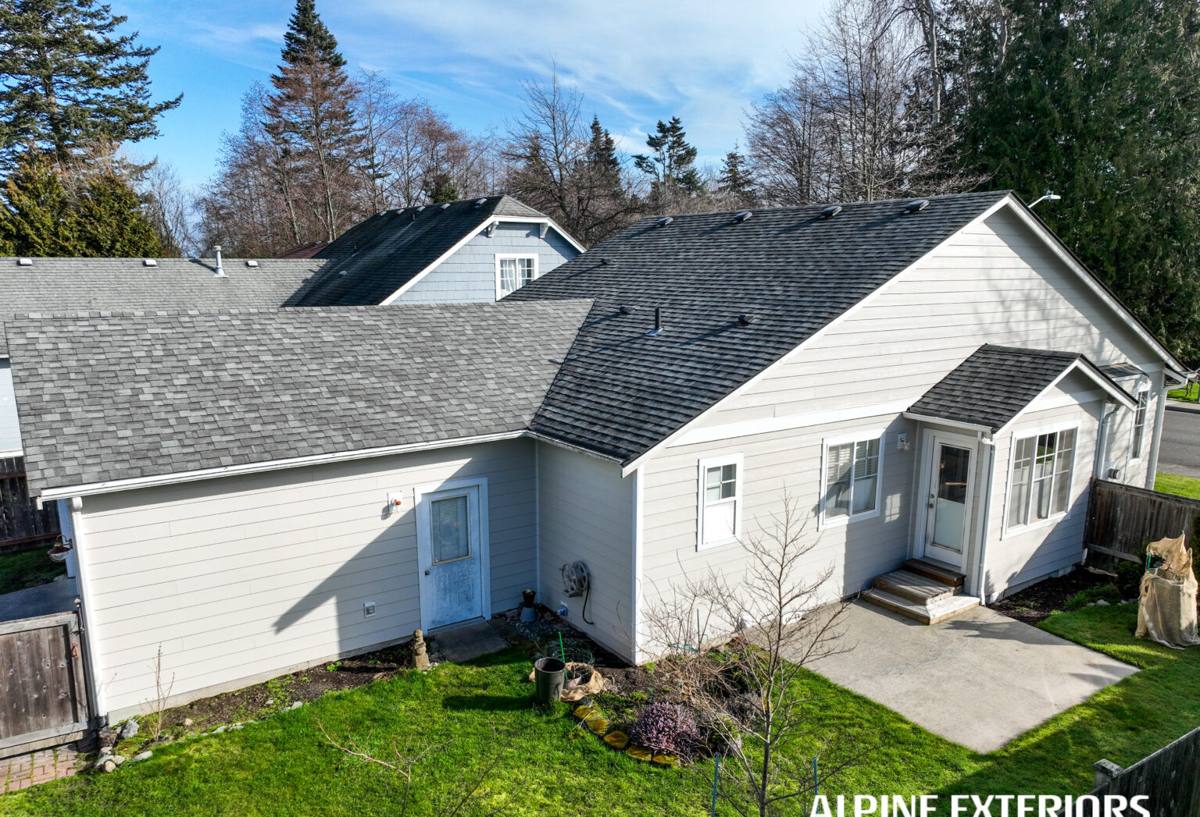
Whatcom County's wet season runs long, and on a coastal lot like Cherry Point, surfaces stay damp longer between dry spells than they would a few miles inland. That extended dampness is exactly what moss, algae, and mildew need to establish themselves on north-facing walls, under eaves, and anywhere airflow is limited.
Moss itself doesn't just look bad — it holds moisture against the siding surface for extended periods, which is a problem for any material that isn't fully sealed and dimensionally stable. Cedar and primed wood siding are particularly susceptible because moisture that gets trapped under organic growth can work into end grain and fastener penetrations. Fiber cement doesn't feed moss the way wood does, and a factory-cured finish resists the staining that comes with long-term moss and algae contact.
Why We Install Only James Hardie Fiber Cement
We made a decision years ago to standardize on James Hardie fiber cement siding and stop installing everything else — no vinyl, no LP SmartSide, no Cemplank, no Allura, no primed spruce or cedar. That's not a marketing position, it's a practical one built around what actually holds up in this climate over decades, not just through the first inspection.
Non-Combustible Material
James Hardie siding is fiber cement — it does not burn. In a region where wildfire smoke and dry-season fire risk have become a bigger part of the conversation even west of the Cascades, that's a real, non-marketing advantage over wood-based and engineered wood products.
Factory-Applied ColorPlus Finish
Hardie's ColorPlus finish is baked on in a controlled factory environment, not brushed or sprayed on site after installation. That finish is formulated to resist fading and hold color consistency far longer than field-applied paint, and it comes with its own finish warranty separate from the product warranty. For a coastal property where UV, salt, and moisture are all working against a painted surface at once, a factory finish is a meaningfully different starting point than site-applied paint.
Engineered for This Exact Climate
Hardie makes climate-specific product formulations, including an HZ5 line engineered for regions with significant moisture exposure like the Pacific Northwest. That's not a generic siding board — it's a fiber cement formulation designed around the freeze-thaw cycles, sustained dampness, and wind-driven rain that define this part of Washington. On an exposed coastal lot like Cherry Point, that engineering distinction matters more than it would on a sheltered inland property.
A Warranty Built to Transfer
Hardie's product warranty is transferable to a subsequent homeowner, which protects resale value in a way a lot of buyers don't think about until they're the one selling. On a property with real coastal exposure, being able to show a documented, transferable warranty on the siding is a legitimate selling point.
Why We Walked Away From the Alternatives
We don't install these products anymore, and it's worth being straightforward about why, rather than just saying "we don't do that."
- Vinyl siding is inexpensive and easy to install, but it expands and contracts significantly with temperature swings, can warp or crack in wind exposure, and its color is baked through the material rather than protected by a separate finish layer — once it fades or is damaged, matching an older run gets difficult.
- LP SmartSide and other engineered wood products perform well when installed and maintained exactly to spec, but they're wood-based, meaning they're more sensitive to moisture intrusion at cut edges and seams than fiber cement, and any lapse in caulking or paint maintenance opens the door to swelling and rot faster than fiber cement allows.
- Cemplank and Allura are also fiber cement products and share some of Hardie's core advantages, but we've standardized our crews, tooling, warranty processing, and color-matching around a single manufacturer so every job we do benefits from the same depth of installation experience.
- Primed spruce or cedar is a traditional, attractive option, but bare or primed wood requires an ongoing paint and caulk maintenance schedule to keep water out, and on a moss-prone, wind-exposed lot like Cherry Point that maintenance burden compounds fast.
None of these are bad products in every context. They're products with trade-offs we're not willing to install on homes that have to survive this specific coastline.
Siding Doesn't Work Alone
An exterior is a system, not a single product. We handle siding, roofing, windows, and decks because those four elements all interact at the same joints, flashings, and transitions — and a coastal property is exactly where sloppy coordination between trades shows up first as a leak.
Roofing and Siding Meet at the Same Flashing
Roof-to-wall transitions, chimney flashing, and eave details are where water intrusion most often starts on a coastal home. When the same crew understands both the roofing and siding side of that joint, it gets detailed correctly the first time instead of two separate contractors each assuming the other handled it.
Windows Are a Siding Problem Too
Window flashing and the siding trim around it are one of the highest-risk water intrusion points on any home, and it's a bigger risk on a wind-driven-rain coastline. Replacing siding without addressing window flashing at the same time just reseals a problem instead of fixing it.
Decks Take the Same Coastal Abuse
Deck fasteners, ledger flashing, and any wood components on an exposed Cherry Point lot face the same salt air and moisture cycle as the siding. We build and maintain decks with the same material and moisture-management standards we apply to the exterior walls.
Comparing Siding Options for a Coastal Lot
| Factor | James Hardie Fiber Cement | Vinyl | Engineered Wood / Cedar |
|---|---|---|---|
| Combustibility | Non-combustible | Combustible | Combustible |
| Finish protection | Factory-baked ColorPlus | Color through material | Field-applied paint/stain |
| Moisture behavior | Engineered for wet climates (HZ5) | Doesn't absorb, but can warp/crack | Absorbent at cut edges, seams |
| Moss/algae resistance | Sealed surface resists staining | Resists growth, can look chalky | Susceptible, needs upkeep |
| Ongoing maintenance | Low | Low | Regular paint/caulk cycle |
| Warranty transfer | Transferable to new owner | Varies by manufacturer | Typically not transferable |
What Correct Installation Looks Like Here
Fiber cement performs the way it's rated to only when it's installed to Hardie's specifications, and on an exposed lot like Cherry Point, the margin for shortcuts is smaller. Before we start, we walk the property with these points in mind:
- Proper starter strip and clearance from grade, decks, and roof lines to keep splashback and standing water away from the bottom course
- Correct fastener type, spacing, and depth — under- or over-driven nails are one of the most common causes of early siding failure
- Weather-resistant barrier and flashing integration at every window, door, and penetration, not just the field of the wall
- Properly caulked and sealed butt joints, sized to the coastal exposure rather than a generic inland spec
- Ventilation and clearances that let the wall assembly dry out between wet-season rain events instead of trapping moisture
- Color and product line selection matched to sun exposure and wind direction on that specific elevation
Why a Local Crew Matters on This Coastline
A crew that works Whatcom County's coastal lots regularly knows the difference between a detail that's fine forty minutes inland and one that needs upgrading for direct water and wind exposure. That's not something you get from a general spec sheet — it comes from having stood on enough Cherry Point, Birch Bay, and Semiahmoo-area roofs and walls to know where the weather actually attacks a house first. We size flashing, fastener schedules, and even color and product line selection around the specific exposure of the lot, not a one-size-fits-all inland default.
If you're planning siding, roofing, window, or deck work on a Cherry Point property, we're happy to walk the exterior with you, point out what the current wear pattern is telling us, and put together a clear, no-pressure estimate using the form below.