 Semiahmoo Siding
 Primed Spruce Siding: A Familiar Sight in Whatcom County
If you've driven around Semiahmoo, Blaine, or anywhere along the Whatcom County coastline, you've seen primed spruce siding on plenty of homes. It's a solid wood product, it takes paint well, and it has a warm, traditional look that a lot of homeowners want. We're not going to tell you it's a bad product in the abstract. In the right climate, installed and maintained correctly, primed spruce siding can perform reasonably well for a good while.
But we don't install it. Not because we're chasing a trend or pushing a product line for margin — it's because after years of working on homes in this specific corner of Washington, we've seen how primed spruce actually holds up against salt air, driving rain, and a moss season that can run eight or nine months out of the year. This page explains that reasoning honestly, including where spruce siding is a fair choice, so you can make an informed decision either way.
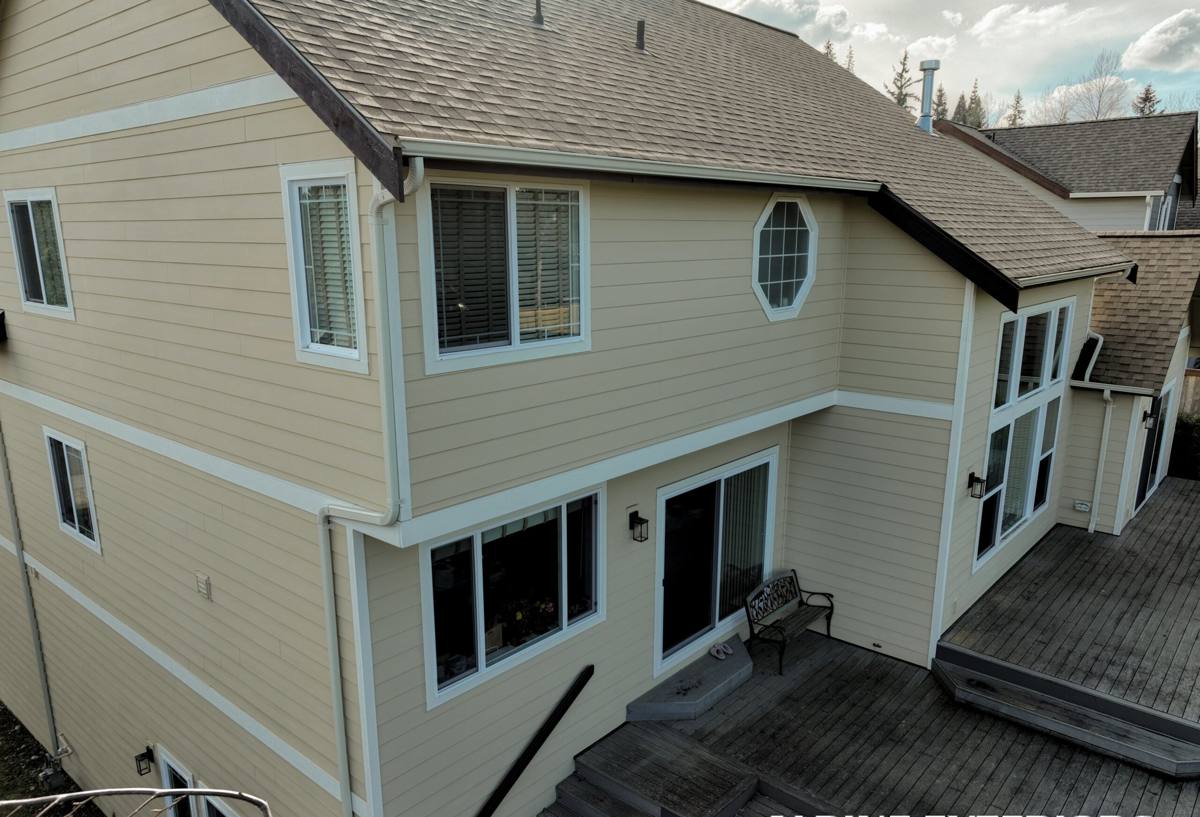
What "Primed" Actually Means — and Doesn't Mean
Primed spruce siding ships from the mill with a coat of primer, not a finished paint system. That primer is a base layer meant to help top-coat paint adhere — it is not designed to be a long-term moisture barrier on its own. The real protection comes from the field-applied paint system that goes on after installation, and critically, from paint being maintained on every exposed surface, including the back side, end cuts, and butt joints that most crews never fully seal.
This is the single biggest gap between how primed spruce siding is marketed and how it's actually used on a job site. In a controlled environment, back-priming every board and caulking every joint before the finish coat goes on is realistic. On a real installation schedule, with real weather windows, corners get cut — not always out of carelessness, but because the product demands a level of field finishing that most budgets and timelines don't account for.
Wood Is Dimensional — Coatings Aren't
Solid wood siding expands and contracts with moisture and temperature. Paint film does not flex the same way wood does over years of cycling. Every expansion-contraction cycle puts stress on the paint bond, and every hairline crack in that film is an entry point for water. Once water gets behind the paint into the wood fiber, it doesn't dry out evenly — it wicks along the grain, and that's where rot starts, usually from the inside out where you can't see it.
What Semiahmoo's Climate Does to Primed Wood Siding
Semiahmoo sits right on the water, and that changes the math on wood siding compared to an inland home even twenty miles away. Three factors specific to this stretch of coastline work against primed spruce more than almost any other siding failure mode we deal with.
Salt Air and Coastal Exposure
Airborne salt is hygroscopic — it pulls moisture out of the air and holds it against whatever surface it settles on. On a home near the Semiahmoo waterfront or anywhere with a direct sightline to Drayton Harbor or the Strait, that means siding surfaces stay damp longer than they would a few miles inland, even on days that look dry. Salt film also breaks down paint sheen and adhesion faster than plain rainwater does, which shortens the repaint cycle a homeowner has to keep up with just to keep the wood protected.
Driving Rain and Wind-Driven Moisture
This part of Whatcom County gets rain that doesn't just fall straight down — winter storms off the Strait push rain sideways into wall assemblies, especially on west- and south-facing elevations. Wind-driven rain finds every gap in a lap siding system: butt joints, nail penetrations, window and door trim intersections, and the bottom edge of each board. Primed spruce is especially vulnerable here because the end grain at every cut and joint is the most absorbent part of the board, and it's also the part most likely to get missed during field priming and caulking.
A Long Moss and Algae Season
Shaded, north-facing walls and anything under tree cover in this area stay damp for most of the year, which is exactly the environment moss and algae need to establish. On wood siding, moss doesn't just sit on the surface — it holds moisture against the paint film and wood underneath for extended periods, accelerating both coating breakdown and the conditions that lead to rot. Keeping wood siding moss-free requires regular washing, which itself adds wear to the paint system over time.
Maintenance Reality: What Ownership Actually Looks Like
The sales pitch for primed wood siding often understates what it takes to keep it looking and performing well in a climate like ours. Here's a realistic side-by-side of ongoing maintenance demands.
| Maintenance Item | Primed Spruce Siding | James Hardie Fiber Cement (ColorPlus) |
|---|---|---|
| Repaint / recoat cycle | Typically every 4–8 years in coastal exposure | Not required — factory finish is warrantied separately from the board |
| Caulk joint inspection | Annual, especially butt joints and trim | Periodic, standard exterior upkeep only |
| Moss/algae washing | Regular, with care not to damage paint film | Regular, no coating to damage |
| Vulnerability to end-grain rot | High if end cuts aren't fully sealed | Not a wood product — no end-grain rot risk |
| Fire resistance | Combustible | Non-combustible core |
| Typical manufacturer warranty | Varies by mill; often limited or prorated | Long-term limited warranty, transferable |
Where Primed Spruce Siding Fails First
When we've been called out to look at failing wood siding in this area, the damage almost never starts in the middle of a flat board. It starts at predictable stress points. Knowing where to look tells you a lot about how a wood siding job was actually finished, not just how it was sold.
- Butt joints — where two boards meet end-to-end; if not back-primed and properly flashed, this is the number one failure point
- Bottom edge of each course — the lowest, most water-exposed edge, often under-primed at the factory
- Field cuts around windows and doors — fresh-cut end grain that needs sealing on-site, which is easy to skip
- Nail penetrations — every fastener is a potential path for water once paint cracks around it
- Ground-level and deck-adjacent boards — splashback and prolonged dampness accelerate everything above
- Shaded north walls — slower drying time plus moss growth compounds paint film breakdown
To Be Fair: What Primed Spruce Siding Gets Right
We'd rather give you the honest picture than talk a product down across the board. Primed spruce siding has real strengths:
- Lower upfront material cost than most fiber cement systems
- A traditional, natural wood look that some homeowners specifically want
- Widely available and easy to source through regional lumber suppliers
- Can be field-cut and customized easily by any carpenter
- Performs acceptably in drier, more sheltered inland settings with disciplined maintenance
If a homeowner understands the maintenance commitment and wants that specific wood look badly enough to take it on, that's a legitimate choice. Our decision not to install it is about matching our labor and our name to a product that performs predictably in Semiahmoo's specific exposure — salt air, driving rain, and a moss season that punishes anything requiring a maintained coating.
Why We Standardized on James Hardie Fiber Cement
We install James Hardie exclusively, and it's worth explaining why rather than just stating it. Hardie's fiber cement boards are engineered from cement, sand, and cellulose fiber — there's no wood grain to wick moisture, no end grain to seal, and no combustible core. Hardie also builds region-specific product lines (their HZ5 formulation is engineered for cold, wet climates like ours) rather than a one-size-fits-all board.
The ColorPlus factory finish is baked on under controlled conditions before the boards ever reach a job site, which is a fundamentally different proposition than field-applied paint over primer. That finish carries its own warranty coverage against fading and peeling, separate from the substrate warranty, and it's backed by a large manufacturer with decades in the fiber cement business — not dependent on a crew getting every caulk joint and end cut right on a rainy install day.
None of that means Hardie is maintenance-free forever, or that installation quality stops mattering — it still has to be installed to Hardie's spec, with correct clearances, fastening, and joint treatment, or you lose the performance the product is designed to deliver. But it removes the single biggest variable that makes wood siding a gamble in this climate: a coating system that has to be perfectly applied and perfectly maintained for decades to keep water out of the material underneath.
Making the Right Call for Your Home
Every home on this stretch of coastline faces a slightly different exposure — a wall facing the water and catching prevailing wind is a different problem than a sheltered inland elevation. If you're weighing primed wood siding against fiber cement, the honest answer depends on how much ongoing maintenance you're willing to commit to, how exposed your home actually is, and how long you want the exterior to go between major projects.
We're happy to walk your home's specific exposure with you, point out the areas that would be highest risk with a wood product, and give you a straight answer — even if that answer involves trade-offs you weren't expecting. If you'd like a free, no-pressure estimate and an honest look at what your home's exposure actually calls for, the form below is the fastest way to get started.