 Semiahmoo Siding
 Exterior Work Built for Whatcom County's North End
Sumas sits at the far edge of Whatcom County, tucked against the Canadian border in a valley shaped by the Nooksack River drainage and the foothills that rise up toward Sumas Mountain. It's a different kind of exposure than you get right on the water, but the same regional weather pattern reaches every part of this county: long wet winters, a short dry summer window, and a marine-influenced climate that pushes moisture into building materials for most of the year. Homes here don't fail because of one big storm. They fail slowly, from thousands of small wet-dry cycles that most homeowners never notice until the siding is already soft.
We work across Whatcom County doing siding, roofing, window, and deck installations, and we've standardized our siding installs on one product family: James Hardie fiber cement. That's not a marketing angle — it's a decision we made after seeing how differently materials perform once they've spent a decade in this specific climate.
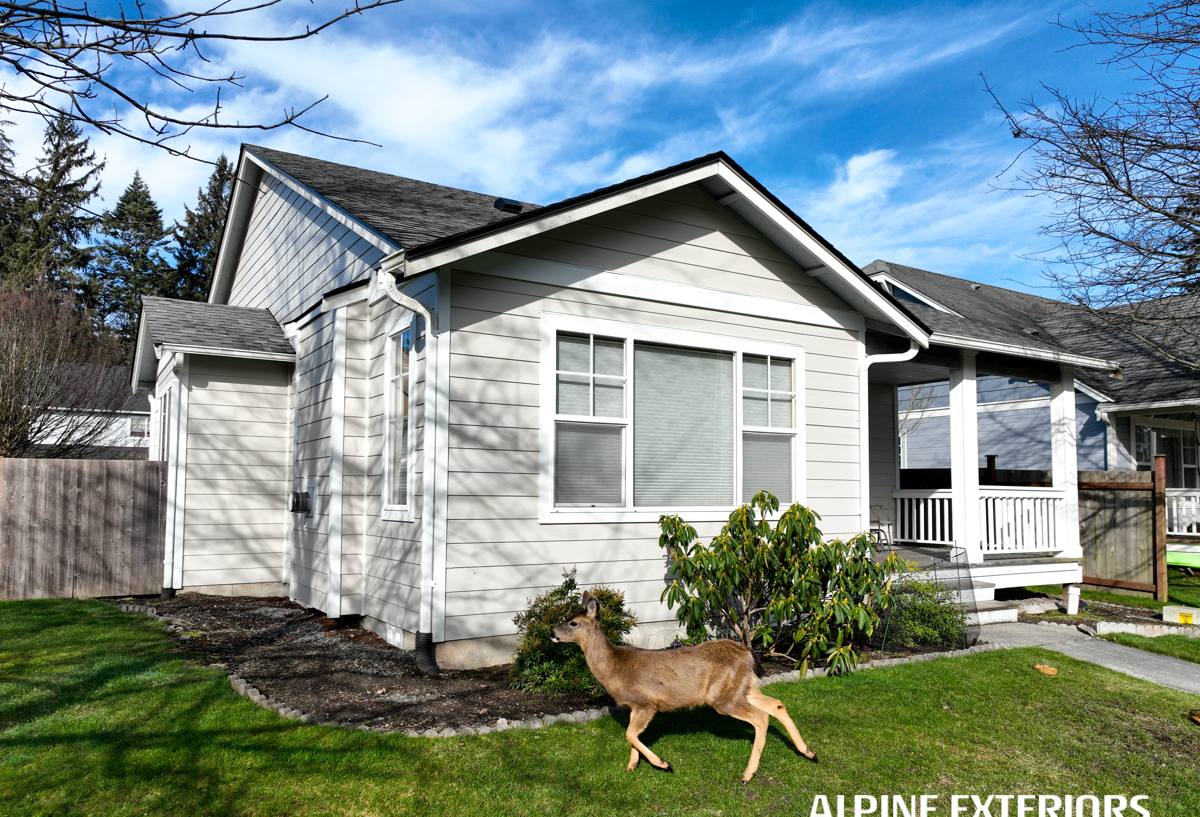
What This Climate Actually Does to a House
Whatcom County's weather isn't dramatic. It's persistent. That's actually the harder condition for a building envelope to handle. A few specific mechanisms show up on almost every older home we inspect in this area:
- Driving rain — wind-driven rain doesn't just fall on siding, it gets pushed sideways into laps, seams, and fastener points, which is exactly where poor materials and poor installation both fail first.
- Moss and algae growth — shaded north- and east-facing walls near tree lines stay damp for extended stretches, and organic growth on siding holds moisture against the surface far longer than bare material would.
- Humid, salt-tinged marine air — even away from the immediate coastline, the airflow patterns off the Strait of Georgia and Puget Sound carry moisture and mineral content across this part of Washington, which is harder on fasteners, trim, and any exposed wood than a drier inland climate would be.
- Freeze-thaw cycling — Sumas sits closer to the foothills, and winter temperature swings here can be sharper than in Bellingham or along the immediate coast. Water that's absorbed into a porous material and then freezes is what actually cracks paint film and splits seams.
None of these forces are exotic. They're just constant, and constant beats dramatic when it comes to slow material failure.
Why We Only Install James Hardie Siding
We get asked regularly why we don't offer vinyl, LP SmartSide, or other engineered wood products, given that they're cheaper up front. The honest answer is that we used to install more than one product line, and the callback pattern we saw over years of service work in this climate is what pushed us to standardize.
The core issue: moisture behavior
Fiber cement is a cementitious product — it doesn't have the wood fiber content that engineered wood siding relies on for structure. That matters here specifically because engineered wood products depend on an intact factory coating and careful field caulking to keep water out of the wood fiber core. In a climate with this many wet days per year, any breach in that coating — a nail pop, a scuffed corner, a gap at a butt joint that wasn't caulked correctly — becomes an entry point for moisture the material isn't designed to shed. Fiber cement doesn't have that vulnerability in the same way. It's dimensionally stable and doesn't swell or delaminate from water absorption the way wood-based products can.
The other issue: what happens over 15-20 years
Vinyl siding holds up fine as a water barrier but it expands and contracts significantly with temperature swings, which loosens fastening over time and telegraphs waviness on a wall — cosmetically more noticeable than a fiber cement wall holds. It's also a petroleum-based product with a service life that tends to show its age faster in constant UV and moisture exposure. James Hardie's ColorPlus factory finish is baked on and warrantied against fading and peeling separately from the substrate warranty, which is a meaningfully different proposition than field-applied paint that has to be maintained on a schedule.
We're not saying every vinyl or engineered wood installation fails. Plenty perform adequately, especially in drier climates. We're saying that for this specific climate, and for the number of years we want to stand behind our own installs, fiber cement is the product we're comfortable putting our name on.
James Hardie Product Lines We Install
| Product | Best Use | What It Offers |
|---|---|---|
| HardiePlank lap siding | Most common wall application | Traditional lap profile, wide color and texture range, HZ10 climate-engineered formulation for the Pacific Northwest |
| HardiePanel vertical siding | Accent walls, gables, modern designs | Clean vertical lines, often paired with batten strips |
| HardieShingle siding | Accent areas, craftsman-style detailing | Staggered or straight-edge shingle profiles without the maintenance of real wood shingle |
| HardieTrim boards | Corners, window and door surrounds, fascia | Matches the siding's moisture resistance so trim doesn't become the weak point |
James Hardie engineers its HZ10 product line specifically for climate zones like ours — higher moisture exposure, more freeze-thaw cycling than the Southeast, and a longer wet season than most of the country deals with. That's a meaningful distinction from a one-size-fits-all siding product.
How a Siding Project Actually Runs
Assessment and moisture check
Before we talk product or color, we look at what's underneath the current siding where accessible, check for rot at trim, sills, and penetrations, and get a sense of how the house has managed water historically. This step matters more in Whatcom County than in drier regions — hidden moisture damage is common on homes that are otherwise well maintained.
Weather barrier and flashing
A rainscreen or properly installed weather-resistant barrier, correct window and door flashing, and attention to every penetration (vents, hose bibs, light fixtures) matters as much as the siding material itself. We've seen good siding installed over poor flashing detail fail years before it should have — the siding gets blamed, but the water intrusion point was somewhere else entirely.
Installation to manufacturer spec
James Hardie has specific fastening, clearance, and caulking requirements, and following them is what the material warranty is actually contingent on. Gaps at butt joints, insufficient ground clearance, and improper nailing are the most common installation errors we see when we're called in to fix someone else's Hardie job.
Final detailing
Trim, caulking at transitions, and touch-up on any factory-finished cuts are what separate a clean install from one that starts showing hairline gaps within a couple of years.
Roofing, Windows, and Decks in the Same Climate
Siding doesn't work in isolation — roof drainage, window flashing, and deck ledger connections all interact with how water moves around a house. We handle all four trades, which means when we're on a property for a siding project, we're also looking at:
- Roof edge and valley condition, and whether water is being directed away from wall assemblies correctly
- Window flashing integration with the new siding plane, especially on older homes being re-sided
- Deck ledger board attachment and flashing, a common rot point where a deck meets the house
- Overall drainage grading immediately around the foundation
A homeowner who hires four separate contractors for these systems often ends up with four different opinions about whose work caused a leak. One crew accountable for the whole envelope removes that ambiguity.
What to Ask Before Hiring an Exterior Contractor
Whatcom County has a wide range of contractors, from large regional companies to small crews working out of a truck. A few questions separate the ones who'll still be reachable in five years from the ones who won't:
| Question | Why It Matters |
|---|---|
| Are you a certified/factory-trained installer for the product you're recommending? | Manufacturer warranties often require certified installation to stay valid |
| What's your approach to flashing and weather barriers, not just the visible siding? | Most failures start behind the siding, not on its face |
| Can I see your WA contractor license and current insurance? | Confirms you're dealing with a legitimate, bonded business |
| Do you carry a written workmanship warranty separate from the manufacturer's material warranty? | Material and labor warranties are not the same thing — ask which one covers what |
| Will the same crew handle roofing/window tie-ins, or is that subbed out? | Fewer parties involved usually means fewer gaps in accountability |
Maintenance That Actually Extends Life Here
Fiber cement is low-maintenance compared to wood, but "low-maintenance" isn't "no-maintenance" in a climate this wet. A short annual routine goes a long way:
- Rinse siding annually, especially shaded and north-facing walls where moss and algae accumulate fastest
- Keep gutters clear so water isn't overflowing directly onto wall sections
- Trim back vegetation and tree branches that keep a wall section shaded and damp
- Re-caulk any cracked or separated joints promptly rather than waiting for the next project
- Walk the exterior once a year and look specifically at trim boards, corners, and anywhere two materials meet
None of this is complicated, but it's the difference between a 30-plus-year wall assembly and one that needs premature repair because small issues went unaddressed.
Why Local Crew Knowledge Matters
A crew that works this specific region regularly develops a feel for details that don't show up in a general installation manual — how much ground clearance to leave given typical splash-back in this rainfall pattern, which wall orientations need extra attention for moss, how local permitting and inspection tends to go in Whatcom County jurisdictions. That's knowledge built from repetition in this exact climate, not from a general national playbook.
If you're planning a siding, roofing, window, or deck project in Sumas or elsewhere in Whatcom County, we're happy to walk the property, look at what's actually happening with your current exterior, and give you a straightforward, no-pressure estimate. There's no obligation — just an honest look at what your home needs.