 Semiahmoo Siding
 Siding Repair Built for Wiser Lake's Weather, Not a Generic Fix
Homes near Wiser Lake sit in a stretch of Whatcom County that takes a real beating from the weather. You're close enough to Semiahmoo and Drayton Harbor to catch salt-laden air off the water, far enough inland to sit under heavy tree cover that keeps moss and algae thriving most of the year, and squarely in the path of the driving, wind-blown rain that rolls off the Pacific through the fall and winter. Siding here doesn't fail because it's old — it fails because it's been fighting a combination of salt, moisture, and shade for years without the right maintenance or the right materials.
A siding repair in this area needs to account for all three of those stressors at once. Patch the wrong way, or patch a material that was never suited to this climate to begin with, and you'll be back out here again in a year or two. Our approach is to figure out why the siding failed before we touch it, then repair it in a way that actually holds up to another Whatcom County winter.
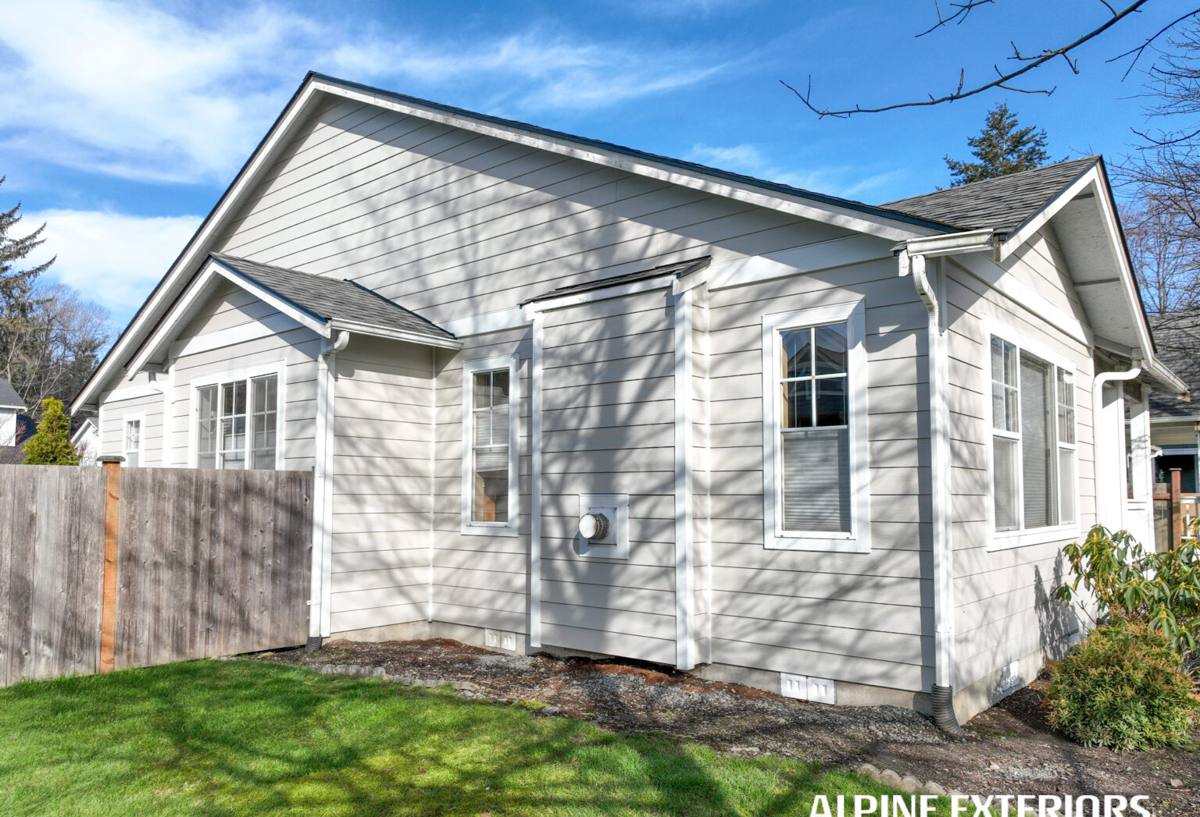
Why Siding Damage Shows Up Faster Around Wiser Lake
Salt Air From Semiahmoo and Drayton Harbor
Airborne salt doesn't need to be right on the water to do damage. It travels on wind and settles on siding, trim, and fasteners, where it accelerates corrosion of nails and staples and slowly breaks down paint films and caulk joints. Over time that shows up as rust streaking near fastener heads, chalky or pitted paint, and seams that have opened up faster than you'd expect for the age of the siding.
Moss and Algae From Heavy Tree Cover
The tree cover and shade that make properties around the lake attractive also mean siding stays damp longer after every rain. Moss and algae take hold in shaded, north-facing sections and in areas where gutters overflow or splashback hits the wall. Left alone, that growth holds moisture against the surface and works its way into seams, corners, and butt joints — which is where hidden rot usually starts.
Driving Rain and Wind Exposure
Whatcom County's winter storms don't just drop rain straight down — they push it sideways, into laps, seams, and anywhere flashing or caulking has started to fail. Siding that was installed with tight tolerances and correct flashing sheds that water fine. Siding installed with shortcuts, or siding that's simply reached the end of its caulk and paint cycle, lets water track behind the wall assembly.
Signs Your Wiser Lake Home Needs Siding Repair
- Persistent moss or dark algae staining that comes back within weeks of cleaning
- Soft, spongy spots when you press on the siding, especially near the bottom courses or below windows
- Cracked, split, or buckled boards or panels, particularly on sun- and wind-exposed walls
- Paint that's peeling, bubbling, or chalking well before its expected repaint interval
- Gaps opening up at seams, corners, or where siding meets trim, window casings, or the foundation
- Visible rust streaks below nail or fastener heads
- Interior clues — musty smells, peeling interior paint, or soft drywall on an exterior wall
What a Correct Siding Repair Actually Involves
A lot of "siding repair" in this region amounts to caulk and a coat of paint over a problem that's still developing underneath. That buys a season or two, not a real fix. A correct repair starts with finding out what's actually happening behind the siding — whether the sheathing or framing underneath has taken on moisture, whether the water-resistive barrier is doing its job, and whether the damage is isolated or spreading.
| Patch-and-Paint Approach | Proper Diagnostic Repair |
|---|---|
| Caulks over cracks and gaps without checking what's behind them | Opens the area to inspect sheathing, framing, and the water barrier before closing it back up |
| Paints over stained or moss-affected boards | Removes and replaces any board or panel with active rot or saturation |
| Reuses existing flashing even if it's failed | Corrects or replaces flashing at windows, doors, and horizontal joints so water sheds properly |
| Matches color only, ignoring butt joint and fastener pattern | Matches material, reveal, and fastening pattern so the repair is structurally consistent, not just cosmetic |
| Treats the symptom (staining, gaps) as the whole problem | Treats the root cause (moisture intrusion, failed drainage plane, damaged material) and the symptom |
Repair vs. Replacement — How to Tell Which You Actually Need
Not every damaged section means a full re-side, and not every "small patch" is really small once you're behind the wall. The honest answer depends on how much of the wall is affected, what the underlying material is, and how long the damage has been progressing.
| Factor | Repair Usually Makes Sense | Replacement Usually Makes Sense |
|---|---|---|
| Extent of damage | Isolated to one or two sections or walls | Recurring across multiple walls or the whole house |
| Underlying material condition | Sheathing and framing are still sound | Rot has reached the sheathing or framing in several areas |
| Siding material | Fiber cement or sound wood with a repairable defect | Original material has an inherent moisture or maintenance problem (aging wood, degraded composite, cracked vinyl at scale) |
| Age and remaining service life | Siding is well within its expected lifespan | Siding is near or past the age where repairs stop being cost-effective |
| Frequency of past repairs | First real repair needed | This is the second or third repair call for the same recurring issue |
Our Siding Repair Process
- On-site inspection. We look at the damage from the outside and, where warranted, open up affected sections to check the sheathing and water-resistive barrier underneath.
- Honest diagnosis. We tell you plainly whether this is a contained repair or a sign of a bigger problem, and why — no upselling a repair into a replacement, and no papering over a problem that needs more than a patch.
- Remove and assess. Any compromised siding, trim, or flashing is removed so we can see exactly what's underneath before closing anything up.
- Correct the cause. Failed flashing, gaps in the drainage plane, or damaged sheathing get fixed first — not just covered.
- Match and install. Replacement material is matched for profile, reveal, and finish so the repair blends into the existing wall rather than standing out as a patch.
- Seal and finish. Seams, joints, and fastener locations are sealed to the same standard as new construction, not just caulked over.
- Walkthrough. We show you what we found and what we did, so you know exactly what's on your wall and why.
Why We Only Install James Hardie When Replacement Is the Right Call
When a repair turns into a full section or full-wall replacement, the material choice matters as much as the workmanship. This company installs James Hardie fiber cement exclusively — we don't install vinyl, LP SmartSide, primed spruce, cedar, or other fiber cement brands. That's a deliberate standard, not a default.
In a climate like Wiser Lake's — salt air, near-constant shade in places, long stretches of damp weather — the material matters more than most homeowners realize. Fiber cement doesn't feed moss and algae the way untreated wood can, doesn't warp or rot the way wood-composite products can when they take on water at cut edges, and doesn't become brittle in cold snaps the way vinyl can. James Hardie's HZ5 product line is engineered specifically for climates with heavy moisture exposure like ours, and the factory-applied ColorPlus finish holds up to UV and salt exposure far better than field-applied paint, which is exactly what's failing on a lot of the siding we get called out to repair. When we replace a section, we want it to actually outlast the rest of the wall, not just match it for a season.
Why It Matters to Hire a Crew That Already Works Wiser Lake
Siding repair around Wiser Lake isn't the same job as siding repair in a dry inland climate. A crew that doesn't regularly work this specific mix of salt air, shade, and driving rain will often underestimate how far moisture has traveled behind the wall, or repair the visible damage without addressing the drainage and flashing details that caused it. A crew that already knows this area knows where water tends to collect on local homes, which orientations take the worst of the wind-driven rain, and what a "small" repair here tends to actually involve once you open the wall up.
That local familiarity also means faster, more accurate estimates — we're not guessing at how Whatcom County weather affects a repair, we're working from what we see on homes near yours season after season.
Maintenance Checklist to Make Your Repair Last
- Rinse siding annually to keep moss and algae from re-establishing, especially on shaded walls
- Keep gutters clear so overflow isn't constantly wetting the siding below
- Trim back tree branches and shrubs to improve airflow and sun exposure on damp-prone walls
- Re-caulk seams and joints as soon as gaps appear, not after a season of water intrusion
- Check and touch up paint on wood or painted sections before bare wood is exposed
- Walk the exterior after major windstorms to check for new cracks, lifted panels, or loose fasteners
- Address soft spots or staining immediately rather than waiting for the next dry season
If you're seeing moss, staining, soft spots, or open seams on your Wiser Lake home, it's worth getting an honest look before another wet season sets in. We offer free, no-pressure estimates — we'll tell you straight whether you're looking at a repair or something bigger, and why.