 Semiahmoo Siding
 Birch Bay and Semiahmoo: A Different Kind of Exterior Job
Homes along Birch Bay and the Semiahmoo waterfront in Whatcom County face a combination of weather stresses that inland siding jobs simply don't deal with. You've got salt-laden air coming straight off the water, wind-driven rain that hits siding sideways instead of falling straight down, and a wet season that stretches long enough to grow a healthy crop of moss on anything that stays damp for more than a few days. None of these are dramatic, one-time events. They're slow, constant pressure, and over years that pressure is exactly what determines whether a siding job still looks good at year fifteen or is already failing at year eight.
We approach exterior work in this area differently than we would on a dry, inland job. Material choice, flashing detail, and ventilation all get treated as climate decisions, not just aesthetic ones. This page walks through what we see on Birch Bay and Semiahmoo homes, how we handle it, and why we've standardized on one siding product instead of offering the full menu.
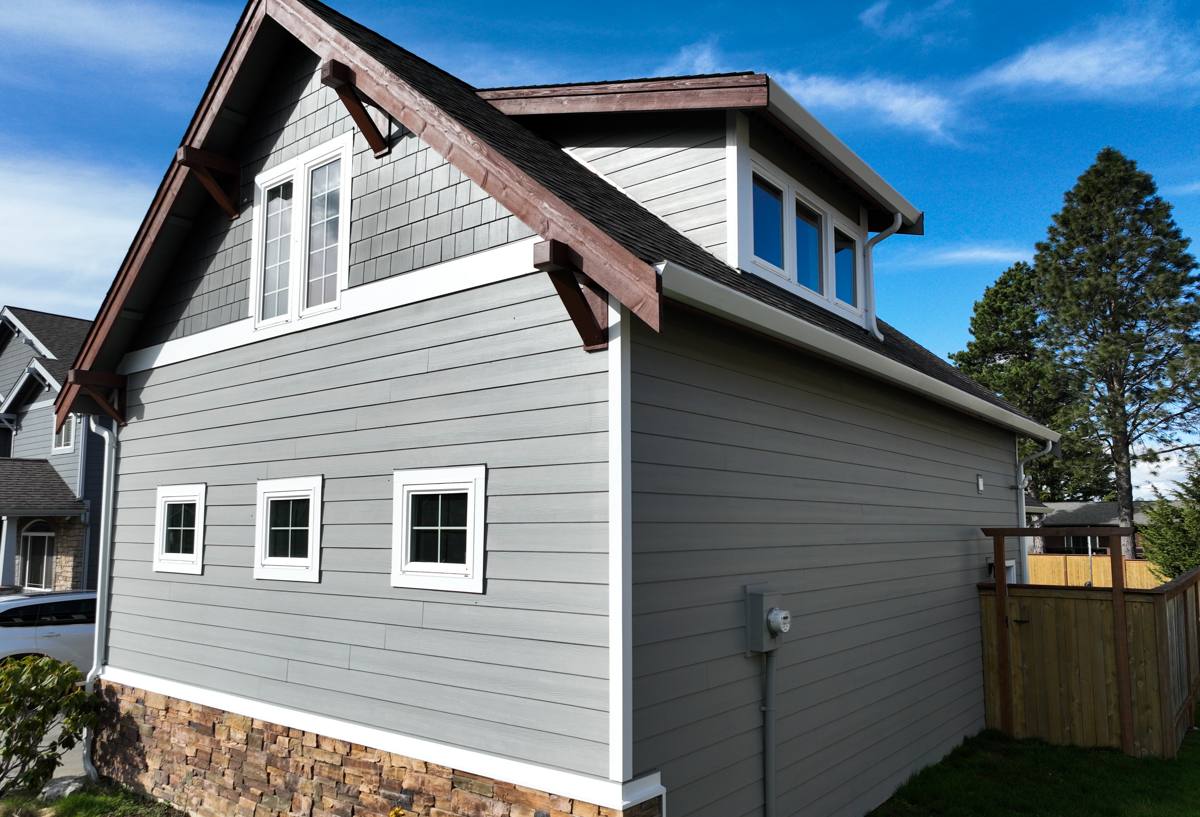
What Salt Air and Driving Rain Actually Do to a House
Salt Air
Salt doesn't just sit on the surface — it works into fasteners, trim joints, and any exposed edge where two materials meet. On metal components (nails, flashing, hardware) it accelerates corrosion. On wood-based siding products, it combines with moisture cycling to break down paint film and open up the substrate underneath faster than the same product would fail a few miles inland.
Driving Rain
Wind off the water doesn't let rain fall straight down — it pushes it sideways and up under laps, trim, and butt joints. Siding systems that rely on gravity alone to shed water (rather than proper lap engineering and flashing) are the ones that end up with hidden moisture behind the cladding. That's often invisible from the street until the sheathing underneath is already compromised.
Moss and Prolonged Dampness
Whatcom County's wet season runs long, and shaded, north-facing walls near the water can stay damp for weeks at a stretch. Moss and algae take hold on any surface that doesn't dry out reliably, and once established they hold moisture directly against the siding surface — which is worse for the material underneath than the rain itself.
Signs a Birch Bay or Semiahmoo Home's Siding Is Losing the Battle
- Dark streaking or green/black growth concentrated on north- or west-facing walls
- Paint that's chalking, peeling, or bubbling, especially near butt joints and trim
- Soft or spongy spots when you press on the siding, particularly near the bottom courses
- Rust bleeding from fastener heads or metal trim pieces
- Visible gaps opening up at seams, corners, or window and door trim
- Warping, cupping, or delamination on the siding boards themselves
- Musty smell or visible staining on interior walls that back up to exterior siding
Any one of these on its own isn't necessarily an emergency. Several of them together, especially on the water-facing side of the house, usually means moisture has been getting behind the cladding for a while.
Why We Install Only James Hardie Fiber Cement Siding
We get asked fairly often why we don't offer vinyl, LP SmartSide, cedar, or primed spruce alongside James Hardie. The honest answer is that we made a standard for ourselves, and in a climate like this one, mixed product performance isn't something we're willing to gamble on.
Vinyl is inexpensive and low-maintenance in the sense that it doesn't need repainting, but it's a thin, flexible material that can warp under sustained heat exposure, crack in a hard impact, and it isn't a structural cladding — it relies on the wall behind it for rigidity. In a salt-air, high-wind coastal setting, we don't think it's the right long-term bet.
Wood-based products like cedar or primed spruce have real appeal — they look great new — but they're the most vulnerable to exactly the conditions this area produces: sustained moisture, salt exposure, and moss growth. They need a disciplined repainting and caulking schedule to hold up, and if that maintenance slips even one cycle, deterioration can move fast.
LP SmartSide is an engineered wood product with a resin-treated strand structure that performs reasonably well when installed and maintained correctly, but it's still wood-based at its core, which means edge sealing, caulking, and paint maintenance matter a great deal, and any lapse in that maintenance shows up as swelling or rot at cut edges and seams — the same failure points we watch for in cedar.
James Hardie fiber cement is non-combustible, dimensionally stable across wet-dry cycles, and doesn't feed moss and algae the way wood-based products can. It's not maintenance-free — nothing exposed to this climate is — but the maintenance burden is lighter and the failure modes we see with wood and vinyl products largely don't apply to it. That's why it's the only siding product we put on homes, full stop.
The Hardie Product Line We Use Here
James Hardie makes climate-engineered product lines (HZ5, for the Pacific Northwest region among others) that are formulated for the specific moisture and temperature patterns of this area, rather than a one-size-fits-all national product. Combined with the factory-applied ColorPlus finish, you get a paint system that's baked on and warranted separately from the substrate, which matters in an area where UV exposure is moderate but moisture cycling is constant.
| Product | Common Use | Why It Fits This Area |
|---|---|---|
| HardiePlank lap siding | Primary wall cladding | Dimensionally stable, resists moisture-driven warping |
| HardieShingle | Accent gables, dormers | Coastal/cottage look without wood's maintenance needs |
| HardieTrim | Corners, window and door surrounds | Consistent expansion rate with the siding, fewer seam gaps |
| HardiePanel | Vertical accent sections | Clean modern lines, durable in exposed wall areas |
It's Not Just the Siding — The Whole Exterior Has to Work Together
Siding is only one piece of a home's defense against this kind of climate. We also handle roofing, windows, and decks, and on a coastal or near-coastal property, those systems all interact. A roof with failing flashing sends water down behind the siding. Windows with degraded seals let wind-driven rain track into the wall cavity right at the trim line. A deck built without attention to ledger flashing rots at the house connection first, not out at the rail. When we look at a Birch Bay or Semiahmoo exterior, we're looking at how water moves across and around the whole building, not just how the siding looks from the street.
Roofing
Roof-wall intersections and valley flashing take a beating from driving rain here. Correct flashing detail at those transitions matters as much as the roofing material itself.
Windows
Window flashing and integration with the siding's water-resistive barrier is one of the most common failure points we find on older homes near the water — not the glass or the frame, but the seal where the window meets the wall.
Decks
Salt air and standing moisture are hard on fasteners and framing connections. Decks near the water need attention to hardware corrosion resistance and drainage, not just the decking surface material.
What a Local Crew Brings to a Job Like This
| Factor | Local Crew | Out-of-Area Crew |
|---|---|---|
| Familiarity with coastal wind/rain exposure | Builds it into flashing and lap detail by default | May apply generic inland practices |
| Response time for follow-up or warranty questions | Same-region, faster turnaround | Often delayed by travel |
| Knowledge of local permitting | Established process with the county/city | Learning curve on each new job |
| Understanding of moss/algae patterns by exposure | Adjusts detailing for shaded, damp walls | May treat all walls the same |
Whatcom County's coastal exposure isn't extreme compared to some parts of the Pacific coast, but it's persistent, and persistent is what wears down siding installed without the right detailing. A crew that works this specific stretch of coastline regularly knows where the problem walls usually are on a given lot orientation before they even climb a ladder.
What Affects the Cost of a Siding Project Here
| Factor | Why It Matters |
|---|---|
| Extent of existing moisture damage | Rot found during tear-off adds sheathing/framing repair before new siding goes on |
| Home size and wall complexity | More corners, dormers, and trim details mean more labor and material cuts |
| Siding profile and accent choices | Mixing lap siding with shingle or panel accents adds material and labor cost |
| Access and site conditions | Waterfront lots with limited staging area can slow scaffolding and material handling |
| Trim and flashing detail level | Proper flashing at every penetration takes more time than a minimal-detail install |
We won't quote a number on this page since every home is different, but we'll walk your specific property and give you a straight, itemized estimate — including calling out any moisture or rot issues we find before we start, not after.
What to Expect Working With Us
- An on-site walkthrough where we look at every wall, not just the ones with visible problems
- A written estimate that separates siding, trim, flashing, and any repair work
- James Hardie fiber cement siding, installed to manufacturer spec — proper clearances, fastening, and flashing at every penetration
- Coordination on roofing, window, or deck work if we find issues in those areas during the walkthrough
- A transferable warranty backing the material, on top of our workmanship
If your home in Birch Bay or Semiahmoo is showing streaking, soft spots, or siding that's just tired-looking after years of coastal weather, we're happy to take a look. Reach out for a free, no-pressure estimate using the form below — we'll walk the exterior, tell you honestly what we find, and lay out your options.