 Semiahmoo Siding
 Siding Repair Built for Point Roberts' Exposed Peninsula
Point Roberts sits on its own peninsula south of the Canadian border, cut off from the rest of Whatcom County by geography in a way few other communities in the state are. That isolation comes with a climate profile all its own: salt-laden air off Boundary Bay and the Strait of Georgia, driving rain with almost nothing around to break it up, and a moss season that runs longer than most homeowners expect. Siding is usually the first exterior system to show what that combination does to a house over time, which is why repair work here needs to account for conditions that a crew working an inland Whatcom County neighborhood may not deal with nearly as often.
We repair siding on Point Roberts homes specifically, not as a side trip from other work. We install and repair with James Hardie fiber cement exclusively — no vinyl, no LP SmartSide, no Cemplank, no Allura, no primed spruce, no cedar. That's a standard we hold to on every repair call, not just full installations, because the material going into a patch matters just as much as the material already on the wall.
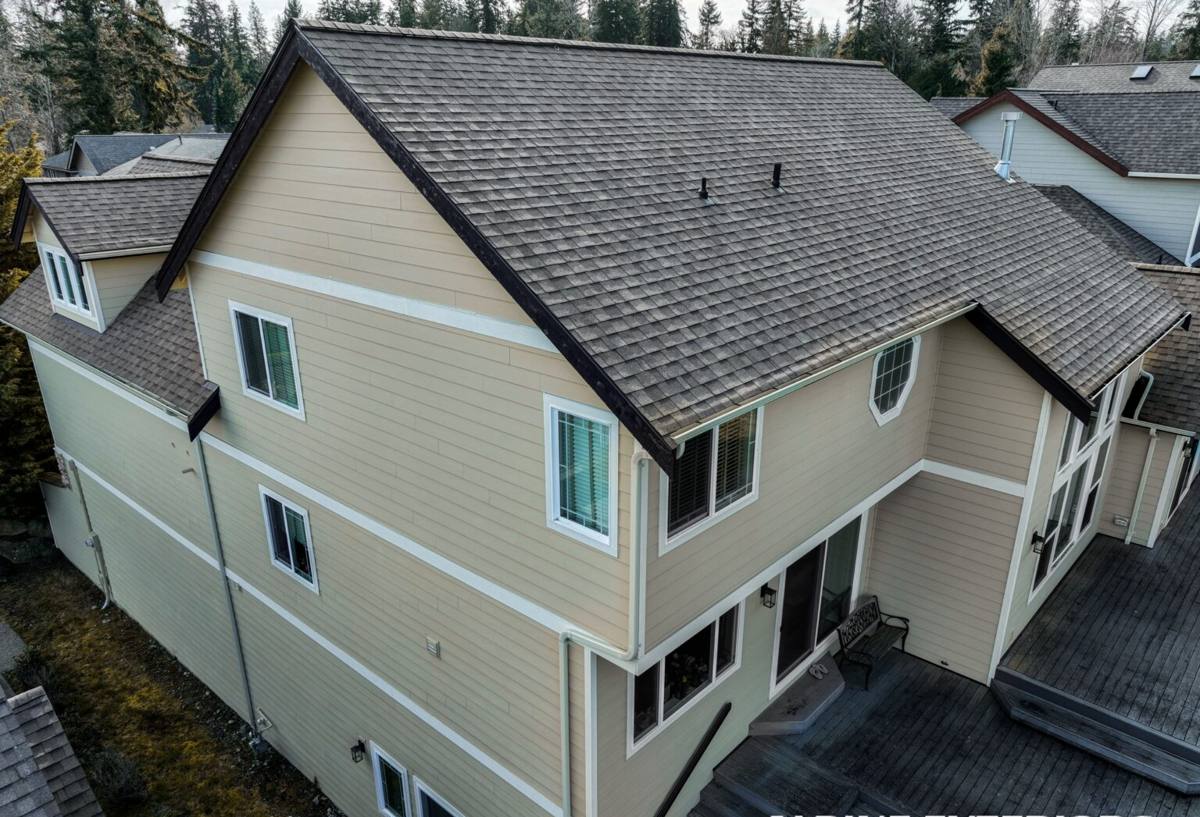
What This Climate Does to Siding on the Point
Salt Air With Almost No Break
Because the peninsula is surrounded by water on multiple sides, homes here take in salt-laden air more consistently than properties set back even a short distance inland. Salt accelerates corrosion in fasteners, trim, and flashing, and it breaks down lower-grade paints and finishes faster than a drier site would. A repair that doesn't account for that corrosion risk from the start tends to need a second repair sooner than it should.
Driving Rain With No Windbreak
Open exposure means wind-driven rain often hits siding sideways rather than falling straight down, pushing water into laps, joints, and any gap in caulking or flashing with more force than a sheltered lot ever sees. Damage that starts as a small opening at a butt joint or corner trim piece can let in a surprising amount of water during a single windy storm off the water, which is why small-looking siding problems on the Point deserve attention sooner rather than later.
A Moss Season That Doesn't Really End
Mild temperatures, near-constant humidity, and shaded north-facing walls add up to a moss and mildew season that runs most of the year in this part of Whatcom County. It tends to show up first on porous or moisture-holding siding surfaces and on walls that don't get much direct sun. Left alone, moss holds moisture directly against the siding surface, which speeds up whatever damage is already underway underneath it.
Signs a Point Roberts Home Needs Siding Repair
Some siding damage is obvious. Some isn't, and that's the kind that causes the most expensive problems if it's ignored. Watch for:
- Cracking, chipping, or crumbling at panel edges or corners
- Soft or spongy spots when pressed, especially near the bottom of walls or below windows
- Paint or factory finish that's peeling, bubbling, or visibly chalking
- Staining or dark streaking below seams, joints, or trim pieces
- Moss or mildew clinging to panel faces that keeps coming back after cleaning
- Gaps opening up at butt joints, corner boards, or window and door trim
Any one of these can be cosmetic on its own. Several showing up together, or showing up in the same area repeatedly, usually points to a moisture problem working its way into the wall assembly rather than just surface wear.
Why We Repair With James Hardie Fiber Cement Only
We don't carry a rotating list of siding brands in the truck. James Hardie's fiber cement is non-combustible, which matters for both safety and insurance underwriting, and its ColorPlus finish is baked on at the factory rather than brushed on in the field, so it holds color and resists moisture intrusion far longer than site-applied paint. The HZ5 formulation is engineered specifically for regions with heavy moisture exposure and freeze-thaw cycling, which describes this stretch of Whatcom County well, and the material stays dimensionally stable instead of swelling or cupping the way some engineered-wood products can after a long wet season. Hardie also backs correctly installed product with one of the stronger transferable warranties in the industry. We won't install LP SmartSide, vinyl, Cemplank, Allura, primed spruce, or cedar — each has its place in the market, but on an exposed property like this, we'd rather stand fully behind one system than offer something cheaper that quietly shifts long-term maintenance risk onto the homeowner.
What That Means When We're Repairing, Not Just Installing
Repair work raises a question new installation doesn't: what's already on the house. If a Point Roberts home already has Hardie siding, a repair is usually a clean match — same profile, same reveal, and a color match against the existing ColorPlus finish where the batch allows it. If the existing siding is a different material entirely, we'll tell you plainly what a patch can and can't accomplish, and when the honest answer is that isolated repair won't hold up as well as addressing the affected section with fiber cement instead.
What a Correct Siding Repair Actually Involves
Diagnosing the Real Cause, Not Just the Symptom
Cracked or stained siding is a symptom. The job starts with figuring out whether that symptom is cosmetic or a sign of moisture already working its way behind the panel. That means pulling back affected sections to check the weather-resistive barrier and flashing underneath, not just patching over what's visible from the outside. Repairing the surface without checking what's behind it is how the same damage reappears a year later.
Matching Existing Siding and Finish
A repair that doesn't match the surrounding panel's profile, exposure width, or finish stands out and can also perform differently in wind and rain than the rest of the wall. For Hardie repairs, that means matching plank width and reveal and getting as close a color match as the existing ColorPlus batch allows. When an exact match isn't possible, we'll say so up front rather than let a mismatched patch surprise you after the fact.
Flashing and Drainage Behind the Repair
Every repair is also a chance to correct whatever let water in to begin with. That usually means re-integrating flashing correctly with the house wrap, restoring proper drainage paths behind the panel, and making sure fasteners and joints are sealed to the same standard as new construction. A patch that looks right but skips this step is a repeat repair waiting to happen, especially in a climate that gives water this many chances to find a way in.
Repair or Full Replacement? How We Make That Call
| Factor | Favors Repair | Favors Full Replacement |
|---|---|---|
| Extent of damage | Isolated to one wall or a few panels | Spread across multiple elevations |
| Underlying moisture | Surface-level, WRB and framing dry | Sheathing or framing already affected |
| Age of existing siding | Recently installed, still under warranty | Near or past expected service life |
| Material on the house | Existing Hardie siding, clean match available | Non-Hardie material failing broadly |
| Long-term cost | Lower upfront, addresses current issue | Avoids repeat repair calls over time |
We'll walk you through where your situation lands on that table before recommending either path — a repair when it genuinely solves the problem, and a straight answer when it won't.
Our Point Roberts Siding Repair Process
- On-site inspection of the damaged area and a check of what's happening behind the siding, not just what's visible
- A clear, written scope covering what's being repaired, the material and color match, and the price before any work starts
- Removal of affected panels, correction of flashing or drainage issues found underneath, and installation of matched fiber cement
- Final walk-through so you can see the completed repair and ask questions before we consider the job done
Why a Crew That Already Works Point Roberts Matters
Point Roberts' geography makes it a genuinely different logistics problem than most siding calls in Whatcom County. Materials, crews, and scheduling all have to account for the peninsula's isolation from the rest of the mainland, and a contractor who doesn't regularly work out here can end up treating the job as an afterthought squeezed into a mainland day rather than planning around it properly. A crew that already knows this corner of the county has already worked out how to handle that logistics question, and how salt air, wind-driven rain, and this area's long moss season behave differently than they do even a short drive away.
Before You Hire for Siding Repair Here
- Ask what material they'll use for the patch and whether it carries a written warranty
- Confirm current Washington contractor licensing and active liability insurance
- Ask how they plan around the logistics of getting crews and materials to Point Roberts
- Get a written scope of work, including the color and profile match, before signing anything
- Ask whether they'll check behind the damaged panel for moisture, not just patch the surface
If you've got damaged, stained, or aging siding on a Point Roberts home, we're happy to take a look and give you an honest read on whether it needs a repair or something more. Reach out below for a free, no-pressure estimate.