 Semiahmoo Siding
 Building New on the Spit: What Your Windows Are Up Against
Semiahmoo Resort sits on a narrow spit surrounded by water, which means every wall of a new home here takes weather from more than one direction. Salt-laden air off the bay accelerates corrosion on hardware and fasteners, wind-driven rain gets pushed sideways into wall assemblies that a calmer inland lot would never see, and the long gray stretch of a Whatcom County winter keeps siding, trim, and window frames damp for weeks at a time. That combination is exactly why window installation matters more here than it does on a typical build.
A new-construction window opening is a hole in your weather-resistive barrier before it's anything else. Get the flashing and sealing wrong and you won't see it for a year or two — then it shows up as a stain under a sill, soft trim, or moss creeping in at a corner that never quite dries out. On a site with this much moisture exposure, we treat every window opening as a water-management detail first and an aesthetic choice second.
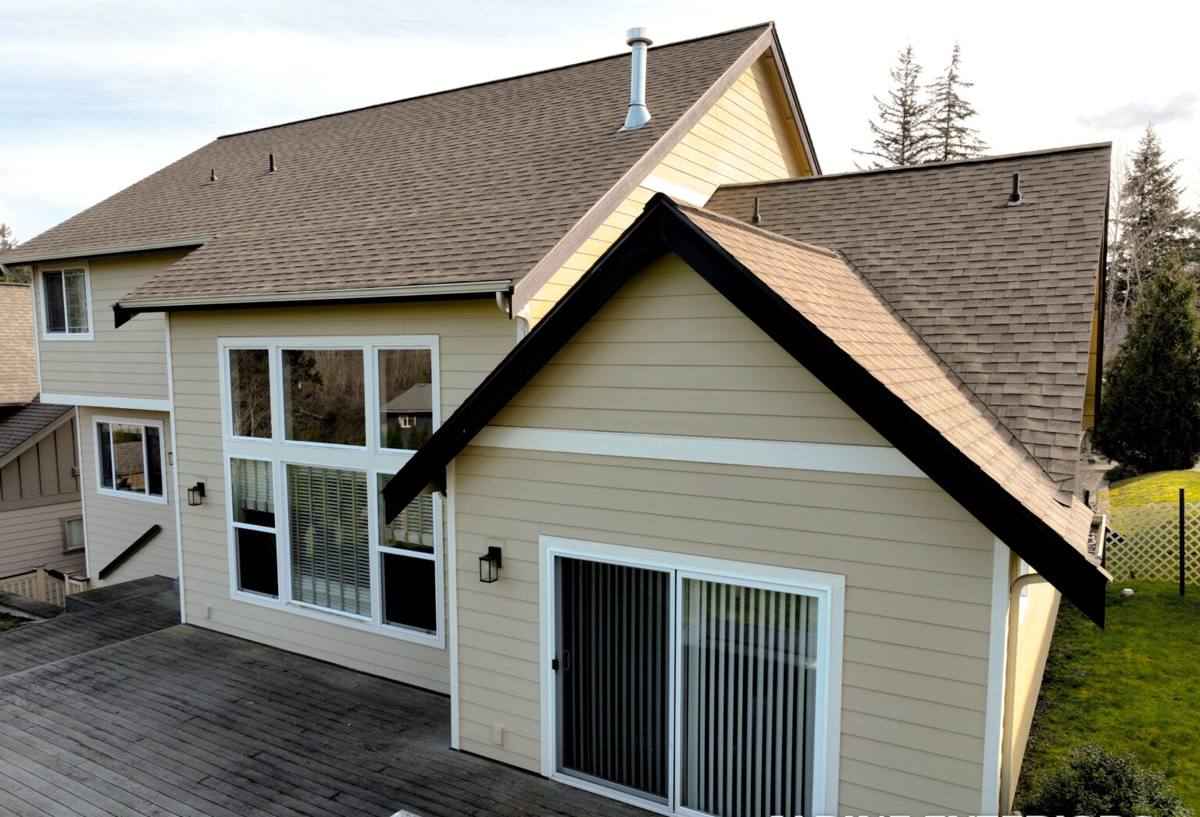
New-Construction Windows vs. Retrofit: Why the Install Method Matters
"New-construction" windows are built with a nailing fin around the perimeter of the frame, designed to be installed before the exterior siding or stucco goes on, while the wall is still open to the framing and the weather-resistive barrier. This is different from a retrofit or "pocket" replacement window, which slides into an existing frame in a finished wall. On a home being built from the ground up in Semiahmoo Resort, new-construction windows are almost always the right call — they let us integrate the window directly into the wall's drainage plane rather than working around finished siding later.
The advantage of building it right the first time is that the flashing sequence is fully accessible. We're not guessing what's behind existing trim or patching around siding that's already up. Every layer — sill pan, side flashing, window, head flashing, weather-resistive barrier lap — goes in in the correct order, in full view, before anything closes it up.
What a Correct New-Construction Window Install Involves
The window unit itself is only part of the job. What actually keeps water out of the wall is the sequence around it. On a marine-exposed site like Semiahmoo Resort, we don't skip steps, and we don't substitute caulk for proper flashing — caulk is a backup layer, not the primary defense.
Our install-day sequence
- Rough opening checked for square, level, and correct dimensions before the window ever shows up on site
- Sloped sill pan flashing installed so any water that gets past the window drains back out, not into the framing
- Weather-resistive barrier cut and prepped in a proper "shingle-lap" pattern so water sheds downward and outward at every layer
- Window set, shimmed level and plumb, and fastened per the manufacturer's specified pattern — not "close enough"
- Side and head flashing tape integrated with the weather-resistive barrier in the correct overlap order
- Head flashing or drip cap installed above the unit to break the path of driving rain
- Perimeter sealed with a compatible sealant rated for the frame material and our climate — not whatever tube was on the truck
- Interior air seal completed so conditioned air isn't leaking out around the frame
Skip the sill pan or get the weather-resistive barrier lap backwards, and a window can look perfect for years before a problem shows up. By then it's a repair inside a finished wall instead of a five-minute fix during framing.
Choosing Frame Material and Glass for a Marine Environment
Homeowners building in Semiahmoo Resort usually ask about the same trade-offs: which frame material holds up to salt air, and how much glass performance they actually need this close to the water. There's no single "best" answer — it depends on your budget, your home's style, and how much upkeep you want to take on.
| Frame Material | Salt-Air / Moisture Performance | Maintenance | Typical Cost Position |
|---|---|---|---|
| Vinyl | Good — won't rust or rot, but check hardware quality | Low | Entry to mid-range |
| Fiberglass | Very good — dimensionally stable, resists corrosion | Low | Mid to upper-mid |
| Aluminum-clad wood | Good exterior protection, but interior wood needs care | Moderate | Upper-mid to high |
| Bare wood | Requires diligent finishing and upkeep in this climate | High | Varies widely |
We're generally cautious about recommending bare wood exteriors on a spit like this — not because wood is a bad product, but because keeping a painted or stained wood sill performing well in constant salt air and driving rain takes a maintenance commitment most owners underestimate. Clad or fiberglass options give you the look you want on the outside without that upkeep burden.
On glass, look at the window's U-factor (how well it resists heat loss) and its air infiltration rating, not just the marketing term "energy efficient." A tighter air-infiltration rating matters more here than in a sheltered inland location, since wind pressure against the glass and frame is a near-constant condition on the spit.
Timing: Coordinating Windows With Your Builder's Schedule
New-construction windows have to arrive and go in at a very specific point in the build — after the weather-resistive barrier is on, but before siding starts. Order too early and you're storing units on site where they can get damaged or weathered; order too late and you hold up the framing crew and the siding crew behind them. On a build in a resort community with an active construction schedule and other trades waiting their turn, that timing discipline matters.
We work directly with your general contractor or builder to lock in a lead time based on the manufacturer's current production schedule, then schedule our crew to be on site the day the openings are ready — not a guess, not "sometime next week." If your GC hasn't nailed down a window supplier yet, we can help you compare options before an order goes in, since a mid-build change is far more expensive than getting the spec right up front.
Our Process for New-Construction Window Installs in Semiahmoo Resort
We keep this straightforward because a new build already has enough moving parts.
1. Plan review and measurement
We review the architectural window schedule against the actual framed openings on site — plans and framing don't always match exactly, and it's cheaper to catch a discrepancy before the windows are ordered than after.
2. Material selection
We walk through frame material, glass package, and hardware finish with an eye toward this site's salt-air and wind exposure, and give you honest trade-offs rather than upselling a package you don't need.
3. Coordinated installation
Our crew installs on the schedule your builder needs, following the full flashing and sealing sequence described above on every opening, not just the visible ones.
4. Walkthrough and documentation
Before siding closes the wall up, we walk the openings with you or your builder so everyone can see the flashing detail while it's still exposed — it's the one point in the build where you can actually verify the work.
Mistakes We Watch For on Spit and Waterfront Builds
Most window failures we get called to diagnose on coastal builds trace back to a handful of repeatable errors: a sill pan that's flat instead of sloped, weather-resistive barrier taped in the wrong lap order so water runs behind it instead of over it, fasteners that aren't corrosion-resistant going into a salt-air environment, or sealant used as a substitute for flashing instead of a backup to it. None of these are visible once the siding goes on, which is exactly why they get missed on jobs where nobody is paying close attention during the framing stage.
The other issue specific to a site like this is wind loading. A window rated fine for a sheltered inland lot can be undersized for the sustained wind exposure on open water. We check the window's design pressure rating against its location on the home — corners and upper stories generally see higher wind loads than a sheltered ground-floor wall — rather than assuming one rating fits every opening.
Why Hire a Crew That Already Works Semiahmoo Resort
Window installation isn't exotic work, but doing it correctly on a marine site is a different skill than doing it on a typical suburban lot. A crew that's worked other builds in this specific area already understands how far the salt air and wind-driven rain reach into a wall assembly, what moss growth in this climate does to a poorly sealed sill over a few winters, and how the local building department and any resort architectural review process typically handle window specifications. That familiarity means fewer surprises mid-build and fewer callbacks after move-in.
It also means we're not learning Whatcom County's coastal exposure conditions on your project. We've already seen what happens when a flashing detail is skipped on a home this close to the water, and we build every opening assuming the weather here will eventually test it — because on this spit, it will.
If you're building new in Semiahmoo Resort and want your windows specified and installed right the first time, we're happy to walk your plans and give you a straightforward, no-pressure estimate using the form below.