 Semiahmoo Siding
 Point Roberts: A Uniquely Exposed Place to Live
Point Roberts sits on its own peninsula at the far edge of Whatcom County, separated from the rest of Washington by water and reachable by land only through Canada. That geography isn't just a curiosity for homeowners here — it means almost every house on the point faces water on more than one side, with wind and moisture coming off Boundary Bay and the Strait of Georgia from multiple directions rather than sheltering behind miles of inland terrain the way a house further from the coast might. Siding on a Point Roberts home works harder than siding in a typical inland Whatcom County neighborhood, and it needs to be installed with that in mind from the first course to the last piece of trim.
This page focuses on one job in one place: siding installation for homes in Point Roberts. Not a general overview of siding, and not a pitch for a product line — a straight explanation of what this specific coastal environment does to exterior cladding, what a correctly installed siding system needs to hold up against it, and why we install only one product to do that job.
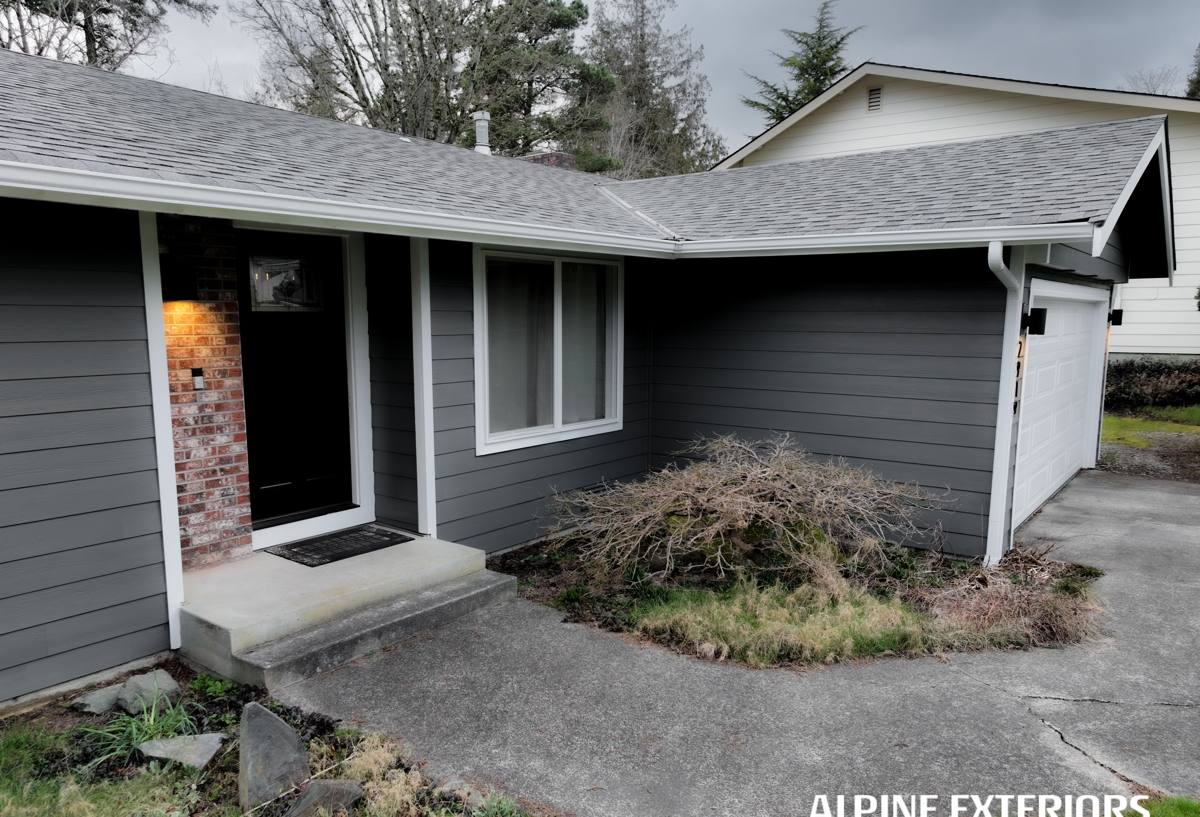
What Salt Air, Driving Rain, and Moss Do to Siding Here
Three conditions define exterior wear on Point Roberts, and most siding failures we see trace back to one of them.
Salt Air and Fastener Corrosion
Homes near open saltwater deal with airborne salt settling on every exterior surface, year-round. Over time it accelerates corrosion in fasteners, trim fasteners, and metal flashing that aren't rated for coastal exposure. Siding itself can tolerate salt air fine if it's a material that doesn't absorb moisture into its core — but the hardware holding it up, and the flashing directing water away from it, matter just as much as the siding panel itself.
Wind-Driven Rain and Water Intrusion
Because Point Roberts is exposed on multiple sides, rain here often arrives horizontally, not straight down. Wind-driven rain finds every gap a calm-weather installation would get away with — a butt joint without proper flashing, a nail driven too tight, a J-channel that wasn't lapped correctly at a window. On a sheltered inland lot, a minor installation shortcut might never show itself. On an exposed Point Roberts wall, it usually will, and often within a few wet seasons.
Moss, Algae, and Shaded North Exposures
Whatcom County's long, wet stretch of the year gives moss and algae plenty of time to take hold, especially on north-facing walls, under tree cover, or anywhere siding stays damp between rain events. Some siding materials absorb moisture into the substrate itself, which feeds surface growth and can lead to swelling, delamination, or rot underneath a coating that still looks fine from the yard. Others resist that moisture uptake and simply need an occasional wash to keep growth from taking hold on the surface.
Why We Install Only James Hardie Fiber Cement Siding
We made a deliberate decision to install one siding system — James Hardie fiber cement — and not vinyl, not LP SmartSide, not Cemplank or Allura, not primed spruce or cedar. That's not a marketing preference; it's a standard we hold ourselves to after seeing how different materials actually perform in exactly the kind of marine, wind-exposed conditions Point Roberts sees.
Built for This Climate
James Hardie engineers specific product formulations for different climate zones, including versions built for the wetter, harsher conditions found along the Pacific Northwest coast. Fiber cement itself is non-combustible and doesn't rely on an organic core that can rot, swell, or feed moss and algae growth the way wood-based or wood-fiber siding products can. That matters directly for a peninsula home dealing with salt air and near-constant seasonal dampness.
ColorPlus Factory Finish
Rather than site-applied paint, Hardie's ColorPlus finish is baked on in a controlled factory process, giving better adhesion and more consistent coverage than field-applied paint typically achieves — a real advantage on a coastline where UV, salt, and moisture all attack a paint film at once. It's backed by a long, transferable warranty, which matters to homeowners who may sell before the siding's usable life is up.
How Siding Materials Compare in Point Roberts' Conditions
| Material | Salt Air / Moisture Behavior | Moss & Algae Resistance | Typical Maintenance |
|---|---|---|---|
| James Hardie fiber cement | Non-combustible, does not absorb moisture into an organic core | Resists surface growth; occasional washing keeps it clean | Repaint/recoat cycle measured in decades, not years |
| Vinyl siding | Doesn't rot, but expands/contracts with temperature and can warp or crack under wind load | Can still host surface growth in shaded, damp areas | Low, but panels are difficult to spot-repair without visible mismatch |
| LP SmartSide (wood-strand) | Engineered wood core is vulnerable if the factory coating is breached | Moisture intrusion at cut edges or fasteners can lead to swelling | Coating and caulking need regular inspection, especially at joints |
| Untreated/primed wood or cedar | Absorbs moisture readily; most exposed to rot in a wet marine climate | Prone to moss and algae without frequent maintenance | Repainting and moisture checks needed on a recurring cycle |
This isn't a claim that other products are defective — plenty of them perform reasonably in milder, sheltered settings. It's why, on an exposed coastal peninsula like Point Roberts, we've standardized on the one material we've seen hold up best without asking homeowners to keep up with frequent upkeep.
What Correct Siding Installation Looks Like Here
The siding panel is only part of the system. On a wind- and rain-exposed Point Roberts wall, the details around it decide whether the installation lasts.
Weather-Resistive Barrier and Flashing
A properly lapped weather-resistive barrier behind the siding, with flashing correctly integrated at every window, door, and penetration, is what actually stops wind-driven rain from reaching the sheathing. Skipping or rushing this step is invisible on install day and expensive to discover later.
Fastening and Clearances
Fiber cement siding has manufacturer-specified fastening patterns, nail spacing, and clearances from grade, roof lines, and adjoining surfaces. Getting these wrong — over-driving nails, closing up expansion gaps, siding installed too close to grade or a deck surface — creates the moisture traps that lead to premature failure, especially in a climate that doesn't give surfaces much time to dry out between storms.
Trim, Caulking, and Detailing
Corner boards, trim, and caulking joints are where most water intrusion actually starts. Using compatible, exterior-rated sealants and finishing trim details correctly the first time matters more here than in a drier, calmer climate where a minor gap might go unnoticed for years.
Our Installation Process
- Assessment: we walk the home, check existing siding and sheathing condition, and identify problem areas specific to the lot's sun, wind, and shade exposure.
- Tear-off and inspection: old siding comes off and we inspect the sheathing and framing underneath for hidden moisture damage before anything new goes up.
- Weather barrier and flashing: a new weather-resistive barrier and properly integrated flashing go in at every window, door, and penetration.
- Installation to manufacturer spec: James Hardie panels, fastening, and clearances installed to the manufacturer's published requirements for this climate zone.
- Trim and detailing: corner boards, trim, and caulking finished with exterior-rated materials suited to marine exposure.
- Final walkthrough: we review the finished work with the homeowner before calling the job done.
Signs Your Point Roberts Home Needs New Siding
- Moss or algae returning quickly after cleaning, especially on north-facing or shaded walls
- Visible warping, cracking, or bowing panels, particularly on wind-exposed elevations
- Soft spots or discoloration around window and door trim, a common sign of water intrusion behind the siding
- Peeling or chalking paint that keeps recurring despite repainting
- Rust staining around fasteners or trim, often an early sign of coastal corrosion
- Rising heating bills or noticeably drafty rooms, which can point to a failing weather barrier behind the siding
Why Local Experience in Point Roberts Matters
Point Roberts' geography adds real logistics to a siding project that a crew unfamiliar with the area can underestimate. Material deliveries and scheduling have to account for the drive through Canada to reach the peninsula, and a crew that regularly works this community plans around that instead of treating it as a surprise mid-project. Just as important, a contractor who has installed siding on multiple Point Roberts homes has already seen how wind exposure, shade patterns, and salt air play out on specific elevations here — knowledge that shows up in better flashing decisions and fewer callbacks, not just faster scheduling.
If you're weighing a siding replacement on your Point Roberts home, we're happy to walk the property, look at what your current siding is telling us, and give you a straightforward, no-pressure estimate for a James Hardie installation built for this coastline. There's a form below whenever you're ready to reach out.