 Semiahmoo Siding
 Lynden Siding Has to Handle More Than People Think
Homeowners in Lynden and the surrounding Whatcom County communities we serve often assume siding failure is just about age. It's usually about exposure. This part of Washington sits in a corridor where damp Pacific weather systems, salt-laden air moving inland off the Strait of Georgia and Puget Sound, and long stretches of overcast, wet months all stack on top of each other. Siding here doesn't just need to look good — it needs to survive a climate that's actively working against it most of the year.
Rain That Doesn't Let Up
It's not the occasional downpour that damages a house — it's the months of steady, driving rain that finds every gap, seam, and fastener hole in a siding system and keeps working at it. Wind-driven rain pushes moisture sideways into wall assemblies that weren't detailed to handle it, and that moisture doesn't dry out quickly in a climate where the sun doesn't do much work for half the year.
Moss Doesn't Care What Siding You Have
North-facing walls, shaded siding under tree cover, and anything near a downspout or roofline valley in this region grows moss and algae if the material and the installation give it a foothold. Porous or poorly sealed siding holds moisture at the surface, which is exactly what moss needs to establish. Over years, that constant dampness against the substrate is what actually shortens a siding system's life — not the moss itself, but what it signals about moisture sitting where it shouldn't.
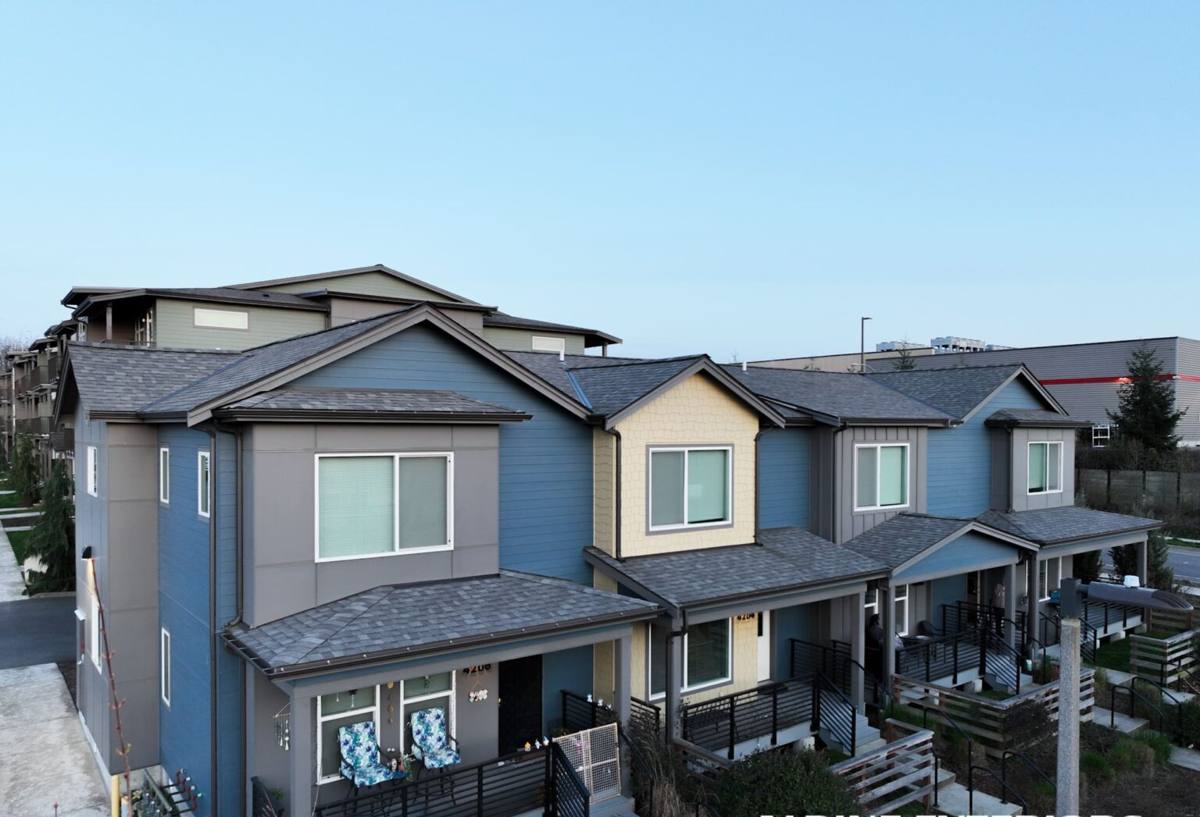
Why We Install Only James Hardie Fiber Cement
We made a deliberate decision as a company: we install James Hardie fiber cement siding, and nothing else. Not vinyl, not cedar, not primed spruce, not LP SmartSide, not Cemplank or Allura. That's not a marketing angle — it's a standard we hold because of what we've seen this climate do to homes over time.
Fiber cement is non-combustible and dimensionally stable in a way wood-based and vinyl products aren't. It doesn't absorb water the way engineered wood siding can, it doesn't soften or delaminate at cut edges and seams the way strand-based products are prone to when moisture gets in, and it doesn't warp, crack, or fade in the same way vinyl does under years of UV exposure and temperature swings. James Hardie's ColorPlus finish is baked on at the factory under controlled conditions, which gives it a more consistent, longer-lasting bond than field-applied paint ever achieves.
What We Won't Install, and Why
Vinyl siding is inexpensive and easy to install, but it's a thin plastic product that expands, contracts, and can become brittle over time — and it's not something you refinish, only replace. Wood-based engineered siding performs well when it stays perfectly sealed at every cut and joint, but that's a hard standard to hold for the life of a house in a wet climate, and moisture intrusion at a compromised edge can spread underneath the surface before it's visible. Cedar and primed spruce are beautiful materials, but they're maintenance-intensive — regular refinishing, vulnerability to rot, and ongoing upkeep that most homeowners don't want to sign up for indefinitely. We'd rather put one product on a home that we trust to perform for decades with reasonable maintenance than offer several products and hope the installation details compensate for a material that's working against the climate.
HZ5 Climate Engineering: Built for Marine Weather
James Hardie doesn't make one universal product — its HardieZone system is engineered by climate. HZ5 products are formulated for regions with freeze-thaw cycles and sustained moisture exposure, which describes Whatcom County's weather pattern well: wet falls and winters, occasional hard freezes, and humidity that lingers rather than clearing out quickly. The HZ5 formulation is built to resist moisture-related damage and hold up through repeated wet-dry and freeze-thaw cycling without the cracking or surface breakdown that can show up in siding not engineered for this kind of exposure.
Choosing the correct climate-engineered product line is a decision we make at the estimate stage, based on the home's exposure — how much direct weather it takes, how shaded it is, and how close it sits to open, wind-exposed terrain.
What a Correct James Hardie Installation Actually Involves
The product is only half the equation. A lot of the siding problems we get called out to inspect on older homes weren't caused by bad material — they were caused by an installation that didn't manage water correctly behind the siding. James Hardie's own installation instructions are specific for a reason.
Water Management Behind the Siding
Correct installation starts with a weather-resistant barrier installed over the sheathing, properly lapped and sealed at every penetration. Behind that, a rain screen gap — a small drainage space between the barrier and the back of the siding panel — lets any moisture that does get past the siding drain and dry out instead of sitting against the wall assembly. Skipping the rain screen is one of the most common corners cut in this region, and it's one of the most consequential.
Fastening, Flashing, and Joints
Fasteners need to hit framing at the manufacturer's specified spacing and depth — overdriven or underdriven nails compromise the panel's ability to move slightly with temperature and humidity changes. Flashing at windows, doors, and roof-to-wall intersections has to be layered correctly so water is always directed outward and down, never trapped behind a joint. Panel seams need proper clearance and, where called for, sealant rated for the application — not just caulk from whatever tube was on the truck that day.
How Siding Materials Compare for Whatcom County Homes
| Material | Moisture & Moss Resistance | Maintenance | Typical Lifespan | Fire Resistance |
|---|---|---|---|---|
| James Hardie Fiber Cement | Strong when installed with proper rain screen and flashing | Occasional washing; factory finish holds color for years | Multiple decades with proper install | Non-combustible |
| Vinyl | Sheds water but seams and laps can trap moisture; doesn't feed moss but doesn't seal against it well either | Low, but cannot be refinished — only replaced | Varies widely; degrades with UV exposure | Combustible, can melt/deform near heat |
| Cedar / Wood | Absorbs moisture; prone to rot and moss without diligent upkeep | High — regular refinishing and sealing required | Shorter without consistent maintenance | Combustible |
| LP SmartSide / Engineered Wood | Performs well sealed; vulnerable at cut edges and compromised joints | Moderate; edge sealing and touch-up matter | Depends heavily on installation quality | Combustible |
Our Process, Start to Finish
Every job follows the same sequence, whether it's a full re-side or a section repair:
- Inspection and moisture check — we look at the existing siding, sheathing, and any trouble spots (north walls, roof intersections, areas with moss staining) before we quote anything.
- Tear-off and substrate repair — old siding comes off, and any damaged or soft sheathing is repaired or replaced before anything new goes on. Covering a compromised substrate is not something we do.
- Weather barrier and rain screen installation — the drainage plane goes in correctly, lapped and sealed, before a single piece of siding is hung.
- James Hardie installation — panels, fasteners, flashing, and joints installed to manufacturer spec, using the HZ5 product line selected for the home's exposure.
- Trim, caulking, and finish detailing — since ColorPlus siding arrives factory-finished, there's no field painting needed on the siding itself, just precise trim and joint work.
- Final walkthrough and cleanup — we go over the finished job with the homeowner and clear the site.
What Affects the Cost of a Hardie Siding Job
| Factor | Why It Matters |
|---|---|
| Home size and number of stories | More square footage and taller walls mean more material and labor, plus added equipment for access |
| Condition of existing sheathing | Rot or moisture damage found during tear-off requires repair before siding goes on |
| Trim, fascia, and detail work | Homes with more architectural detail take more time to flash and finish correctly |
| Number of windows and doors | Each opening needs its own flashing and trim work |
| Site accessibility | Tight lots, landscaping, or limited equipment access can add labor time |
| Product line and profile selection | HZ5 formulations and specific panel or lap styles vary in material cost |
We give exact numbers after a walk-around, not before — anyone quoting a firm price over the phone hasn't seen your walls.
Signs Your Current Siding Is Already Failing
- Soft or spongy spots when you press on the siding, especially near the bottom courses or window sills
- Persistent moss or algae staining that comes back soon after cleaning
- Paint that's peeling, bubbling, or chalking well before you'd expect
- Visible gaps opening up at seams, corners, or trim joints
- Panels that look warped, buckled, or separated from the wall
- Noticeably higher heating bills without another explanation
- Siding that's well past the manufacturer's expected service life for the material
Why Hire a Crew That Already Works in Lynden
A crew that regularly works siding jobs in Lynden and the rest of Whatcom County already knows how this weather behaves on a house — which walls take the worst of the wind-driven rain, where moss tends to establish first, and how much rain screen clearance actually matters here versus a drier climate where installers can get away with cutting that step. That local pattern recognition shows up in the details: where we pay extra attention to flashing, how we sequence a job around the wet season, and what product line we recommend for a given home's exposure.
It also matters for the long run. James Hardie's warranty coverage depends on correct installation, and a crew with an established track record on Hardie products in this specific climate is who you want standing behind that installation years down the road — not a crew that installs five different siding brands and treats them all the same way.
If your Lynden home needs new siding or you're just not sure whether what's on the walls now is still doing its job, we're happy to take a look. Reach out for a free, no-pressure estimate using the form below.