 Semiahmoo Siding
 Deck Replacement in Laurel: Built for This Climate, Not a Catalog Photo
Laurel is one of the Whatcom County communities we work in alongside Semiahmoo and Blaine, and decks out here age differently than decks in drier parts of the country. The same marine-influenced air that shapes exterior work across this corner of Washington — salt-tinged in the coastal stretches, damp and mossy everywhere else — settles into deck framing, fasteners, and surface boards year-round. A deck that would coast along for two decades in a dry inland climate can start showing real problems here in half that time if it wasn't built, or fastened, for what this weather actually does.
Deck replacement is a different job than deck repair. Repair patches specific problems on a structure that's still fundamentally sound. Replacement means the framing, the ledger connection, or enough of the surface has aged out that patching it further would just be delaying the same failure. This page covers how we tell the difference, what a correct replacement actually involves in this climate, and why the details matter more here than they do somewhere drier.
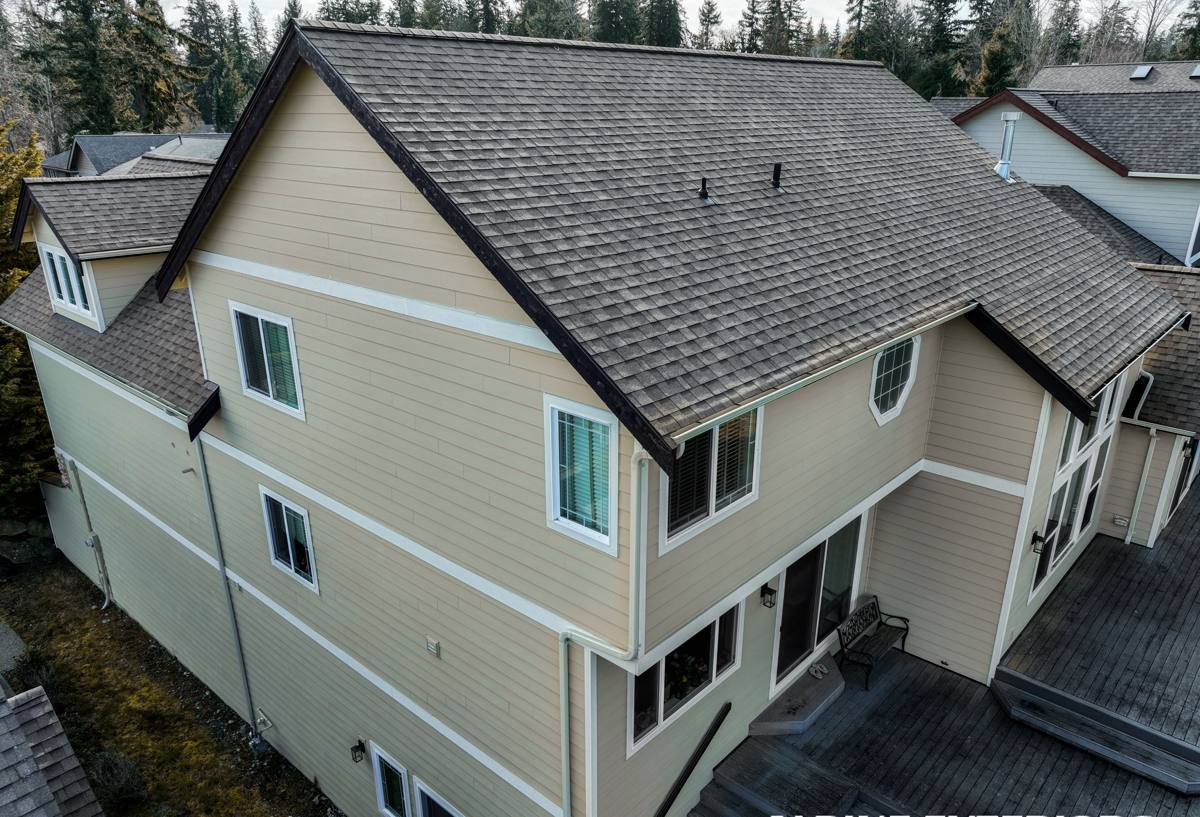
What Driving Rain, Salt Air, and Moss Actually Do to a Deck
Moisture That Doesn't Let Up
Whatcom County gets long stretches of steady rain, and on exposed lots that rain arrives at an angle instead of falling straight down. Wind-driven moisture works its way under boards, into fastener holes, and along the ledger connection where the deck meets the house — the single most safety-critical joint on the whole structure. A deck surface can look fine while the framing underneath is holding onto moisture it never fully sheds between storms.
Salt Air's Slow Work on Hardware
Areas nearer the coast, including the stretch around Semiahmoo, carry salt-laden air that settles onto metal continuously, not just during storms. Salt accelerates corrosion in joist hangers, structural screws, and railing hardware well before rust is visible from the top of the deck. A fastener that's lost holding strength doesn't announce itself — it shows up later as a board that's started to lift, a railing that flexes more than it should, or a hanger pulling slightly away from the ledger.
A Moss Season That Runs Most of the Year
Mild temperatures and near-constant humidity add up to a moss and algae season that covers most of the calendar in this part of Washington, and shaded or north-facing deck surfaces are usually the first place it takes hold. Beyond looking bad, moss holds moisture directly against the decking surface, which is exactly the condition that accelerates rot in wood and can shorten the practical life of lower-grade composite boards.
Signs a Laurel Deck Has Reached Replacement, Not Repair
Not every aging deck needs a full rebuild, and not every deck problem is purely cosmetic. Telling those two categories apart correctly is the first real job of an honest estimate.
- Soft, spongy, or springy spots anywhere in the decking or framing — this almost always means rot has already set in
- Visible gap, movement, or rust staining at the ledger board where the deck attaches to the house
- Multiple support posts or footings showing settling, movement, or contact with standing water
- Widespread graying, splitting, or checking across most of the surface rather than a few isolated boards
- Railings that flex, wiggle, or feel loose under normal weight — a safety issue, not a cosmetic one
- A structure built to older framing or fastening standards that never accounted for local wind and moisture loads
One or two of these on an otherwise sound deck usually points to a repair. Several of them together, especially anything involving the ledger connection or the main support posts, usually means the honest answer is a full replacement.
Choosing a Decking Material That Actually Holds Up Here
Every decking material available today can look good in a showroom. What separates them is how they behave after a few wet seasons of this specific climate — repeated wetting and drying, shaded moss growth, and in coastal spots, salt air working on top of all of it.
| Material | Moisture Behavior Here | Maintenance Needed | Typical Lifespan |
|---|---|---|---|
| Pressure-treated wood | Absorbs and releases moisture readily; prone to checking and splitting over time | Regular cleaning and refinishing on a set schedule | 10-15 years with consistent upkeep |
| Cedar | Naturally moisture-resistant but still needs sealing to hold that resistance | Moderate to high; refinishing needed to prevent graying and moss | 15-20 years with regular maintenance |
| Capped composite | Resists moisture absorption at the core thanks to the protective cap layer | Low; periodic rinsing to clear moss and debris | 25-30 years, often with a manufacturer warranty |
| PVC decking | Doesn't absorb moisture into the board material itself | Low; similar upkeep to capped composite | 25-30+ years |
We walk homeowners through these trade-offs honestly rather than pushing whichever product carries the best margin. A wood deck done right, on a sound structure, with a realistic maintenance schedule, is still a legitimate choice for plenty of homeowners. Composite and PVC cost more upfront but shift less long-term maintenance burden onto the homeowner in a climate that's this consistently wet.
What a Correct Deck Replacement Actually Involves
The Ledger Connection Comes First
The ledger board — where the deck attaches to the house — carries a large share of the structure's total load and is the single most common serious failure point on older decks. A correct replacement re-evaluates this connection from scratch: proper flashing to keep water from tracking behind the ledger and into the house rim joist, correct fastener type and spacing, and hardware sized for the actual load the deck will carry.
Corrosion-Resistant Hardware Throughout
Standard-grade fasteners and joist hangers corrode faster in this climate than most homeowners expect, especially in coastal-adjacent areas. We use hardware rated for the moisture and, where relevant, salt exposure this region sees, not the cheapest option that happens to meet minimum code.
Framing Sized and Spaced for Real Conditions
Joist spacing, beam sizing, and post spacing all need to account for the decking material going on top and the loads it will actually see. A frame built to bare minimum spec for one decking product can feel spongy or perform poorly under a different material, which is one reason we design the structure and the surface material as one decision rather than two separate ones.
Drainage and Airflow Underneath
A deck built tight to the ground or without adequate airflow underneath traps moisture against the framing, which accelerates rot regardless of how good the surface material is. Correct grading, gapping, and ventilation underneath the structure are part of a proper replacement, not an optional add-on.
Code Compliance and Permitting
Deck replacement in Whatcom County typically requires permitting, particularly for elevated structures, guardrail height and spacing, and stair requirements. We handle that process as part of the job rather than leaving it for the homeowner to sort out, and we build to current code rather than simply matching whatever the old deck happened to be.
How Our Deck Replacement Process Works
- On-site assessment. We inspect the existing deck's framing, ledger connection, and support posts to confirm replacement is the right call and to understand what the new structure needs to account for.
- Material and design discussion. We go over decking material options, railing choices, and layout, with honest trade-offs for each rather than steering toward one option.
- Written scope and permitting. A clear scope of work and cost goes in writing before anything is signed, and we pull the required permits before construction starts.
- Demolition and structural rebuild. The old structure comes out, and the new framing, ledger connection, and support posts go in to current code and corrosion-resistant hardware standards.
- Surface installation and finish work. Decking, railing, and stairs go in last, followed by a final walkthrough so you know exactly what was done and what maintenance schedule fits the material you chose.
Maintenance That Actually Extends a New Deck's Life
- Rinse the surface periodically to clear moss, algae, and organic debris before it works into the material
- Keep gaps between boards clear so water and airflow move through the deck the way it was designed
- Trim back landscaping that shades the deck or traps moisture against its edges
- Check railing posts and visible hardware once or twice a year for early corrosion or looseness
- Reseal or refinish wood decking on a schedule suited to this climate — longer intervals shorten a wood deck's life fast here
- Address any soft spot, movement, or gap at the ledger immediately rather than waiting for a scheduled inspection
A Short Checklist Before Hiring for Deck Replacement
- Ask what they inspect before recommending replacement over repair, and whether that included the ledger connection and support posts
- Confirm they carry current Washington contractor licensing and active liability insurance
- Ask what fastener and hardware grade they use, and whether it accounts for this region's moisture and salt exposure
- Confirm permitting is handled as part of the job, not left to the homeowner
- Get a clear, written scope of work and material specification before signing anything
Why It Matters That We Already Work in Laurel
A crew that mostly builds decks in a drier region can still do competent work, but they're learning this climate's failure points on your project instead of already knowing them. Working in Laurel and the surrounding Whatcom County communities regularly means we already know how driving rain finds its way into a poorly detailed ledger connection, how fast moss takes hold on a shaded north-facing deck, and what hardware grade actually holds up through a full wet season here rather than corroding out in a few years. That familiarity shows up in a more accurate first estimate and fewer surprises once the old deck comes out and the real condition of the framing underneath is visible.
If you're weighing whether your deck needs repair or a full replacement, or you're starting fresh with a new build, we're glad to walk the site and give a straight, no-pressure read on what it actually needs. Reach out below for a free estimate.