 Semiahmoo Siding
 Full Siding Replacement in Ferndale: Why the Whole System Comes Off
There's a real difference between patching a few damaged boards and replacing a home's siding outright, and knowing which one a house actually needs is the first decision that shapes everything after it. A full replacement means stripping the exterior down to the sheathing, dealing with whatever's been happening behind the old siding for years, and rebuilding the wall system correctly from the water-resistive barrier out. It's a bigger job and a bigger investment than a repair, which is exactly why it's worth doing right the first time.
We're based near Semiahmoo and work Ferndale regularly as part of our everyday Whatcom County service area — this isn't a job we drive in for once and never see again. Ferndale homes deal with the same salt-tinged marine air, sideways-driven rain, and long moss season that shapes exterior work across this part of the county, and a full replacement is where those conditions matter most, because whatever gets built back into the wall now is what the house lives with for decades.
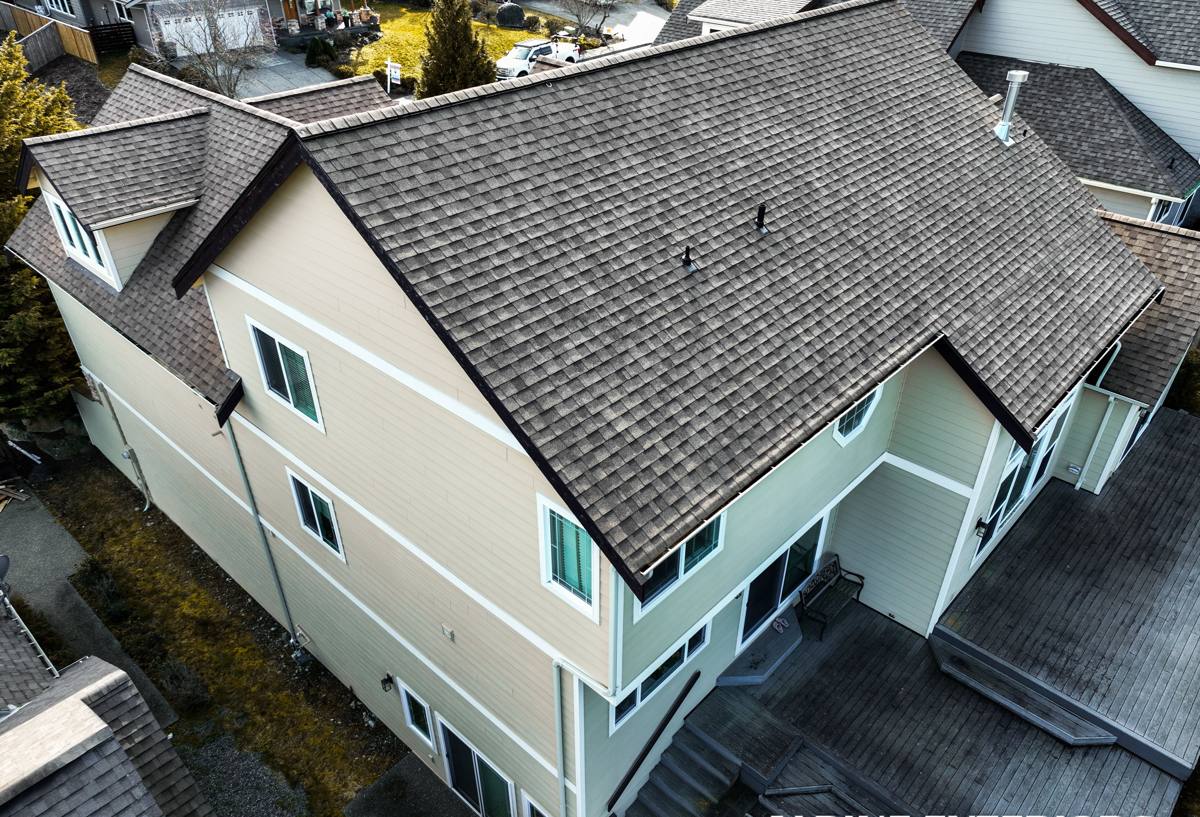
Signs a Ferndale Home Needs Replacement, Not Repair
What You Can See From the Ground
Some signs are visible without a ladder. Boards that are soft, cracked, or crumbling at the edges, paint that won't hold no matter how often it's redone, siding that's visibly cupping, buckling, or pulling away at the seams, and moss or mildew that returns to the same spots every year no matter how many times it's cleaned off are all indications that the material itself — not just its finish — has reached the end of its useful life.
What's Usually Happening Underneath
The more important signs are often the ones you can't see from the driveway. Soft or discolored drywall on interior walls near the exterior, a musty smell that shows up in certain rooms during wet weather, and visible daylight or gaps at trim and corner boards all point to moisture that's already gotten past the siding and into the wall assembly. By the time those signs show up, the damage usually isn't limited to the siding itself — it's reached the sheathing, and that changes the scope of the job from a straightforward re-side into a repair-and-rebuild.
What a Correct Full Replacement Actually Involves
Full Tear-Off and Sheathing Inspection
A correct replacement starts with removing the existing siding entirely, not layering new material over the old. That's the only way to actually see the sheathing, framing, and water-resistive barrier underneath and find out what condition they're really in. Skipping this step to save time is one of the most common ways a replacement job ends up covering up a problem instead of solving it.
Repairing What's Underneath Before Anything New Goes On
It's common to find some amount of rot, soft sheathing, or compromised framing once the old siding comes off, especially on a home that's gone a while without attention. Those areas need to be cut out and rebuilt with sound material before any new siding goes on top. A siding system is only as good as what it's fastened to, and installing new Hardie panels over damaged sheathing just hides the problem for a while longer.
Water-Resistive Barrier and Flashing Details
Every full replacement is a chance to rebuild the drainage plane correctly — a continuous water-resistive barrier, properly lapped and taped seams, and flashing that's integrated correctly at windows, doors, and every roof-to-wall transition. In a climate where rain regularly gets pushed sideways by wind, these details matter more than the siding material itself. A well-chosen product installed over sloppy flashing will still leak.
Installing to James Hardie's Climate Spec
Fiber cement performs the way it's engineered to only when it's installed to Hardie's published specifications — correct fastener type and spacing, proper clearance from grade and rooflines, and the HZ5 product line that's built for cold, wet regions like this one. We follow that spec on every replacement rather than treating it as optional.
Why We Only Replace Siding With James Hardie Fiber Cement
A full tear-off is exactly the moment material choice matters most, because it's the one time in a home's life when the wall gets opened up and rebuilt from scratch. We don't offer vinyl, LP SmartSide, Cemplank, Allura, primed spruce, or cedar as a lower-cost alternative on replacement jobs, and that's a deliberate professional standard, not an oversight. Each of those products has legitimate uses elsewhere, but we've made the call that on a job where we're already doing the harder, more disruptive work of a full replacement, we want to put back a material we can fully stand behind:
- Non-combustible core — fiber cement doesn't feed a fire the way wood-based siding can
- Factory-applied ColorPlus finish — baked on under controlled conditions instead of field-painted, holding color far longer against fading and moisture
- HZ5 formulation — engineered specifically for regions with heavy moisture exposure and freeze-thaw cycling
- Dimensional stability — resists the swelling, cupping, and warping that wood-based products can develop after repeated wetting
- Strong transferable warranty — backed by the manufacturer when installation follows their spec, which we treat as the baseline, not an upsell
Our Ferndale Siding Replacement Process
- On-site assessment — we walk the exterior, check for signs of moisture behind the siding, and give you an honest read on whether the home needs repair or full replacement
- Written scope and proposal — a clear, itemized scope before any contract is signed, including which Hardie profile and HZ line fits the home
- Scheduling and material order — timed around weather windows, since tear-off exposes the home to the elements until the new system is closed in
- Tear-off and sheathing inspection — old siding comes off entirely so we can see exactly what's underneath
- Repairs, with transparency — any rot or damage found gets flagged and discussed before we move forward, not buried in a change order after the fact
- Water-resistive barrier, flashing, and Hardie installation — built to spec, not shortcuts
- Cleanup and walk-through — job site cleared of debris, and a final walk-through so you know what was done and why
- Warranty registration — your new siding is registered with the manufacturer so the warranty is active from day one
What Gets Skipped When a Replacement Job Is Rushed
Not every siding replacement is built the same way, even when the finished product looks similar from the street. The difference usually isn't visible until years later, when one house is still performing and the one next to it is showing moisture problems again.
| Step | Done Correctly | Often Skipped or Rushed |
|---|---|---|
| Tear-off | Full removal down to sheathing | New siding installed over old material to save labor |
| Sheathing inspection | Damaged sections cut out and rebuilt | Soft or rotted sheathing covered rather than repaired |
| Water-resistive barrier | Continuous, properly lapped and taped | Gaps left at seams and penetrations |
| Flashing | Integrated at every window, door, and roof-wall transition | Reused old flashing or minimal detailing at transitions |
| Fasteners | Correct type, spacing, and corrosion resistance per spec | Whatever's on hand, regardless of manufacturer spec |
| Cleanup | Site cleared, debris hauled, walk-through provided | Debris left for the homeowner to deal with |
Why a Crew That Already Works in Ferndale Matters
A contractor who's regularly in Ferndale already has a working sense of how this area's weather behaves — where moss tends to hold on longest, which exposures take the worst of the wind-driven rain, and how salt air off the water factors into fastener and flashing choices even a short distance inland. That familiarity doesn't replace careful assessment on any individual home, but it means fewer surprises and a faster, more accurate read on what a given house actually needs. Being based near Semiahmoo puts us close enough to Ferndale to schedule efficiently, follow up quickly if a question comes up after the job, and treat it as part of our regular service area rather than a special trip.
Questions to Ask Before You Hire
- Will the old siding be fully removed, or is this an over-siding job?
- What happens if rot or damaged sheathing is found once tear-off starts?
- What siding material and product line are being installed, and why?
- How is flashing detailed at windows, doors, and roof-to-wall transitions?
- Is the installer a current, factory-trained James Hardie installer, and is the manufacturer warranty registered after the job?
- Do they carry current Washington contractor licensing and active liability insurance?
- Is there a clear, written scope of work before any contract is signed?
If your Ferndale home is showing signs it needs more than a patch — or you just want an honest opinion on whether repair or full replacement makes sense — we're happy to take a look and walk you through what we find. Reach out below for a free, no-pressure estimate.