 Semiahmoo Siding
 Decks in Laurel Take a Different Kind of Beating
Laurel sits close enough to the water that every deck in the neighborhood is doing double duty: holding up structurally while fighting off salt air, near-constant winter rain, and a moss season that can run six months or longer. That combination is harder on wood and hardware than most homeowners realize until they start noticing soft spots underfoot, rust streaks around fasteners, or boards that stay damp and green long after the rest of the yard has dried out.
A deck built the same way in a drier inland part of Whatcom County might go a decade without needing attention. In Laurel, the same deck often needs its first real repair inspection much sooner — not because the original build was bad, but because the environment is more aggressive. Salt-laden air accelerates corrosion on nails, screws, and metal connectors. Driving rain finds its way into every joint and end-grain cut that wasn't properly sealed or flashed. And moss doesn't just look bad — it holds moisture against the wood surface long after a normal rain would have evaporated off.
We repair decks in Laurel regularly enough to know which failures show up first, which ones are cosmetic, and which ones need attention before they become a safety issue.
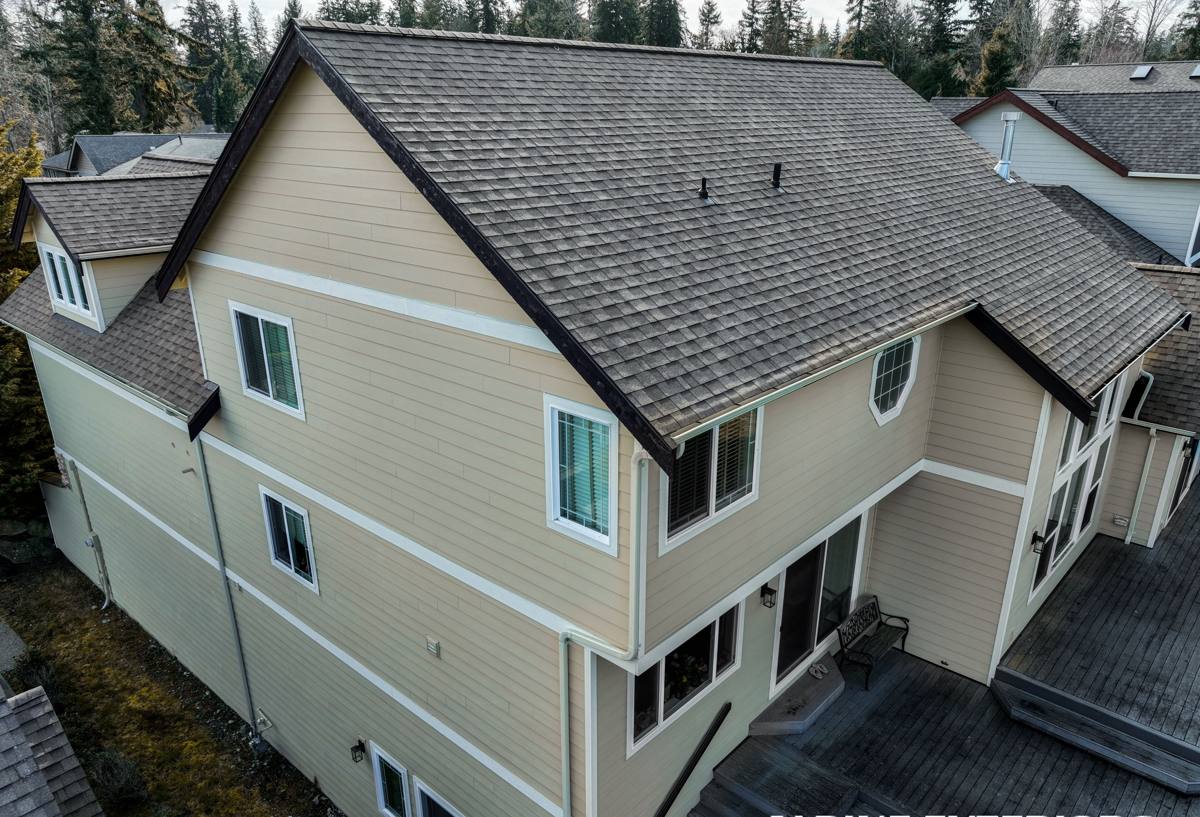
What "Deck Repair" Actually Covers
Structural Repairs
These are the ones that matter most for safety: a ledger board pulling away from the house, joists that have softened from trapped moisture, posts that have rotted at the base where they meet a concrete footing, or railings that have loosened to the point they no longer meet a solid push test. Structural issues are rarely obvious from a quick look — they're usually found by checking underneath the deck, probing wood with a screwdriver, and inspecting connection points most homeowners never see.
Surface and Cosmetic Repairs
These are the issues you notice from the top: cupped or splintering boards, popped or corroded fasteners, faded or peeling finish, and stair treads that have started to feel spongy. Surface problems are more visible but not always more urgent — sometimes a deck with rough-looking boards is structurally solid, while a deck that looks fine from above has a real problem underneath. Part of a proper repair job is figuring out which is which before any work starts.
The Problems We See Most Often in Laurel
- Fastener corrosion: Salt air speeds up rust on standard nails and screws, especially where the coating has worn thin from foot traffic or weather exposure.
- Ledger board separation: The point where the deck attaches to the house is a common spot for water intrusion if flashing was missing or installed incorrectly during the original build.
- Soft or rotted joists: Usually found where debris has collected and held moisture against the wood for extended periods, often near the house or under low-clearance sections.
- Moss and algae buildup: Beyond looking bad, moss keeps board surfaces damp for far longer than they'd otherwise stay wet, which speeds up decay underneath.
- Post-base decay: Wood posts set in or near concrete footings can wick and hold moisture at the base, which is often the first place rot starts on an older deck.
- Loose or failing railings: Whether from corroded fasteners or wood that's dried and shrunk around the connection points, railings are a safety item we check closely on every repair visit.
Repair vs. Replacement: How We Decide
Not every deck problem means starting over, and not every deck is worth patching. We look at the extent of the damage, the age and condition of the framing, and how the deck was originally built before recommending a direction.
| Factor | Repair Usually Makes Sense | Replacement Usually Makes Sense |
|---|---|---|
| Framing condition | Joists and beams are solid; damage is limited to a few boards or connections | Widespread soft or rotted framing found in multiple areas |
| Age of the deck | Under 15-20 years, built with adequate framing sizes for current use | Older deck nearing the end of its structural life, or undersized for today's code |
| Scope of damage | Isolated issues — a bad ledger connection, a few rotted boards, loose railings | Damage spread across the surface, framing, and posts |
| Cost comparison | Repair cost is clearly lower than a rebuild for the remaining useful life | Repair costs start approaching a large share of full replacement |
| Design and layout | Current layout and size still work for how the space is used | Homeowner wants a different footprint, added stairs, or a layout change |
Most of the time, a deck that's been reasonably maintained can be repaired rather than torn out. We'll tell you honestly when a repair isn't a good use of money and a rebuild is the smarter long-term move.
How Our Repair Process Works
1. Full Inspection, Not Just a Look at the Surface
We check the deck from underneath as well as on top — ledger connections, post bases, joist condition, and the fasteners holding it all together. This is where most of the real information about a deck's condition actually is.
2. A Clear, Honest Scope
Before any work starts, you get a straightforward explanation of what's actually wrong, what needs to be fixed now versus what can be monitored, and what it will cost. No pressure to upgrade to a full rebuild if a targeted repair will do the job.
3. Repair the Right Way, Not the Fast Way
That means replacing corroded fasteners with hardware rated for exterior and coastal-exposure use, correcting flashing at the ledger board where water intrusion started the problem in the first place, and matching structural repairs to current best practice rather than just patching over the same mistake that caused the damage.
4. Cleanup and a Final Walkthrough
We walk the finished repair with you, point out what was done, and flag anything worth keeping an eye on going forward.
Materials: Matching the Repair to Coastal Conditions
What we use for a repair depends on what's already there and what will hold up best going forward. Pressure-treated lumber remains a solid, economical choice for framing and structural repairs when it's properly sealed at cut ends and connections. For surface boards, homeowners in Laurel often ask us to compare wood against composite decking — both have a place, but they come with different trade-offs worth understanding honestly.
Wood decking costs less upfront and is straightforward to repair board-by-board, but it needs regular sealing or staining to hold up against driving rain and salt air — skip that maintenance for a few years and you'll see it in faster surface wear. Composite decking costs more initially and doesn't need staining, but it's less forgiving of poor installation — hidden fastener systems and proper gapping matter more with composite than with wood, since mistakes there tend to show up as buckling or moisture trapped underneath. We'll walk you through which option fits your deck, your budget, and how much upkeep you actually want to do.
Moss, Algae, and the Maintenance That Prevents Repeat Repairs
A repaired deck in Laurel won't stay in good shape without some seasonal attention — the same conditions that caused the original damage don't go away after the repair is done. Moss and algae are the biggest ongoing issue: left alone, they hold moisture against board surfaces and accelerate the same decay process that led to the repair in the first place.
A simple homeowner checklist between professional visits:
- Sweep debris off the deck surface regularly, especially in fall when leaves and needles collect in corners and against the house
- Rinse off visible moss and algae before it has a chance to establish and spread
- Check railings periodically for any looseness or give
- Look underneath the deck once or twice a year for standing water, debris buildup, or damp spots that aren't drying between rains
- Re-seal or re-stain wood decking on the schedule recommended for the product you have — coastal exposure typically shortens the interval compared to inland conditions
- Address small issues — a popped fastener, a slightly soft board — before they turn into bigger structural problems
Why a Crew That Already Works in Laurel Matters
Deck repair isn't the same job everywhere in Whatcom County. A crew that mostly works drier, inland properties may not immediately recognize the early signs of salt-air corrosion or know how aggressively moss needs to be dealt with this close to the water. Working regularly in Laurel and the surrounding Semiahmoo area means we've seen how decks here actually fail over time — not in theory, but from doing the repairs — and we build that knowledge into every fix, from the hardware we choose to how we detail flashing at the ledger board.
It also means a faster, more accurate diagnosis. We're not guessing at how the local climate has affected your deck — we already know what driving rain and a long moss season typically do to a structure like yours, and we know what a repair needs to hold up against it going forward.
Get a Straightforward Estimate
If your deck in Laurel has soft spots, loose railings, corroded fasteners, or just looks tired after another wet Whatcom County winter, we're happy to take a look and give you an honest read on what it needs. The estimate is free, there's no pressure to do more than what's actually necessary, and you'll walk away knowing exactly what's going on with your deck either way. Use the form below to get started.