 Semiahmoo Siding
 Composite Decking for Peace Arch Homes: Built for the Water, Not Just Near It
Peace Arch sits close enough to Semiahmoo Bay that salt air, wind-driven rain, and shade from mature trees are part of daily life for most homes here. That combination is hard on outdoor living spaces. A deck built the way it would be built inland — standard framing, standard fasteners, no real drainage plan — tends to show problems within a few seasons: soft spots, streaking, persistent green growth in shaded corners, and fasteners that start to bleed rust through the board. Composite decking done correctly is one of the more durable answers to that problem, but "composite decking" covers a wide range of products and installation quality, and not all of it holds up the same way in this specific environment.
This page is about one thing: composite deck installation for homes in the Peace Arch area, and what actually needs to happen — above and below the boards — for it to hold up to Whatcom County's marine climate for the long haul.
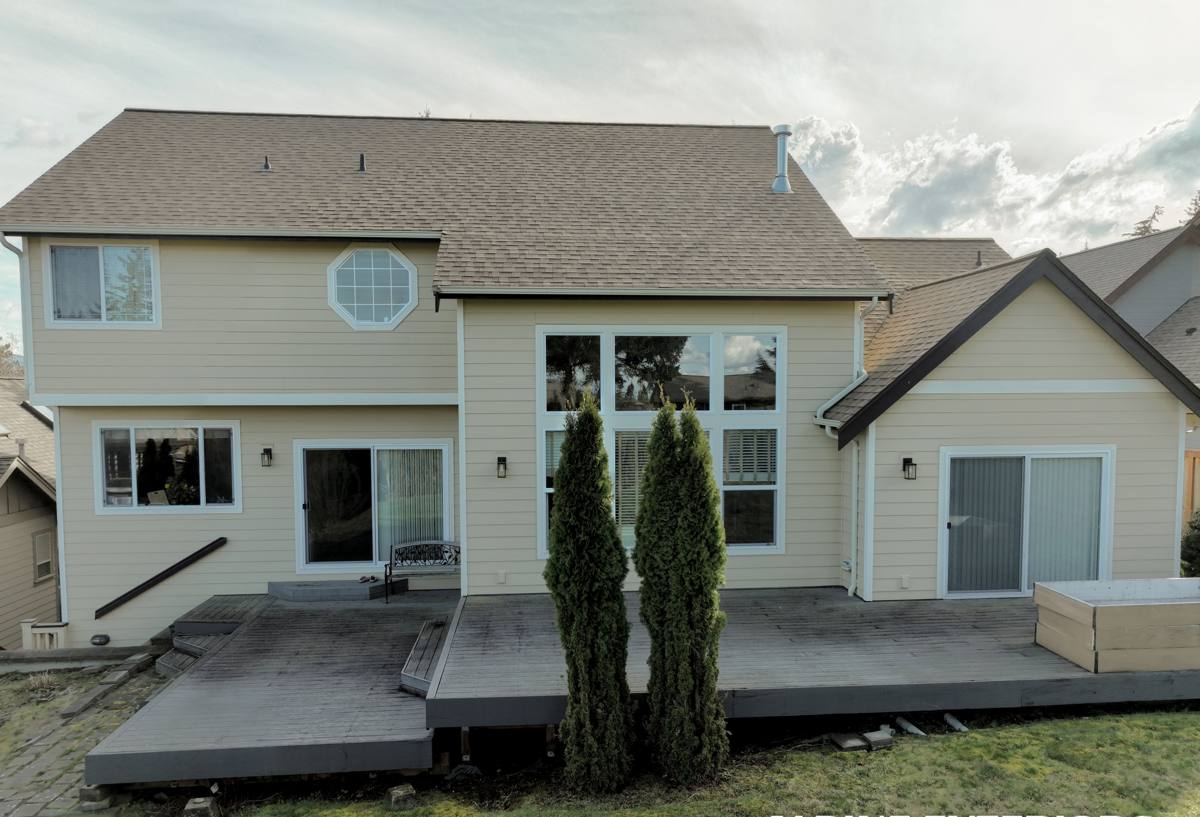
What Salt Air, Driving Rain, and Moss Season Actually Do to a Deck
Every coastal deck problem we get called out for near Semiahmoo traces back to one of three things:
Salt-laden air
Airborne salt accelerates corrosion on anything metal — screws, joist hangers, structural brackets, railing hardware. Standard coated fasteners can start to fail from the inside out long before the deck surface shows any wear, which is why fastener and hardware choice matters as much as the decking board itself.
Driving, sideways rain
Rain here doesn't just fall straight down. Wind off the water pushes it under railings, into ledger connections, and against the house band board at odd angles. A deck built without real flashing and drainage detailing will trap that water against the structure instead of shedding it, which is where rot in the framing underneath a perfectly good-looking composite deck usually starts.
Long, low-light, damp seasons
Shade from surrounding trees plus a wet Pacific Northwest fall and winter add up to a long stretch where deck surfaces simply don't dry out fast. That's the recipe for moss and algae film, especially in north-facing corners and under furniture that never gets moved. It's a surface and traction issue, not just a cosmetic one — a mossy composite deck gets slick.
None of this means composite decking is a bad fit for Peace Arch — the opposite is generally true. It means the installation has to actually account for these conditions instead of following a generic build.
Why Composite Makes Sense in This Environment
We install wood decking too, and it has its place. But for a lot of Peace Arch properties — especially anything close to the water, shaded, or low-maintenance by preference — capped composite decking solves problems that wood decking in this climate never fully solves. Here's the honest comparison:
| Material | Salt Air / Moisture Behavior | Maintenance Needed | Typical Lifespan Here |
|---|---|---|---|
| Capped composite | Sealed outer layer resists moisture absorption and salt staining; won't rot | Periodic washing, no staining or sealing | Long-term, backed by manufacturer warranty |
| Uncapped / older-generation composite | Can absorb moisture at the surface, more prone to mold and fading over time | More frequent cleaning, watch for surface wear | Shorter than capped composite in wet climates |
| Pressure-treated wood | Absorbs water, prone to cupping and splitting under repeated wet/dry cycles | Annual cleaning and re-staining/sealing | Shorter, with more visible wear near the water |
| Cedar | Naturally rot-resistant but still absorbs moisture; grays and softens with UV and salt exposure | Regular sealing to hold color and resist moisture | Moderate, maintenance-dependent |
We steer most Peace Arch clients toward capped composite for exactly the reasons in that table — not because wood or older composite products are bad, but because the maintenance and moisture trade-offs don't favor them in a marine climate like this one.
What a Correct Installation Actually Involves
The board is the least of it. Most of the deck's long-term performance is decided before a single composite plank goes down.
Substructure and framing
Joists, beams, and posts need to be sized and spaced for the specific composite product being used — composite has different span ratings than wood, and undersized framing leads to bounce and premature board sag. We use fasteners and structural hardware rated for coastal/corrosive environments, not standard interior-grade hardware, given the salt air here.
Ledger flashing and water management
Where the deck attaches to the house, proper flashing has to direct water out and away from the band board and rim joist — this is the single most common failure point we find on older decks in this area, and it's invisible until it isn't.
Drainage and airflow underneath
Composite decks need airflow beneath the boards to shed the moisture that driving rain pushes underneath. Blocked or poorly ventilated substructures trap dampness, which shows up as mold on the underside of boards and around fasteners even when the visible surface looks fine.
Fastening method
Hidden fastener systems keep the surface clean and reduce the number of exposed metal points where salt air can start corrosion. Fastener spacing and picture-framing (border boards) also affect how the deck handles expansion and contraction through temperature swings.
Railing and post connections
Railing posts are a common weak point — improperly blocked or flashed post connections let water into the structure at exactly the point where it's hardest to inspect later.
Our Process, Start to Finish
- On-site assessment: We look at sun/shade exposure, drainage slope, existing structure (if it's a replacement), and how exposed the site is to wind-driven rain off the bay.
- Board and layout recommendation: Based on that assessment, we recommend a board type, color, and layout suited to the specific exposure — a shaded, north-facing deck gets different guidance than an open, sun-exposed one.
- Structural plan: Framing, hardware, and flashing details get specified before any demo or build starts, not decided on the fly.
- Demo (if replacing an existing deck): We check the ledger connection and framing underneath for hidden rot before proceeding — this is often where we find the real reason the old deck needed replacing.
- Build: Framing, flashing, drainage, then decking, railing, and any trim or fascia.
- Walkthrough: We go over the finished deck and basic care with the homeowner before calling the job done.
Choosing Boards and Color for This Environment
Darker composite boards absorb more heat, which can be a factor on decks that get full afternoon sun — but on a lot of Peace Arch lots with tree cover, heat is less of a concern than moisture and mold visibility. Lighter and mid-tone boards tend to show less contrast when moss film or water spotting develops between cleanings, which matters on shaded decks that don't dry out quickly. We'll walk through the realistic look of a few options on your specific site rather than just handing over a color chart — sun exposure and shade patterns vary a lot from lot to lot even within the same neighborhood.
Maintaining a Composite Deck in Peace Arch's Climate
Composite decking is genuinely lower-maintenance than wood, not maintenance-free. In this climate, a little seasonal attention goes a long way:
- Sweep debris and organic buildup (leaves, needles, pollen) regularly — trapped organic matter is what feeds moss and algae growth
- Wash the deck surface a few times a year with a soft-bristle brush and a composite-safe cleaner, more often in shaded or north-facing areas
- Keep gutters and downspouts near the deck clear so runoff isn't dumping extra water onto the deck surface or substructure
- Check railing posts and fastener points periodically for any sign of movement or corrosion at metal connections
- Avoid pressure-washing at close range or high pressure, which can damage the board's cap layer over time
- Move planters and furniture occasionally so moisture and moss don't build up unnoticed underneath
Mistakes We See on Existing Decks in This Area
When we're called out to look at a failing deck near Semiahmoo, a handful of issues come up again and again: standard interior-grade fasteners used outdoors near the water, missing or improperly lapped ledger flashing, framing spaced for wood rather than the composite product installed on top of it, and little to no airflow beneath the deck surface. Individually, any one of these might not cause an immediate problem — combined with a few wet Whatcom County winters, they compound into rot, corrosion, or a soft, uneven deck surface well before the composite boards themselves have worn out.
Why Local Experience with This Area Matters
A deck built to a generic spec sheet and a deck built for Peace Arch's specific exposure to salt air and driving rain off Semiahmoo Bay are not the same project, even if the same composite product goes on top. Crews who work this area regularly know which sites need extra attention to drainage and hardware, which shaded lots will need moss-resistant color and layout choices, and where ledger and railing connections tend to fail first in a marine climate. That local pattern recognition is the difference between a deck that needs attention again in a few years and one that doesn't.
If you're planning a new composite deck or need to replace one that's showing its age, we're happy to take a look and give you an honest read on what your site needs. There's no cost and no pressure for an estimate — use the form below to get started.