 Semiahmoo Siding
 Decks along the Cherry Point shoreline take a beating that decks twenty miles inland never see. Salt-laden air corrodes fasteners from the inside out, driving rain finds every gap in a ledger board or joist, and a moss season that can run eight months or more turns walking surfaces slick and traps moisture against wood that should be drying out. We repair decks in Cherry Point regularly, and the pattern is consistent: the damage almost always starts at connection points and low-airflow areas long before it's visible on the surface.
This page is about deck repair specifically for Cherry Point homes — what the local climate does to a deck, what an honest repair actually involves, and how we approach the work so it holds up rather than needing to be redone in a few years.
What Cherry Point's Climate Does to a Deck
Whatcom County's marine climate is the single biggest factor in how a deck ages here, and Cherry Point sits close enough to the water that salt air is a daily reality, not an occasional event. Three things compound on each other:
- Salt air corrosion — standard fasteners and connectors that would last decades in a drier, inland climate can start rusting within a few years near the water. Corroded fasteners lose holding strength quietly, often before any visible sign shows up on the deck surface.
- Driving rain and wind-driven moisture — rain here doesn't just fall straight down; wind pushes it sideways into ledger connections, under railings, and into end grain that isn't sealed. Water that gets in and can't drain or dry out is what causes rot, not rain itself.
- Long moss season — shaded, north-facing, or low-airflow decks can stay damp for months at a time. Moss and algae hold moisture against the wood surface, which accelerates decay and makes boards dangerously slick underfoot.
None of these are unusual or alarming on their own — they're just the baseline conditions a deck in this part of Whatcom County has to be built and maintained for. A deck that was framed and fastened without that in mind will show problems years earlier than one that was.
Why Problems Often Start Underneath, Not On Top
Homeowners usually notice a deck problem because a board feels soft, springy, or looks discolored. But by the time that's visible, the underlying framing, ledger connection, or fasteners have usually been compromised for a while. Surface boards are the easiest part to replace — the framing, flashing, and connections underneath are where a repair either holds or fails again.
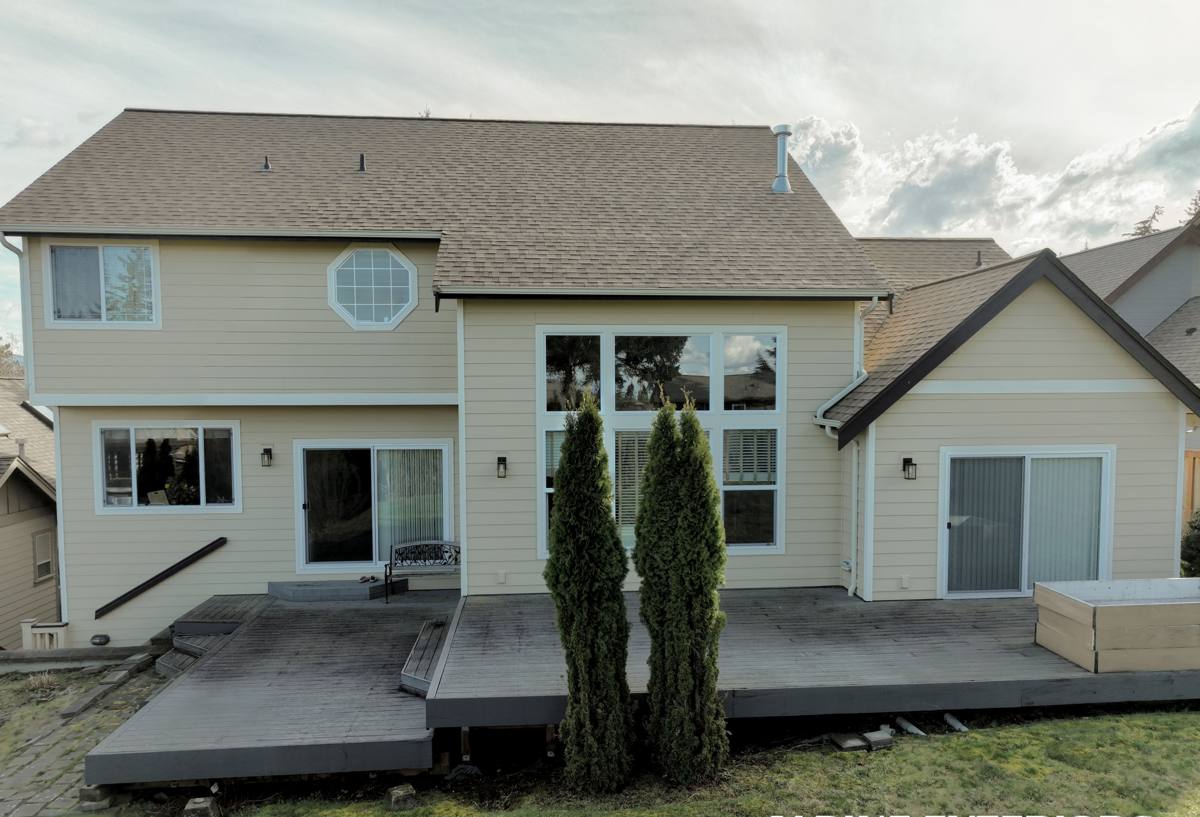
Common Deck Problems We See in Cherry Point Homes
Every deck is different, but the failure patterns in this area repeat often enough that we can generally tell what we're dealing with before we even start pulling boards.
- Soft or spongy decking boards — usually moisture trapped underneath from poor drainage or a lack of gaps between boards for airflow.
- Rusted or failing fasteners — screw heads that snap off, nails that have lost their grip, or joist hangers with visible rust and pitting.
- Ledger board rot — the ledger (where the deck attaches to the house) is one of the most common failure points because flashing details are often missed or degrade over time, letting water track behind the siding and into the framing.
- Moss and algae buildup — beyond being slippery, moss holds moisture directly against the wood fibers, which speeds up decay in exactly the spots it grows thickest.
- Cupped, warped, or split boards — repeated wet-dry cycling causes wood to move; boards that weren't properly spaced or fastened will cup, warp, or split over a few seasons.
- Loose or wobbly railings and posts — post bases at deck level trap water easily and are a common spot for hidden rot, since they're rarely inspected closely.
Repair or Replace? How to Tell the Difference
Not every deck problem means starting over, and not every "just replace a few boards" job is actually a complete fix. The honest answer depends on how far the damage has spread and whether it's cosmetic or structural.
| Situation | Usually Repairable | Usually Needs Replacement |
|---|---|---|
| Decking boards | A handful of isolated soft or damaged boards | Widespread cupping, splitting, or soft spots across most of the deck |
| Ledger board | Localized rot caught early, with sound framing behind it | Rot has spread into the rim joist or house framing |
| Support posts / footings | Surface weathering, minor checking | Soft wood at ground contact, footing movement, or undersized posts for current code |
| Railings | Loose balusters, single failed post | Widespread wobble, rot at multiple post bases, or non-code spacing |
| Fasteners/hardware | Scattered corrosion, deck otherwise sound | Hardware corroded throughout, or wrong-grade fasteners used originally |
Cost is driven far less by square footage than by how much of the structure underneath is affected. A deck that looks rough on the surface but has sound framing is often a modest repair. A deck that looks fine on top but has a rotted ledger or failing posts is a bigger job — and that's exactly why an honest inspection matters more than a quick surface estimate.
What a Proper Deck Repair Actually Involves
A repair that's done right addresses the cause of the damage, not just the symptom. Here's what that looks like in practice:
1. Full Structural Inspection
Before any board comes off, we check the framing, ledger connection, flashing, post bases, and fastener condition — not just the parts that look bad from the top. This is where we find the problems that would otherwise come back in a year or two.
2. Ledger and Flashing Correction
If the ledger board or its flashing is the source of water intrusion, that gets corrected as part of the repair — replacing a few decking boards without fixing a bad ledger connection just delays the same failure.
3. Framing and Fastener Replacement
Any joists, posts, or hangers that have lost structural integrity get replaced, and fasteners get upgraded to a grade suited for a marine, salt-air environment rather than whatever standard hardware may have been used originally.
4. Decking Board Replacement
Damaged boards are replaced with proper spacing for drainage and airflow — a detail that's easy to shortcut but is one of the main things that determines whether the new boards last.
5. Moss, Algae, and Surface Treatment
Existing moss and algae are cleaned off surfaces being retained, and any treatment needed to slow regrowth in shaded or low-airflow areas is addressed as part of the job, not left for the homeowner to manage separately.
6. Sealing and Finish
Exposed end grain, fastener heads, and new lumber get sealed appropriately for the wood or composite material used, since unsealed wood in this climate starts absorbing moisture almost immediately.
Materials and Hardware: Why Grade Matters Here
In a salt-air environment, the specification of the hardware often matters more than the specification of the decking material itself. Standard galvanized fasteners can start showing corrosion within a few years this close to the water, while stainless steel or properly rated hot-dip galvanized hardware is built to hold up to salt exposure over the long term. We use fastener and connector grades matched to a marine climate as a standard practice, not an upgrade.
On decking material itself, both wood and composite have real trade-offs worth understanding honestly:
- Pressure-treated wood — lower upfront cost, requires ongoing sealing/staining to perform well in this climate, and is more sensitive to installation quality (spacing, fastening) than composite.
- Composite decking — higher upfront cost, doesn't rot, but still requires proper substructure ventilation and the correct fastening system — composite decking installed without adequate airflow underneath can trap moisture against the framing below it just the same as wood.
- Cedar and other naturally rot-resistant woods — a common regional choice for its appearance and natural resistance, but it still needs correct fastening and periodic sealing to get full value from that resistance.
We'll walk through these trade-offs honestly for your specific deck rather than defaulting to whichever material is easiest to sell — the right choice depends on your budget, how much maintenance you want to do, and how exposed the deck is to sun, shade, and weather.
Our Process, Start to Finish
| Step | What Happens |
|---|---|
| 1. Free Estimate | We inspect the deck in person — framing, ledger, fasteners, and surface — and explain what we find in plain terms. |
| 2. Written Scope and Quote | You get a clear breakdown of what needs repair versus replacement, and why, before any work starts. |
| 3. Scheduling | We plan the work around weather where possible, since structural repairs go better in dry conditions. |
| 4. Repair Work | Structural fixes first, then decking, railings, and finish work, in that order. |
| 5. Cleanup and Walkthrough | Site is cleaned up and we walk the finished deck with you before calling the job done. |
Maintenance Checklist for Cherry Point Deck Owners
Regular upkeep is what keeps a repaired deck from needing the same work again. A few habits go a long way in this climate:
- Sweep off moss, algae, and debris regularly, especially in shaded or low-airflow areas
- Check that gutters and downspouts aren't dumping water directly onto or under the deck
- Inspect fasteners and hardware once a year for early rust or corrosion
- Look closely at the ledger board connection where the deck meets the house
- Reseal or restain wood decking on the manufacturer's recommended schedule, not just when it looks faded
- Keep planters, rugs, and furniture that trap moisture off the deck surface for extended periods
- Check post bases and any wood-to-ground contact points for softness
Warning Signs Worth Calling About Sooner Rather Than Later
Some issues are worth a call before they turn into a bigger repair: springy or soft-feeling boards, visible gaps or staining at the ledger board, rust streaking near fasteners, or a railing that's developed any wobble. Catching these early is usually the difference between a modest repair and a much larger one.
Why Hiring a Crew That Already Works in Cherry Point Matters
Deck repair isn't the same job everywhere. A crew that mostly works inland doesn't see salt-air fastener corrosion or a moss season this long on a regular basis, and it shows in the choices they make — the hardware they default to, how much attention they pay to ledger flashing, and whether they treat moss and moisture control as part of the repair or an afterthought. We work on decks in this climate regularly, which means the inspection catches what's actually likely to be a problem here, and the repair is specified for the conditions the deck will actually face, not generic conditions.
It also means straightforward answers. If a repair is enough, we'll tell you that. If the framing underneath is compromised and a repair would just be a temporary patch, we'll tell you that too, along with why.
Get a Free, No-Pressure Estimate
If your deck in Cherry Point is showing soft spots, rust at the hardware, persistent moss, or just feels less solid than it used to, we're happy to take a look and give you a straight assessment of what it needs. There's no obligation and no pressure — just an honest read on what's going on and what it would take to fix it right. Use the form below to request your free estimate.