 Semiahmoo Siding
 Bellingham's Siding Problem Isn't Like Everywhere Else's
Homes in Bellingham sit in a specific overlap of conditions: close enough to Semiahmoo Bay and the Salish Sea to catch salt-laden air, exposed to the driving, wind-pushed rain that rolls in off the water for much of the year, and shaded enough by the region's tree cover and cloud cover that moss and algae have a long, uninterrupted season to establish themselves on any surface that stays damp. Any one of those conditions is manageable. Together, they punish siding materials that aren't built to handle all three at once.
We install siding for homes across this stretch of Whatcom County, and Bellingham comes with a fairly consistent set of failure patterns: caulk joints that gave up years before the siding did, wood or engineered-wood products that swelled and softened at the bottom courses, and painted surfaces that needed re-coating every few years just to keep the moss from taking hold. This page is about what fiber cement siding done correctly looks like for a Bellingham home, and why the details of the install matter more here than in a drier, calmer climate.
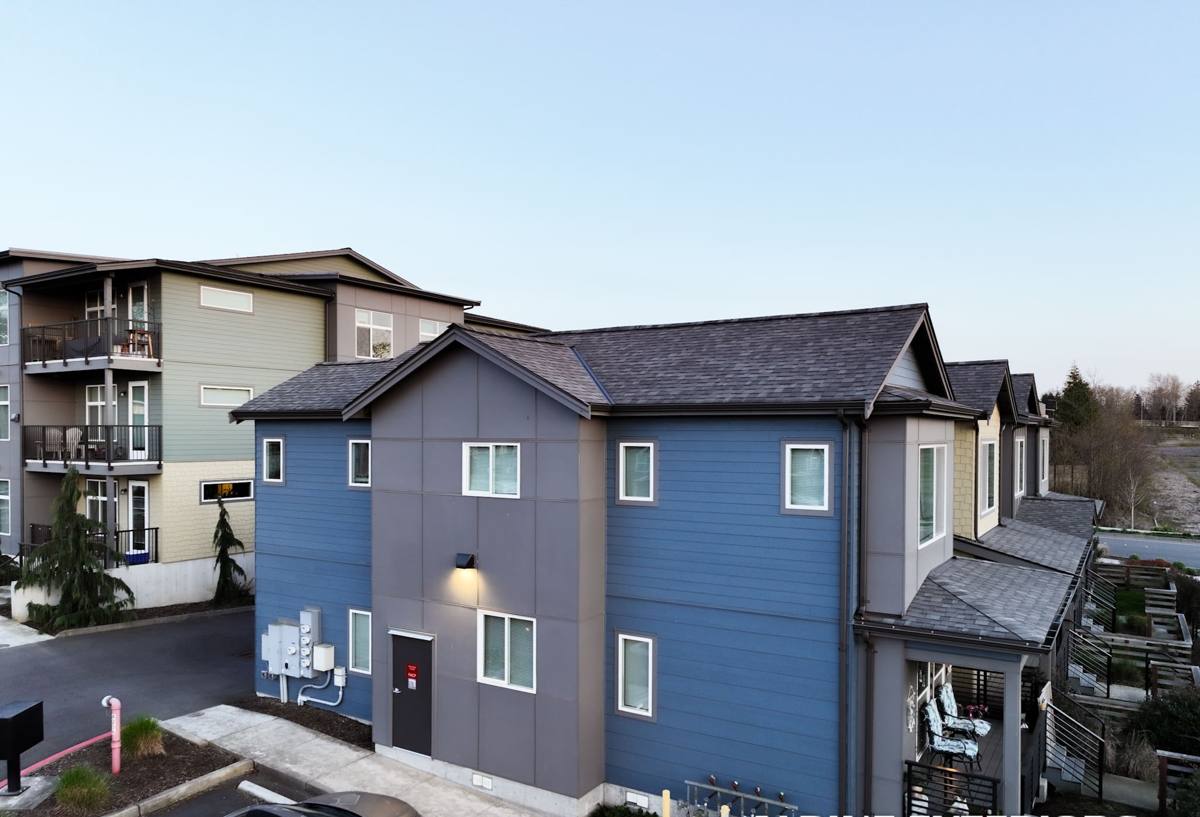
What the Local Climate Actually Does to Siding
Salt Air
Airborne salt from the bay doesn't just affect homes right on the water. It travels on wind and settles on siding, trim, and fasteners across a wide radius, especially on homes with west- or southwest-facing exposure that catch weather coming off the Salish Sea. Salt accelerates corrosion in exposed metal fasteners and trim, and it interacts with certain paint and coating systems in ways that shorten their service life.
Driving Rain
Bellingham doesn't just get a lot of rain — it gets a lot of wind-driven rain, which behaves differently than a straight-down shower. Driving rain gets pushed sideways and upward into laps, seams, and penetrations that a calmer climate's siding details would never have to deal with. This is why water management behind the siding (not just the surface finish) is the single biggest factor in how long a siding job lasts here.
A Long Moss and Algae Season
Cool temperatures, shade, and consistent moisture add up to a moss and algae season that runs far longer than in most of the country. Any siding surface that holds moisture, has a porous or textured finish, or sits in constant shade becomes a candidate for green and black growth within a few years if the material and finish aren't resistant to it.
Why Fiber Cement Is the Right Base Material for This Climate
Fiber cement is cement, sand, and cellulose fiber formed under pressure into a rigid, dimensionally stable board. Compared to wood-based or wood-fiber siding products, it doesn't absorb and release moisture the same way, which matters enormously in a climate that stays damp for months at a stretch. It won't rot, it doesn't feed insects, and it's non-combustible — a genuine advantage during wildfire smoke and ember seasons that have become a more regular part of Pacific Northwest summers.
But "fiber cement" is a category, not a guarantee. The quality of the cement formulation, the factory finish, and how well a specific product line is engineered for a wet coastal climate all vary between manufacturers. That's the gap between a fiber cement product that looks right on install day and one that still looks right in fifteen years.
Why We Only Install James Hardie
We install James Hardie fiber cement siding exclusively. We don't install LP SmartSide, vinyl, or other fiber cement brands, and that's a standard we hold ourselves to, not a claim that every alternative is unusable everywhere. A few reasons this standard matters specifically for a climate like Bellingham's:
- HZ5 engineering: Hardie's HZ product line is formulated for climate zones with cold, wet weather and freeze-thaw cycling — which describes the Pacific Northwest far better than a generic, one-size-fits-all fiber cement formulation does.
- ColorPlus factory finish: the color is baked on at the factory under controlled conditions, rather than field-applied paint that has to cure correctly on a job site in variable weather. A factory finish holds color and resists the kind of surface breakdown that lets moss and algae get a grip.
- Non-combustible core: relevant given the wildfire smoke seasons the region has seen in recent summers, even though Bellingham itself isn't a high fire-risk area the way parts of eastern Washington are.
- A warranty structure built around correct installation: Hardie's transferable warranty assumes the product is installed to their published specs — which is also why installation quality matters as much as the product choice itself.
We're not going to tell you every other siding product is worthless — plenty of them perform fine in the right conditions with the right maintenance. What we will say is that we've standardized on one product system because it lets us guarantee a consistent result on every home we touch, rather than juggling different materials with different moisture behaviors and different failure modes.
What a Correct Installation Involves
Most fiber cement siding failures we get called out to inspect in this area weren't caused by the board itself — they were caused by installation shortcuts that don't show up as a problem until years later. In a climate that pushes rain sideways and grows moss on anything that stays damp, these details aren't optional extras:
Water Management Behind the Siding
A correctly built wall assembly manages water that gets past the siding surface — because in driving rain, some always will. That means a proper weather-resistive barrier, correctly lapped and taped house wrap, and flashing at every window, door, and penetration that directs water back out rather than letting it track behind the siding.
Clearance and Gapping
Hardie's install spec calls for specific clearances from grade, roof lines, decks, and other siding terminations, plus gaps at butt joints and around trim to allow the board to move seasonally without cracking caulk or trapping water. Skipping these clearances is one of the most common shortcuts we see, and it's usually invisible until the siding starts staying wet at the bottom edge.
Fastening
Correct fastener type, spacing, and depth matter for wind resistance and for preventing the kind of loose boards that let water behind the assembly. In a salt-air environment, fastener material also matters — corrosion-resistant fasteners aren't a luxury upgrade here, they're a requirement for the job to hold up.
Caulking and Sealant Limits
Caulk is a maintenance item, not a permanent water seal. A correct install minimizes how much of the water-tightness depends on caulk in the first place, because caulk joints are exactly what fails first under years of driving rain and UV exposure.
Touch-Up and Color Matching
Cut edges and any field-touched areas need to be sealed and color-matched using Hardie's specified touch-up products to preserve both the water resistance and the warranty coverage of the ColorPlus finish.
Cost Factors for a Bellingham Fiber Cement Project
Every home is different, and we don't quote sight unseen — but these are the variables that actually move the price on a fiber cement siding job in this area:
| Factor | Why It Affects Cost |
|---|---|
| Siding profile (lap, shingle, panel) | Shingle and specialty profiles take more labor time to install than standard lap siding |
| Tear-off vs. new construction | Removing old siding and dealing with what's underneath (sheathing condition, existing moisture damage) adds labor and sometimes repair scope |
| Wall complexity | Homes with lots of corners, dormers, and roof intersections need more cutting, flashing, and trim detail than a simple rectangular wall |
| Trim and accessory scope | Corner boards, window and door trim, fascia, and soffit work are often bundled with a siding project and add material and labor |
| Existing moisture damage | Rotted sheathing or framing found once old siding comes off has to be repaired before new siding goes on — this is the most common source of a mid-project cost adjustment |
| Color and finish selection | Standard ColorPlus color options are typically priced differently than premium or custom color selections |
The moisture-damage line item is worth calling out specifically: in a climate this wet, it's common to find some degree of hidden water damage behind older siding, especially at window sills, deck ledgers, and lower wall sections. A trustworthy contractor tells you about it, shows you what they found, and prices the repair honestly rather than covering it up under new siding.
Maintaining Fiber Cement Siding in a Salt Air and Moss Climate
Fiber cement is low-maintenance compared to wood, but "low-maintenance" doesn't mean "no maintenance," especially in this climate. A short annual routine keeps a correctly installed system performing for decades:
- Rinse siding surfaces annually (a garden hose is usually enough) to clear salt residue, pollen, and organic buildup before it becomes a growth surface for moss or algae
- Keep gutters clear so overflow doesn't run down the siding face and keep lower courses perpetually damp
- Trim back vegetation and tree branches that shade siding and restrict airflow, since shaded, still-air areas are where moss establishes first
- Inspect caulk joints at trim and penetrations every year or two and have any cracked or failing caulk replaced before it lets water behind the assembly
- Watch for moss or algae starting at the bottom courses near grade or under eaves and deal with it early with a gentle wash rather than pressure-washing, which can drive water behind the siding
- Have a professional check flashing and clearances at grade, decks, and roof lines if you notice any siding staying visibly damp longer than the surrounding wall
Why a Local Crew Matters for This Job
Fiber cement installation isn't exotic — it's a well-documented system with a published spec. But applying that spec correctly depends on understanding how a specific home sits in a specific climate exposure. A crew that works Bellingham regularly already knows which elevations take the worst of the driving rain, which lots stay shaded enough to need extra attention to ventilation and moss resistance, and which older homes in the area are likely to have moisture issues waiting behind the existing siding. That local pattern recognition doesn't replace following the manufacturer's install spec — it's what makes sure the spec gets applied where it actually matters on your home, not just checked off as a formality.
It also means a crew that's still reachable years after the job is done — for a warranty question, a maintenance question, or simply a second opinion on something you're noticing on the siding.
If you're planning a siding project in Bellingham or anywhere else in the Semiahmoo area, we're happy to take a look at your home, walk you through what correct James Hardie installation looks like for your specific exposure, and provide a free, no-pressure estimate — just fill out the form below.