 Semiahmoo Siding
 Bellingham Decks Face a Different Kind of Wear
A deck in Bellingham doesn't fail the same way a deck in a dry inland climate does. Here, the damage is slow and comes from three directions at once: salt-tinged air rolling in off the water, long stretches of driving rain that find every gap in a joint or fastener, and a moss season that can stretch from October through May. None of these things destroy a deck overnight. They work on it quietly, year after year, until a board that looked fine in summer turns soft underfoot by the following spring.
Most of the deck repair calls we get in Whatcom County aren't dramatic collapses. They're homeowners who noticed a spongy spot near the stairs, a railing post that wiggles more than it used to, or dark streaks running down the fascia board. Catching those early is the difference between a repair that costs a few hundred dollars and one that turns into a full rebuild.
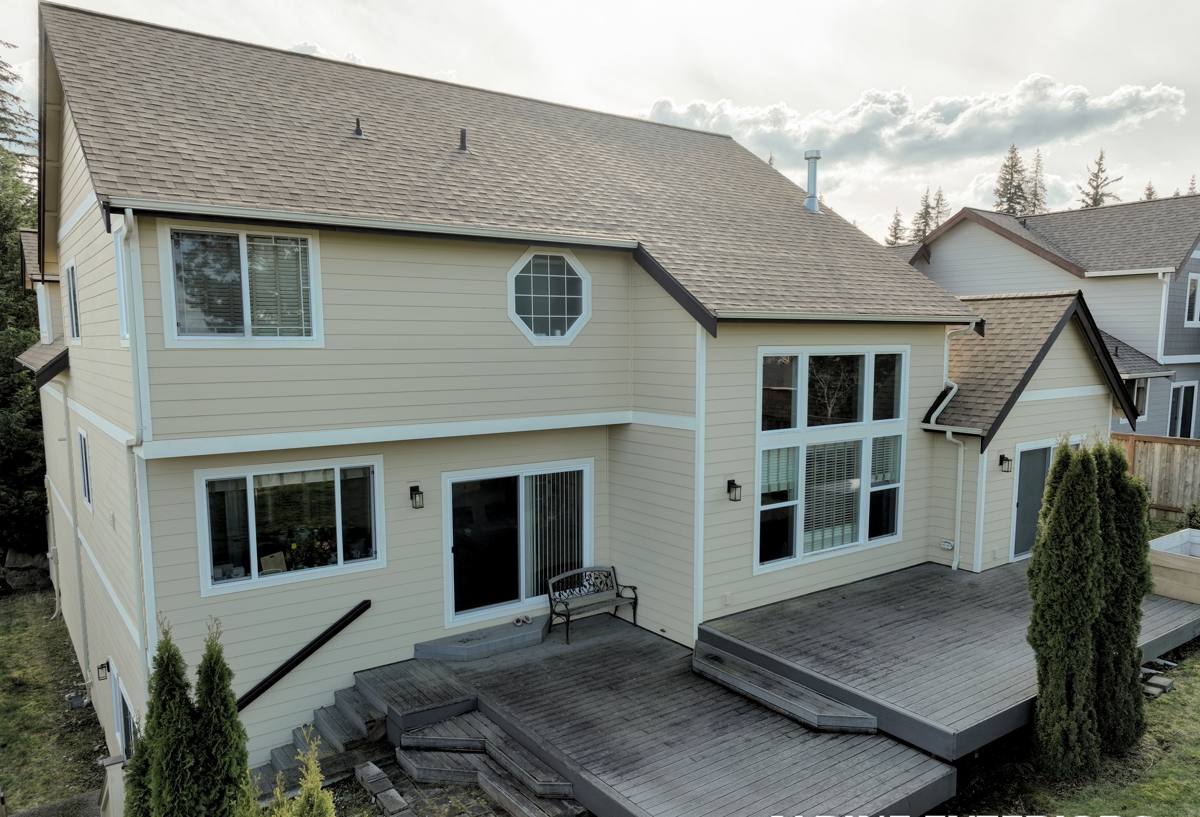
Signs Your Deck Needs Attention
Decks rarely fail all at once, so it helps to know what early trouble actually looks like:
- Soft or springy decking boards, especially near the house or along the perimeter
- Rust streaks below fastener heads or around joist hangers
- Railings or posts that flex more than they should when you lean on them
- Gaps opening up where the deck meets the house (the ledger board connection)
- Persistent green or black growth on boards that stays damp for days after rain
- Stair stringers that feel uneven or bounce when you walk down them
- Visible daylight or separation between deck boards and the framing underneath
If you're seeing more than one or two of these, it's worth having someone look underneath the deck, not just at the surface. Surface staining is often the least of it — the framing and connections below are where structural problems actually start.
What's Really Going On Underneath
Ledger Board and Structural Connections
The ledger board — where the deck attaches to the house — is the single most important connection on the whole structure, and it's also the one most exposed to water intrusion if flashing was installed poorly or has failed over time. In a climate with as much sustained rain as Whatcom County gets, a poorly flashed ledger can trap moisture against the house framing for months without anyone noticing until the board is already compromised.
Fasteners and Hardware
Older decks, or decks built with the wrong grade of hardware, often show corrosion around nails, screws, and joist hangers well before the wood itself fails. Salt-laden coastal air accelerates this. Once fasteners start to rust and lose their grip, the boards they're holding start to move independently of the frame, which is usually what creates that springy, unstable feeling.
Decking Boards and Moss Growth
Moss and algae aren't just cosmetic. They hold moisture against the wood surface and keep boards from ever fully drying between rain events, which speeds up rot from the top down. Shaded decks under trees or on the north side of a house are especially prone to this, and a long moss season here means boards can stay damp for weeks at a stretch.
Railings and Stairs
Railing posts take a lot of lateral stress and are often under-attached even on decks that are otherwise sound. Combined with moisture at the base where posts meet the deck frame, this is one of the more common repair points we find — and one of the more important ones, since it's a safety issue, not just a cosmetic one.
Repair or Replace: How to Think About It
Not every deck problem calls for a full rebuild, and not every deck is worth patching. The honest answer depends on how much of the structure is still sound versus how much has been compromised.
| Situation | Repair Usually Makes Sense | Replacement Usually Makes Sense |
|---|---|---|
| Framing and joists | Solid, dry, no rot at connections | Soft or rotted joists, multiple compromised beams |
| Ledger board | Intact, properly flashed | Water damage at the house connection |
| Decking boards | A few boards showing wear or damage | Widespread softness across most of the surface |
| Age of deck | Under 15-20 years, built to code | Older deck, unknown or outdated construction |
| Railings/stairs | Isolated loose posts or treads | Structural flex throughout, undersized original framing |
In a lot of cases the framing underneath is actually in better shape than the decking on top, since boards take the direct beating from rain and moss while joists stay somewhat protected. That's good news, because it usually means a repair — replacing boards, fasteners, and any compromised framing members — can extend the life of a deck significantly without a full teardown.
What a Proper Repair Actually Involves
A repair that only addresses what's visible from the top tends to come back as a problem within a year or two. A repair that holds up in this climate starts underneath.
- Full inspection of the substructure — joists, beams, posts, and the ledger connection — not just the walking surface
- Checking and correcting flashing at the ledger board where it meets the house
- Replacing corroded fasteners and hardware with materials rated for exterior, coastal-adjacent use
- Sistering or replacing any joists or framing members showing rot or soft spots
- Removing and replacing damaged decking boards, matched as closely as possible to existing material
- Addressing moss and algae buildup, including any grading or drainage issues keeping the deck from drying out
- Re-securing railings and stair connections to current safety standards
Skipping the substructure check is the most common shortcut in cheap deck repairs, and it's the one that costs homeowners the most in the long run — you end up paying to fix the same spot twice.
Materials and Fasteners: Our Standard
What a deck is built or repaired with matters as much as the labor. In a wet, salt-influenced climate, we stick to a consistent standard rather than mixing whatever happens to be on hand:
- Fasteners and hardware: stainless steel or hot-dip galvanized rated for exterior and ground-contact use, matched to the decking material to avoid galvanic corrosion
- Flashing: corrosion-resistant flashing at every ledger and post connection, installed to shed water away from the framing, not toward it
- Replacement lumber: pressure-treated lumber rated for ground contact where it's touching or near the ground, with cut ends re-sealed on site
- Composite or capped boards: a reasonable option where moss and moisture have been a recurring problem, though we're upfront that composite has its own maintenance considerations, particularly around cleaning and how it handles standing debris
We don't push one product as a cure-all. Wood, composite, and hybrid approaches each have trade-offs in cost, maintenance, and how they age in a marine climate — we'll walk you through what fits your specific deck rather than defaulting to whatever's easiest to install.
Our Process on a Bellingham Deck Repair
We start with an on-site inspection that includes getting underneath the deck, not just walking the surface. From there we give you a clear picture of what's structural versus cosmetic, and an honest read on repair versus replacement before any work starts. Once you approve a scope, we handle demolition of only the affected sections, address the framing and moisture issues first, then rebuild the visible surface, railings, and stairs to match. We clean up thoroughly and walk the finished repair with you before calling it done.
Seasonal Deck Care Between Repairs
A repaired deck lasts longer with a little regular attention, especially given how long the wet season runs here:
- Sweep leaves and debris off the deck surface regularly, especially in fall
- Rinse off moss and algae buildup before it has a chance to establish, particularly on shaded areas
- Check that gaps between boards stay clear so water can drain instead of pooling
- Inspect railings and stair connections once or twice a year for looseness
- Look underneath the deck occasionally for signs of new staining or soft wood near the ledger
- Keep planters and furniture that trap moisture off the deck surface for long stretches
Why Hire a Crew That Already Works This Area
Deck problems in Whatcom County follow patterns that aren't always obvious to a crew that mostly works drier inland climates. Knowing where moisture tends to collect on a coastal-influenced deck, how fast moss reestablishes here, and which fastener grades actually hold up against salt air isn't guesswork — it's something you learn from doing this work repeatedly in Bellingham and the surrounding area. That local experience shows up in the details: where we check for hidden rot first, how we flash a ledger board, and which repairs we know will actually hold through another wet winter instead of needing to be redone.
If you've got a deck showing any of the signs above, or you just want an honest opinion on whether it needs repair or replacement, we're happy to take a look. Reach out for a free, no-pressure estimate using the form below.