 Semiahmoo Siding
 Siding Repair Built for Custer, Not a Generic Checklist
Siding repair sounds like a small job until you're the one standing in front of a soft board or a stretch of cracked trim trying to figure out whether it's a quick fix or the first sign of something bigger. In Custer, that call is harder to make than it is in a lot of the country, because this stretch of Whatcom County near Semiahmoo Bay puts more stress on exterior walls than a typical inland climate does. We repair siding on Custer homes regularly, and this page is about what that actually involves — not a generic list of siding tips, but what correct repair work looks like on properties dealing with this specific combination of salt air, driving rain, and a moss season that barely takes a break.
Repair work gets treated as an afterthought by a lot of contractors — something you squeeze in between bigger installation jobs. We don't run it that way. A repair done wrong doesn't just fail to fix the problem, it can trap moisture behind the wall and make the eventual full re-side more expensive than if nothing had been touched at all.
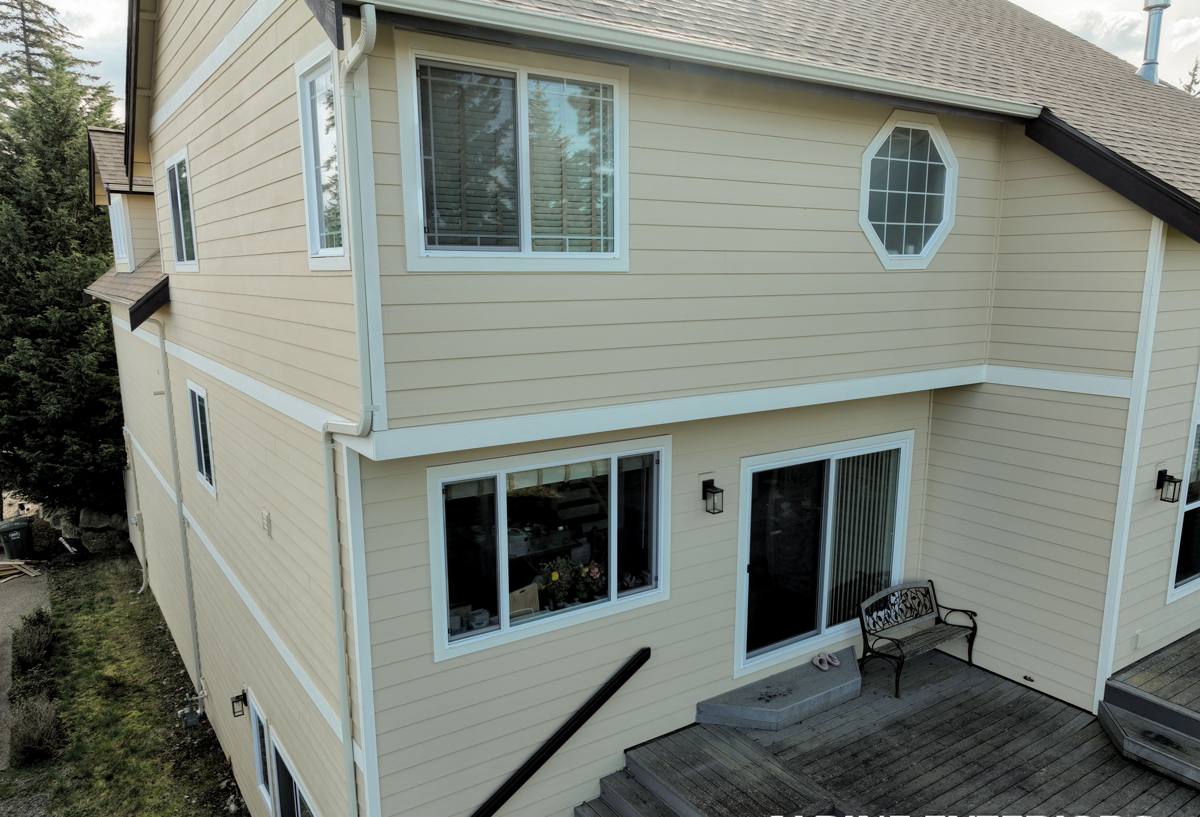
What Semiahmoo-Area Weather Does to a Wall Over Time
Salt Air Off the Bay
Custer sits close enough to Semiahmoo Bay and Drayton Harbor that salt-laden air reaches most properties in the area, not just the ones with a water view. Salt speeds up corrosion on fasteners, trim hardware, and flashing, and it breaks down lower-grade paints and finishes faster than they'd fail in a drier climate. A repair that ignores this — using the wrong fastener, or a caulk and touch-up paint that isn't rated for salt exposure — tends to fail again within a few seasons.
Driving, Wind-Pushed Rain
Rain out here doesn't fall straight down for much of the year. Wind pushes it sideways into lap joints, under trim, and into any seam where the water management wasn't detailed correctly the first time. That's exactly where most of the repair calls we get originate — not from flat, open wall surfaces, but from corners, penetrations, and trim lines where wind-driven rain had years to find a weak point.
A Long Moss Season
Mild temperatures and steady moisture keep moss and mildew active across most of the calendar on shaded, tree-lined Custer lots. Organic growth on a siding surface holds moisture against the wall behind it, and that's a slow, compounding problem — by the time it's visible from the ground, it's often been working on the material underneath for a while.
The Repair Calls We Get Most Often in Custer
- Cracked or split boards near window and door corners, usually from either a settling issue or moisture that got behind the material and pushed it apart from the inside
- Soft or spongy sections near grade, under downspouts, or anywhere water regularly runs down the wall face
- Failed caulk joints and open seams around trim, windows, and corner boards, which is one of the most common entry points for wind-driven rain
- Storm and impact damage from falling branches or wind-blown debris, which is common on wooded Custer lots
- Persistent moss or dark staining that keeps returning shortly after cleaning, usually on north-facing or shaded walls
- Loose panels or popped fasteners where sustained wind exposure has worked hardware loose over time
What a Correct Repair Actually Involves
The visible damage is rarely the whole story. A repair that only addresses what you can see from the ground, without checking what's happening behind it, tends to be a short-term fix rather than a real solution.
| Step | Why It Matters in This Climate |
|---|---|
| Check moisture levels behind the damaged area, not just at the surface | Wind-driven rain often travels further into the wall than the visible damage suggests |
| Confirm the sheathing and framing behind the repair are sound | Custer's wet-season exposure means rot can be present even when the siding face looks intact |
| Match material profile, reveal, and finish where possible | Mismatched repairs stand out and can create new water-shedding problems at the transition |
| Re-flash and re-seal penetrations and joints correctly, not just cosmetically | Prevents the same failure from recurring in the next storm season |
| Use fasteners and sealants rated for salt-air, marine exposure | Standard hardware corrodes faster this close to Semiahmoo Bay |
Skipping any of these steps doesn't necessarily show up right away. It shows up eighteen months or two winters later, as the same problem, usually a little worse than before.
Repair or Replace? How We Help You Decide
Not every repair call ends in a repair, and not every visible problem means a full re-side is necessary. We walk the property and give a straight read on which side of that line the job actually falls on.
| Usually a Repair | Usually Points Toward Replacement |
|---|---|
| Isolated damage — one section, one wall, one storm event | Multiple walls showing the same failure pattern independently |
| Sound sheathing and framing behind the damaged area | Soft or rotted sheathing found in more than one spot during inspection |
| Caulk, flashing, or fastener failures with no widespread moisture intrusion | Recurring interior moisture signs — musty smell, soft drywall, staining |
| Siding that's otherwise within its expected service life | A finish that's failing broadly across the house, not just at one spot |
An honest answer here matters more than it sounds like it should. Patching a wall that actually needs replacement usually buys a year or two at best, and the cost of that patch doesn't come off the eventual re-side.
What Repairs Typically Cost
Cost depends heavily on scope. A small, isolated repair — one damaged board, one section of trim, a handful of caulk joints — is usually a modest job measured in a few hundred dollars. Repairs that involve rotted sheathing, extensive re-flashing, or matching discontinued or hard-to-source material profiles run higher, sometimes into the low thousands, before it makes more sense to talk about replacing the affected wall section outright. We give a firm number after seeing the actual damage, not a phone estimate based on a description.
If Your Existing Siding Isn't James Hardie
We install James Hardie fiber cement exclusively, but a lot of the repair calls we get in Custer are on homes with vinyl, engineered wood, or cedar siding that was there before the current owner, or installed by someone else. We're upfront about how we handle that: we'll repair what's there when a repair is the honest answer, using compatible material and correct technique, even though it isn't the product we install on new work. What we won't do is pretend a patch on a wood-based or vinyl system solves a moisture problem that the material itself is structurally prone to. If the underlying issue is the material's long-term fit for this climate rather than an isolated failure, we'll say so directly, and talk through what a Hardie re-side would look like as the longer-term fix — without pressure either way.
How Our Repair Process Works
- Inspection. We walk the exterior, check the damaged area from both outside and, where possible, from inside the wall cavity, and test moisture levels rather than guessing from a visual look.
- Diagnosis and quote. We tell you what we found, whether it's a repair or something bigger, and give a clear, itemized quote before any work starts.
- Material matching. For Hardie repairs, we source matching profile and ColorPlus finish where available. For other materials, we use compatible product and disclose upfront if an exact match isn't possible.
- The repair itself. Damaged material comes out, the sheathing and framing behind it get checked and addressed if needed, and the new section goes in with correct flashing, fastening, and sealing for this climate.
- Cleanup and walkthrough. We clear debris and walk the finished repair with you before calling the job done.
Why Hiring a Crew That Already Works Custer Matters
A contractor who mostly works drier, inland markets can still do competent general carpentry, but they haven't necessarily seen how fast wind-driven rain finds a weak seam on a Semiahmoo-area property, or how quickly moss re-establishes on a shaded Custer wall after a surface cleaning. That familiarity changes what gets checked during an inspection and what gets prioritized in a repair. A crew that's already out in this specific stretch of Whatcom County knows which details tend to fail here first, because we've seen the pattern repeat across multiple properties, not just read about it. That's the difference between a repair that holds and one that's back on the schedule in two years.
A Quick Checklist Before You Call
- Note where the damage is — near grade, at a corner, around a window or door, or on a shaded wall — it helps us prioritize the inspection
- Press-test any soft-looking area gently with your hand; note whether it gives or feels spongy
- Check whether the issue is isolated to one spot or showing up in more than one place on the house
- Look inside along the same exterior wall for musty smells, staining, or soft drywall
- Avoid caulking over a damaged area yourself before an inspection — it can hide what an inspector needs to see
- Have any past siding or roofing work info handy if you know when the current siding was installed
If you're dealing with damaged, cracked, or soft siding on a Custer home, we're glad to come take a direct look and give you a straight answer — repair, or something more — with no pressure either way. Reach out using the form below to schedule a free estimate.