 Semiahmoo Siding
 Building a Deck That Actually Holds Up in Bellingham
A deck in Bellingham does a different job than a deck almost anywhere else in the country. It's not just an outdoor living space — it's a structure that has to shed water for eight or nine months of the year, resist the slow creep of salt-laden air off Bellingham Bay and the Strait, and stay usable even when moss and algae want to claim every horizontal surface. We build custom decks for homeowners throughout Bellingham and the surrounding Whatcom County area, and almost every callback we get on someone else's deck traces back to the same root cause: it was built like a deck in a dry climate, not a deck in a marine one.
This page is about doing it right the first time — the materials that actually make sense here, the parts of the structure that matter more than people think, and what our process looks like from the first conversation to the final walk-through.
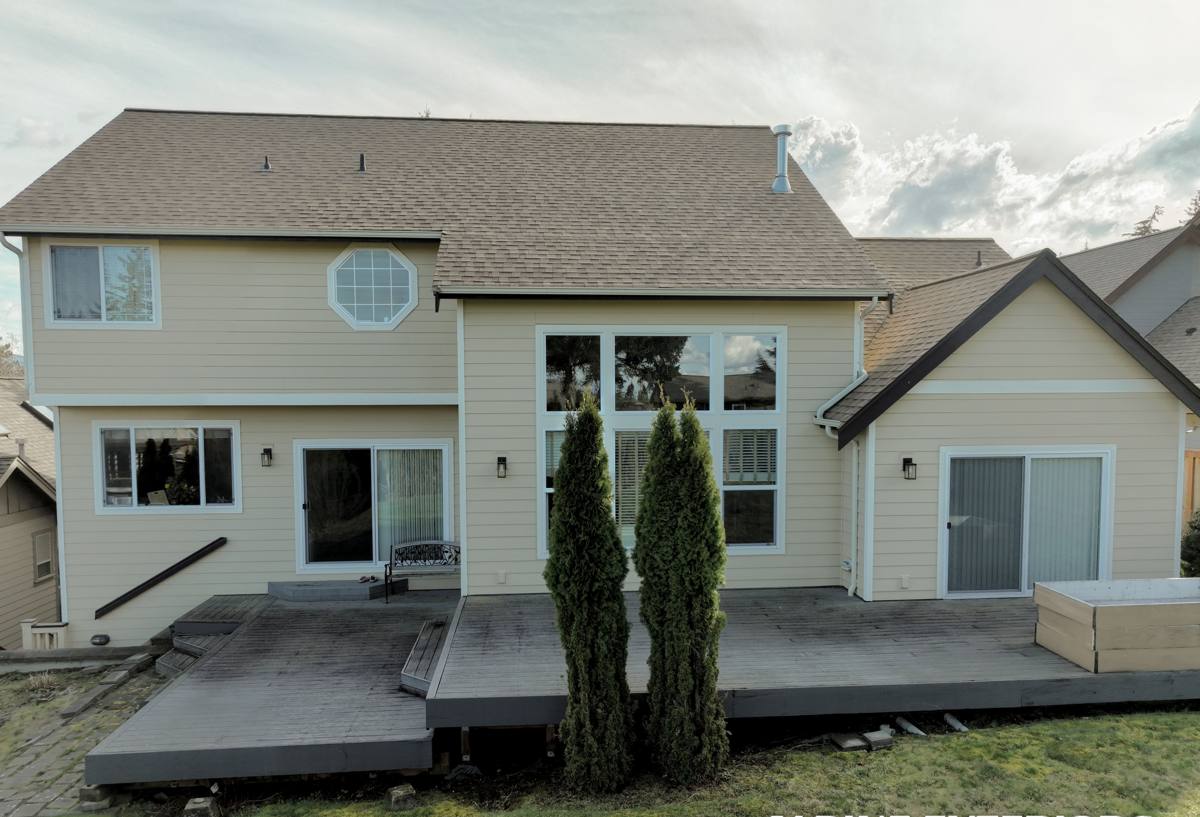
What Whatcom County Weather Actually Does to a Deck
Three things drive almost every deck problem we see in this region:
- Driving rain. Storms off the water don't just fall straight down — wind-driven rain gets pushed sideways into railings, ledger connections, and any joint that isn't properly flashed or sealed.
- Salt air. Proximity to Semiahmoo Bay, Bellingham Bay, and the Strait means airborne salt accelerates corrosion on fasteners, hardware, and any metal component that isn't rated for it. A screw that would last decades inland can rust and stain within a few seasons here.
- A long moss season. Cool, damp, and shaded conditions for much of the year mean moss, algae, and mildew get a head start on any deck surface that doesn't drain and dry quickly. Once moss takes hold on boards or framing, it holds moisture against the wood and speeds up rot.
None of these are exotic problems, and none of them require exotic solutions — they require a builder who designs for them from the ground up instead of treating them as an afterthought.
Choosing the Right Decking Material for This Climate
There's no single "best" decking material — there's a best material for your budget, your maintenance tolerance, and how much sun or shade your particular yard gets. Here's how the common options actually compare once you factor in Bellingham's conditions:
| Material | How it handles our climate | Maintenance | Typical lifespan here |
|---|---|---|---|
| Pressure-treated fir/pine | Affordable, but absorbs moisture readily and needs consistent sealing to resist rot and moss staining in shaded, damp spots | Annual cleaning and re-sealing recommended | 10-15 years with upkeep |
| Cedar | Naturally rot- and insect-resistant, ages to a silver-gray patina, but still needs cleaning to keep moss from gaining a foothold in shaded areas | Periodic cleaning, optional staining | 15-20+ years with care |
| Composite decking | Doesn't absorb water the way wood does, resists rot outright, and is far less hospitable to moss growth — a strong fit for our wet, shaded lots | Occasional washing, no staining/sealing | 25-30 years, often with a manufacturer warranty |
| PVC/capped polymer | Fully synthetic, essentially immune to moisture damage and rot; performs well in constant dampness and salt air | Occasional washing | 25-30+ years |
For homes with a lot of shade from mature trees, low airflow, or proximity to the water, we usually steer clients toward composite or PVC decking simply because moss and moisture are a losing battle against untreated or lightly-treated wood in those conditions. For open, sunnier lots with good airflow, a well-maintained cedar deck can still be the right call — especially if you like the look and don't mind the upkeep.
Why We're Selective About Certain Wood Products
Some lower-grade treated lumber and thin veneer wood products look fine on day one but aren't built for sustained wet-dry cycling. Our standard is to only install decking-grade material rated for exterior, high-moisture use, and to be upfront when a product a homeowner has seen online isn't going to hold up to a Whatcom County winter — not because the product is inherently bad, but because it's the wrong tool for this specific climate.
The Structure Underneath: Where Decks Actually Fail
Homeowners usually judge a deck by the surface boards, but the framing, footings, and connections underneath are what determine whether a deck lasts 10 years or 30. This is also where cutting corners is easiest to hide — and hardest to catch after the fact.
Footings and Posts
Footings need to be sized and set below frost depth and bear on undisturbed or properly compacted soil. In our wetter clay and till soils, undersized or shallow footings are a common cause of decks that settle unevenly within a few years.
Ledger Attachment
Where a deck attaches to the house, the ledger board and its flashing are the single most water-sensitive connection on the entire structure. Improperly flashed ledgers let wind-driven rain track behind the siding and into the house framing — a slow, expensive problem that often isn't discovered until there's visible rot or a soft spot in the floor above.
Joist Protection and Hardware
Joists should be protected with a proper flashing tape at the top edge, not just left as raw cut lumber. All structural hardware — joist hangers, post bases, screws, and bolts — should be rated for the type of treated lumber being used and for exterior/coastal exposure, since standard hardware corrodes faster in salt air.
Fasteners and Hardware: The Detail That Determines Rust and Staining
This is one area where we don't cut costs, because the failure is so visible and so preventable. Fasteners rated for coastal or high-moisture exposure cost more up front but avoid the rust streaking, black staining, and eventual hardware failure that comes from using standard-grade screws and brackets near salt air. If you've seen a deck with dark streaks running down from every screw head, that's a fastener mismatch — not something inherent to the wood.
Drainage, Airflow, and Keeping Moss Off the Deck Long-Term
Moss doesn't grow because a deck is "old" — it grows because moisture is sitting somewhere it shouldn't. A few design choices make a real difference over the life of the deck:
- Proper board spacing so water drains through rather than pooling on the surface
- Grading and drainage below the deck so water doesn't collect and wick back up into framing
- Adequate clearance and airflow underneath, especially for low, ground-level decks in shaded yards
- Avoiding dead-end corners and tight-against-the-house layouts that trap damp air and debris
- Gutter and downspout placement that doesn't dump roof runoff directly onto or under the deck
Even the best material will grow moss eventually if water has nowhere to go. Good drainage and airflow buy you years between cleanings and slow the rate at which moss returns after each one.
Our Process, Start to Finish
- On-site consultation. We walk the yard, look at drainage, sun/shade exposure, and how the deck will connect to the house, and talk through how you'll actually use the space.
- Design and material selection. We lay out size, shape, railing style, and material options based on your budget and how much maintenance you want to take on long-term.
- Written estimate. A clear, itemized quote — no vague allowances that turn into surprise change orders.
- Permitting. We handle the permit application and inspections required for your jurisdiction so the deck is built to code, not just built to look right.
- Construction. Footings, framing, ledger flashing, decking, and railing, built in that order with inspections at the structural stages.
- Final walk-through. We go over the finished deck with you, including basic care so you know what to expect in year one versus year ten.
Permits and Code in Whatcom County
Most decks above a certain height or attached to the house require a building permit, whether the property is inside Bellingham city limits or in unincorporated Whatcom County — the specific thresholds and process vary by jurisdiction. Skipping the permit step might save time up front, but it creates real problems later: unpermitted structures can complicate a home sale, and uninspected framing and ledger connections are exactly the kind of thing that fails quietly over years rather than obviously on day one. We pull the required permits as part of the job rather than leaving that step to the homeowner.
Maintenance: What Bellingham Deck Owners Should Actually Do
Maintenance needs depend heavily on material choice, but a few habits apply across the board in this climate:
- Clear leaves, needles, and debris from the deck surface and between boards each fall before the wet season sets in
- Rinse or sweep off moss and algae as soon as it appears rather than letting it establish
- Check ledger flashing and railing connections annually for any sign of water intrusion or loose hardware
- Re-seal or re-stain wood decking on the schedule recommended for that specific product — don't wait until it looks obviously weathered
- Keep gutters and downspouts clear so roof runoff isn't draining onto or under the deck
- Trim back overhanging vegetation to improve airflow and sun exposure on shaded sections
Composite and PVC decking cut down on most of this list, but even those materials benefit from an occasional wash to keep organic growth from taking hold in grain textures and gaps.
Why Hiring a Crew That Already Works in Bellingham Matters
A lot of deck problems we're called out to repair weren't built by incompetent crews — they were built by capable builders working from a playbook that doesn't account for this specific climate. A framer who mostly works drier inland regions may not default to coastal-rated fasteners, may under-detail ledger flashing because it's rarely tested by wind-driven rain, or may not think about moss and drainage as a design consideration rather than a cleaning problem.
Working regularly in Bellingham and the surrounding Whatcom County area means we're not guessing at how a deck will hold up here — we're building to conditions we deal with directly, on a coastline where salt air, rain, and moss aren't occasional issues but standing expectations for anything left outdoors year-round.
Ready to Talk Through Your Deck Project?
If you're planning a new deck or replacing one that's showing its age, we're happy to come take a look, talk through material options that fit your yard and budget, and give you a straightforward estimate — no pressure, no obligation. Use the form below to get started.