 Semiahmoo Siding
 Ferndale's Siding Problem Isn't Like Inland Washington's
Ferndale sits close enough to Semiahmoo Bay and the Strait of Georgia that homes here deal with a different mix of punishment than siding fifty miles inland. It's not one big threat — it's three smaller ones working together, year-round, for years on end.
First is salt-laden air moving off the water. It doesn't take a storm to carry it; a normal onshore breeze is enough to deposit fine salt residue on siding, trim, and fasteners over time. Second is driving rain — Whatcom County doesn't just get rain, it gets rain pushed sideways by wind, which finds every gap, lap, and unsealed seam that vertical rain would never reach. Third is moss. Ferndale's tree cover, humidity, and long stretch of overcast, damp months from fall through spring give moss and algae months at a time to establish themselves on north-facing walls, under eaves, and anywhere siding stays shaded and slow to dry.
None of these three is dramatic on its own. Together, over a decade or two, they're exactly what separates siding that still looks good from siding that's swelling, staining, or rotting at the laps.
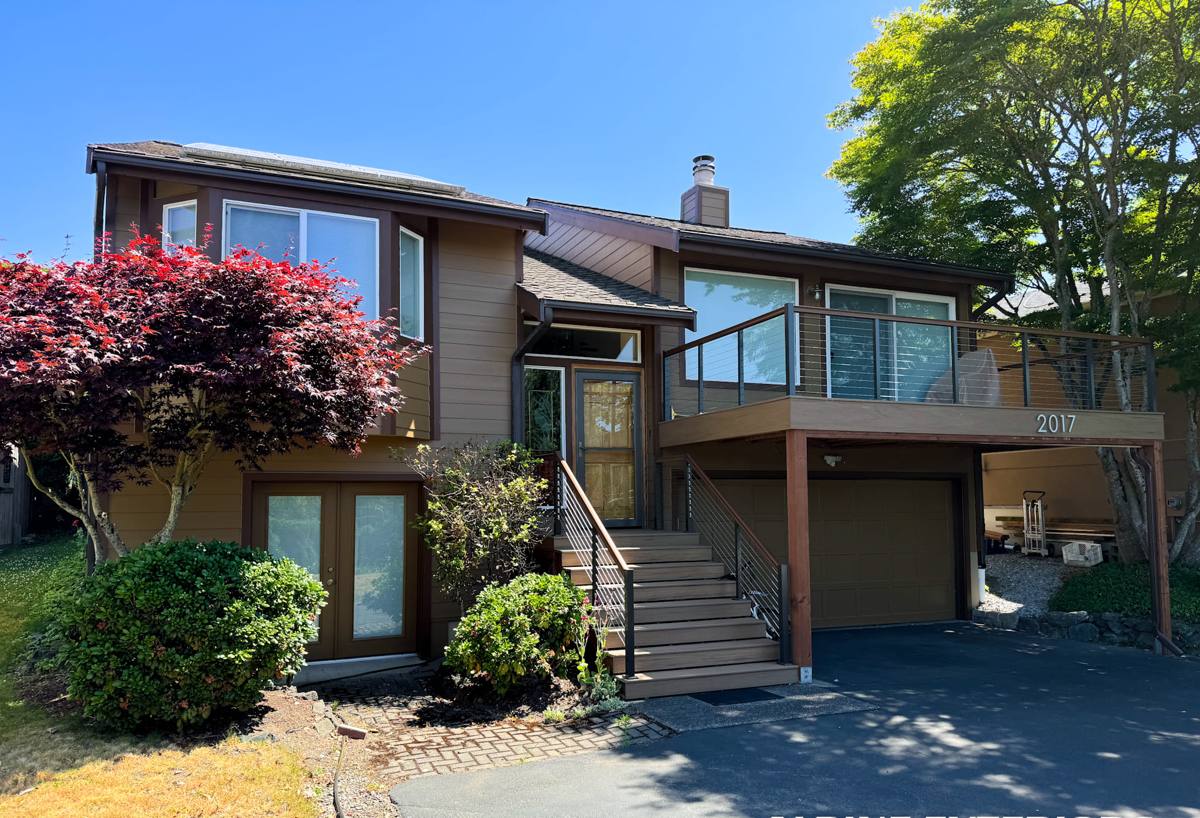
Why This Climate Rules Out Certain Siding Products
We install James Hardie fiber cement exclusively — we don't install vinyl, LP SmartSide, Cemplank, Allura, primed spruce, or cedar. That's not a marketing position, it's a standard we hold ourselves to based on how those products actually perform under Ferndale's specific combination of salt, wind-driven rain, and sustained damp shade.
Wood-based products — cedar and OSB-core engineered wood like LP SmartSide — depend on their coatings and sealed edges staying intact to keep moisture out. In a climate where surfaces rarely get a long, uninterrupted dry stretch to fully cure and where moss holds moisture against the wall longer than it would in a drier region, any breach in that protective layer gives water a head start on the wood underneath. Vinyl doesn't rot, but it moves with temperature swings, its seams and J-channels are where wind-driven rain gets pushed through, and it doesn't hold paint if a homeowner later wants a color change. Fiber cement without factory-applied finish (primed spruce trim, some competing fiber cement) puts the coating quality in the installer's or a later painter's hands rather than a factory-controlled process.
James Hardie's fiber cement is engineered from cement, sand, and cellulose fibers — it doesn't feed moss or rot, and it doesn't expand and contract the way vinyl or wood does. Combined with a factory-applied ColorPlus finish, that gives Ferndale homes a siding system where the weak points (seams, fasteners, coating edges) are far fewer and better controlled than on the alternatives.
The Right Hardie Product Line for This Location
James Hardie makes climate-specific formulations, and for Ferndale we specify their HZ5 product line, engineered for regions with prolonged moisture exposure and freeze-thaw cycling — a closer match to Whatcom County's weather pattern than the HZ10 formulation built for hot, humid, high-UV climates. Getting this line correct matters more than most homeowners realize; it's a manufacturing detail that affects how the board resists moisture absorption at the core, not just the surface.
What We Typically Recommend for Ferndale Homes
- HardiePlank lap siding — the standard choice for most Ferndale homes, in a smooth or cedar-textured finish depending on the home's style
- HardieShingle — for homes wanting a shingled or Cape Cod look without the moss and moisture issues that come with real cedar shingles in this climate
- HardieTrim boards at corners, window and door surrounds, and fascia — matched fiber cement trim instead of wood, closing off one of the most common rot-entry points on a home
- HardiePanel for vertical-siding sections, accent walls, or gable ends where that look is called for
What a Correct Installation Actually Involves
Hardie siding's performance record is built on installation to the manufacturer's specification — and in a climate that gives water every opportunity to find a weak point, the difference between a correct install and a rushed one shows up faster here than it would in a drier region.
The Details That Matter Most in a Wet, Salt-Exposed Climate
- Weather-resistant barrier and flashing: A continuous water-resistive barrier behind the siding, with proper flashing at every window, door, and roofline intersection, so any water that gets past the siding has a way out instead of a place to sit
- Correct fastening: Hardie specifies fastener type, placement, and depth precisely — over-driven or under-driven nails compromise both the water seal and the manufacturer's warranty
- Proper clearances: Minimum gaps between siding and roofing, decks, and grade so the bottom edge of the siding isn't sitting in standing water or splashback
- Butt joint and seam treatment: Sealed or flashed correctly at every joint, since horizontal seams are exactly where wind-driven rain gets pushed against the wall here
- Factory-cut edges exposed, field cuts sealed: Field-cut edges need to be primed or sealed per Hardie's specification, or that cut edge becomes the one unprotected spot on the whole wall
Skip any one of these and the siding itself is still good — the installation is what fails, and it fails at the seams, corners, and bottom edges first, which is exactly where Ferndale's combination of rain and salt air does the most work.
Our Process for a Ferndale Hardie Project
We keep the process straightforward because the technical work is where the effort should go, not the paperwork.
- On-site assessment: We walk the home, check current siding and sheathing condition, note moss-prone areas, drainage issues, and any spots where past moisture damage shows — this shapes the scope before we quote it
- Product and color selection: We walk through HardiePlank, HardieShingle, and trim options along with ColorPlus finish colors, so the plan matches both the home's style and this climate's demands
- Tear-off and inspection: Removing the old siding lets us inspect sheathing and framing underneath for hidden moisture damage before anything new goes up — a step that gets skipped by crews trying to move fast, and the one that matters most on an older Ferndale home
- Barrier, flashing, and installation: Weather barrier, flashing, and Hardie siding installed to manufacturer specification, with the fastening and clearance details above followed on every course
- Final walkthrough: We review the finished work with the homeowner and confirm everything meets both Hardie's installation standard and our own
Why a Crew That Already Works Ferndale Matters Here
Siding installation isn't identical everywhere in Whatcom County, and a crew that's worked Ferndale specifically brings a few things a general contractor from farther inland won't have front of mind.
They know which walls on a given lot orientation take the worst of the wind-driven rain off the water, and plan flashing and sealing accordingly instead of treating every elevation the same. They've seen how fast moss re-establishes on shaded, damp walls here and factor that into product and finish recommendations rather than being surprised by it a year later. And they're familiar with the local permitting process and inspection expectations, which keeps a project moving instead of stalling on paperwork a crew unfamiliar with the area might not anticipate.
None of that shows up as a line item on a quote, but it's the difference between siding that's installed correctly for this specific location and siding that's installed correctly for wherever the crew usually works.
Comparing Siding Options for a Ferndale Home
| Factor | Vinyl | Cedar / Wood | James Hardie Fiber Cement |
|---|---|---|---|
| Moss and algae resistance | Moderate — surface growth, doesn't feed it | Low — organic material, feeds growth | High — doesn't feed organic growth |
| Wind-driven rain resistance | Depends on seams and J-channel sealing | Depends entirely on coating and joint maintenance | High when installed to spec, with flashed seams |
| Salt air effect | Can chalk and become brittle over time | Accelerates weathering and coating breakdown | Minimal — non-organic, factory-finished |
| Finish maintenance | No repainting, but color can't change easily | Repainting or restaining every few years | ColorPlus factory finish, repaint interval much longer |
| Typical lifespan in this climate | 20–30 years | 15–25 years with regular maintenance | 30+ years with proper installation and care |
What Ferndale Homeowners Should Budget For
Costs vary by home size, complexity (corners, trim detail, stories), tear-off scope, and product line chosen, so we won't quote a number without seeing the home — but the honest range for a full James Hardie re-side in this region runs from a moderate mid-five-figure project on a smaller single-story home to considerably more on a larger, more detailed two-story house. A free on-site estimate is the only way to get a number that actually applies to your home.
Living With Hardie Siding in Ferndale's Climate
Fiber cement is low-maintenance compared to wood or even vinyl, but "low-maintenance" isn't "no-maintenance" — especially with Ferndale's moss season working against you.
- Rinse siding down once or twice a year, focusing on shaded north and east-facing walls where moss and algae take hold first
- Keep gutters clear so overflow isn't running down the siding face during heavy rain events
- Trim back vegetation and tree cover that keeps a wall shaded and slow to dry — the single biggest factor in how fast moss returns
- Check caulking at trim joints and penetrations every year or two and re-seal if it's cracked or pulling away
- Address any impact damage or cracked boards promptly — a small crack is a quick fix, a neglected one becomes a moisture entry point
Homeowners who stay on top of this short list get the full lifespan out of their siding investment; those who ignore it lose some of the advantage fiber cement has over wood in the first place.
Warranty and What It Actually Covers
James Hardie backs its siding products with a non-prorated limited warranty that's transferable to a future homeowner if the house sells — a real factor in resale value for a home in a market where buyers increasingly ask what the exterior is made of. The ColorPlus factory finish carries its own separate finish warranty covering fading and chipping. Warranty coverage assumes installation followed Hardie's specification, which is one more reason installation quality isn't optional — it's what keeps the manufacturer's warranty valid if something ever does go wrong.
If you're planning a siding project in Ferndale and want a straight answer on what your home actually needs, we'll come take a look and give you a free, no-pressure estimate — no upsell to a product we don't stand behind.