 Semiahmoo Siding
 Composite Decking and the Cherry Point Climate
Cherry Point sits right up against the Salish Sea, and that location shapes everything about how an outdoor deck holds up here. Homes in this part of Whatcom County deal with a specific combination of stresses: salt-laden air blowing in off the water, long stretches of driving rain, and a moss season that can run from early fall through late spring. A deck built without that combination in mind will show problems years before it should — and often in ways that aren't obvious until the damage is already done underneath.
Composite decking has become the default choice for a lot of homeowners in this area, and for good reason. It doesn't absorb water the way wood does, it doesn't need annual sealing, and modern capped boards resist the moss and algae staining that's almost unavoidable on a shaded, damp deck near the coast. But composite is only as good as the substructure and installation underneath it. A composite deck built like a wood deck — same fastener spacing, same drainage assumptions, same lack of ventilation — will still fail early, just in different ways than wood does.
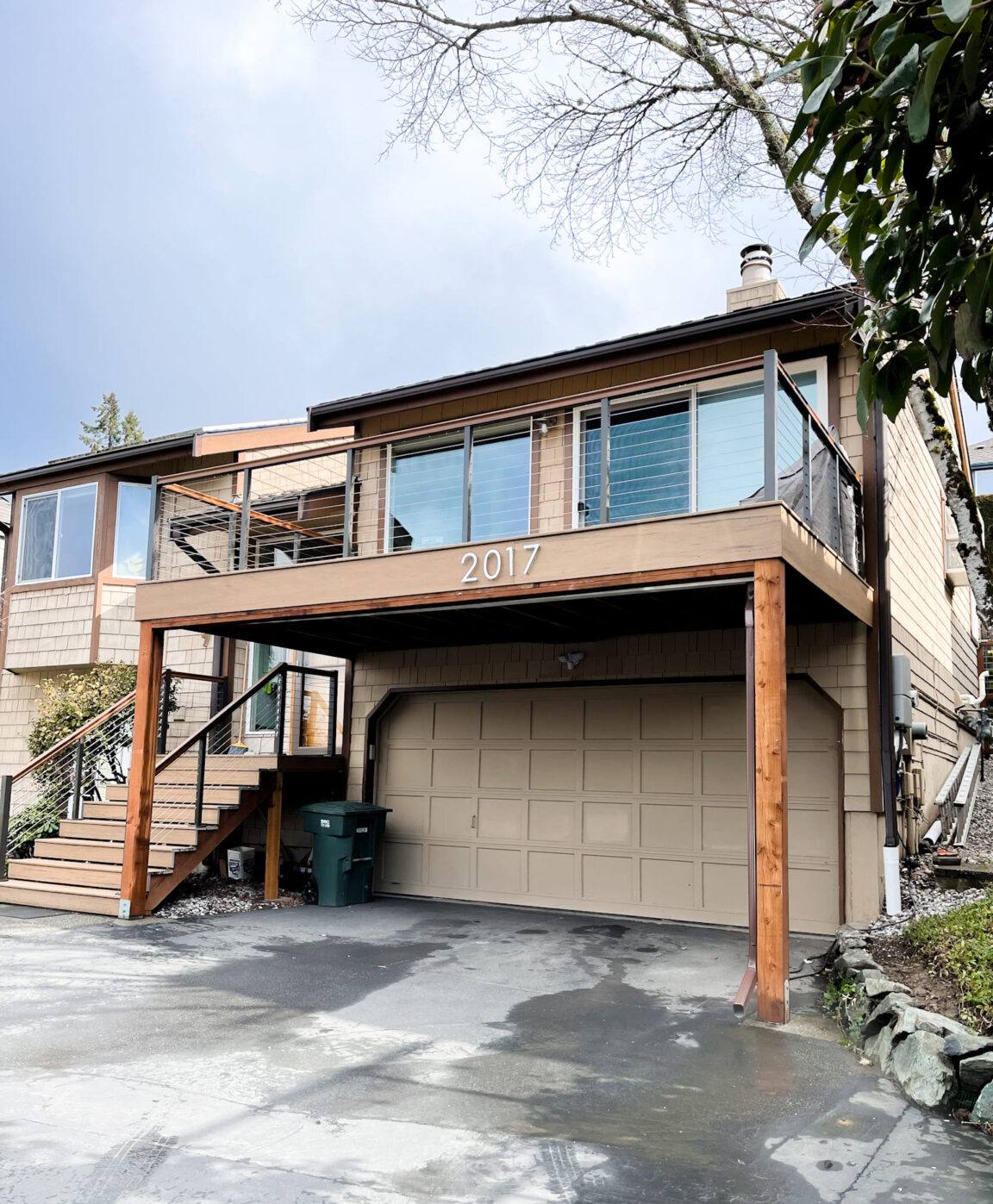
What Salt Air, Rain, and Moss Do to a Deck Over Time
Salt Air and Corrosion
Airborne salt doesn't just affect boats and metal railings near the water — it accelerates corrosion in any exposed fastener, bracket, or ledger connection. Standard fasteners can start rusting and staining a deck's surface well before the boards themselves show wear. This is one of the most overlooked failure points on decks built close to Cherry Point's shoreline.
Driving Rain and Moisture Intrusion
Rain here doesn't fall straight down — wind off the water drives it sideways into ledger boards, under rail posts, and into any gap where flashing was skipped or done poorly. On a wood deck this shows up as rot. On a composite deck, the boards themselves won't rot, but the framing underneath can if it wasn't protected and ventilated properly during the build.
Moss, Algae, and Organic Buildup
A long, wet moss season means any deck surface that stays damp and shaded — under trees, on the north side of a house, in a low-airflow corner — will grow moss and algae. On untreated wood this stains and softens the surface. On composite, it's mostly a surface-cleaning issue, but board spacing, drainage, and gap width all affect how fast it builds up and how easy it is to remove.
Composite, Wood, or PVC: What's Right for a Cherry Point Deck
There's no universally "best" decking material — there's a best material for this specific climate and how a homeowner wants to spend their maintenance time. Here's how the three common options actually compare for a home exposed to salt air, regular rain, and moss.
| Factor | Pressure-Treated Wood | Composite | PVC / Vinyl |
|---|---|---|---|
| Upfront material cost | Lowest | Moderate to higher | Highest |
| Moisture & rot resistance | Low — needs sealing/staining | High — boards don't absorb water | Very high — fully synthetic |
| Moss & algae resistance | Low, stains and pits over time | Good, especially capped boards | Good |
| Maintenance routine | Annual cleaning, sealing, or staining | Periodic washing, no sealing | Periodic washing, no sealing |
| Fastener/corrosion sensitivity | Moderate | Moderate — depends on hardware used | Low |
| Appearance over 10+ years | Fades, grays, splits without upkeep | Holds color well, especially capped | Very consistent, can look less natural |
| Typical lifespan with proper install | 10-15 years before major repair | 25-30 years | 25-30+ years |
Composite tends to be the practical middle ground for most Cherry Point homes — meaningfully lower maintenance than wood, without the higher cost and sometimes less natural look of full PVC systems. Wood still has a place for homeowners who want a specific traditional look and are committed to yearly upkeep, but that upkeep is a real commitment in a climate this wet.
What a Correctly Built Composite Deck Actually Involves
Composite boards get most of the attention, but the substructure underneath does most of the work of keeping a deck sound for decades. In a marine, high-rain climate, a few details matter more than they would somewhere drier:
- Joist spacing built for composite — most composite boards need tighter joist spacing than traditional lumber decking to avoid sagging or bounce over time.
- Corrosion-resistant fasteners and hardware throughout, not just at the visible surface — ledger bolts, joist hangers, and hidden fastener clips all need to hold up to salt air, not just standard exterior-grade coating.
- Proper ledger flashing where the deck attaches to the house, so driving rain can't work its way behind the band board and into the wall assembly.
- Ventilation and drainage under the deck so moisture doesn't sit trapped against joists and framing, which is what actually causes long-term structural problems on a "waterproof" composite deck.
- Correct board gapping for expansion, drainage, and airflow — too tight and water and debris sit on the surface; too wide and it looks sloppy and collects grit.
Skipping any one of these doesn't show up on day one. It shows up in year five or eight, as soft framing under boards that still look brand new on top.
Our Process for Cherry Point Composite Decks
Site Assessment and Design
We start by looking at the specific conditions on your property — sun and shade patterns, prevailing wind and rain exposure, drainage slope, and how close the deck sits to salt air off the water. That assessment shapes hardware choices and board layout before we ever order material.
Substructure and Drainage
This is where most of the long-term performance is decided. We build framing to the spacing composite manufacturers actually require, flash every point where the deck meets the house, and make sure water has somewhere to go instead of sitting against wood framing.
Installation
Boards go down with hidden fastener systems where the product supports it, correct expansion gaps, and attention to how each run terminates at rails, stairs, and the house — the details that determine whether a deck looks clean or shows problems within a couple of seasons.
Finish Details
Fascia, stair details, and railing connections get the same corrosion-aware hardware as the structure itself. A deck that looks great but has a mismatched fastener rusting through the fascia in two years isn't a finished job.
Keeping a Composite Deck Clean Through Moss Season
Composite decking is low-maintenance, not no-maintenance. In a climate that stays wet and shaded for long stretches, a little routine care keeps a deck looking good and prevents surface buildup from becoming a slip hazard.
- Sweep debris off the surface regularly, especially leaves and needles that trap moisture against the boards.
- Rinse the deck periodically with plain water to keep pollen, dust, and early moss spores from taking hold.
- Use a soft-bristle brush and a cleaner made for composite decking on shaded or north-facing areas where moss is more likely to establish.
- Keep gutters and downspouts near the deck clear so runoff isn't dumping extra water onto one section.
- Check railing posts and stair connections once a year for any sign of corrosion or loosening at fastener points.
- Trim back overhanging branches where practical to reduce shade and debris buildup on the deck surface.
Common Mistakes We Fix or Avoid
A lot of the composite deck problems we get called out to look at trace back to a handful of avoidable issues:
Wood-spec framing under composite boards. Composite is heavier and flexes differently than wood decking — framing built to old lumber spacing standards leads to bounce and premature sagging.
No ventilation under low decks. A deck built close to grade without airflow underneath traps moisture against the framing, even though the surface looks dry and fine.
Standard hardware instead of corrosion-resistant hardware. This is a bigger deal near Cherry Point than it would be further inland — salt air will find every piece of untreated or under-rated metal on a structure.
Ignoring expansion gaps. Composite boards expand and contract with temperature and moisture. Boards installed tight against each other or against fixed trim can buckle or push against the house over time.
Why a Crew That Already Works Cherry Point Matters
Decking manufacturers write installation specs for a general climate. A contractor who works this specific stretch of Whatcom County coastline knows where those general specs need to be tightened up — which fastener grades actually hold up to salt air here, which corners of a property see the worst driving rain, and where moss and shade problems tend to concentrate on a given lot. That local pattern recognition is the difference between a deck that's still solid in twenty years and one that needs framing repairs at year eight, hidden under boards that still look new.
It also matters for something more basic: showing up. A crew based near Cherry Point and Semiahmoo can get to a warranty question or a follow-up detail without treating your project as an out-of-the-way stop on a long drive.
Ready for a Deck Built for This Climate
If you're planning a new composite deck, or replacing one that's showing its age faster than it should, we're happy to take a look and give you a straight, no-pressure assessment of what your property needs. The estimate is free, and there's no obligation — just an honest read on what a properly built deck looks like for your home in Cherry Point.