 Semiahmoo Siding
 Siding Built for a Peninsula Cut Off From the Mainland
Point Roberts sits on its own peninsula at the southern tip of the Tsawwassen headland, separated from the rest of Whatcom County by water and from the rest of the continental U.S. by a stretch of Canadian soil. That geography isn't just a trivia point — it shapes almost everything about how a home here weathers, and how a siding project here needs to be planned. Homes on this exclave take on salt-laden wind off Boundary Bay and the Strait of Georgia from multiple directions, with very little inland buffer to slow it down.
Add in a long, damp Pacific Northwest winter, heavy evergreen tree cover on many lots, and a marine layer that keeps humidity high well into what other parts of Whatcom County would call the dry season, and you get siding conditions that are genuinely harder on a wall assembly than most inland Semiahmoo or Blaine properties see. Wood-based products and lower-grade composites tend to show their weaknesses here faster. This page is about what it actually takes to do fiber cement siding right on a Point Roberts home, and why we install it exclusively as James Hardie.
What Point Roberts' Climate Actually Does to a Wall
Salt Air
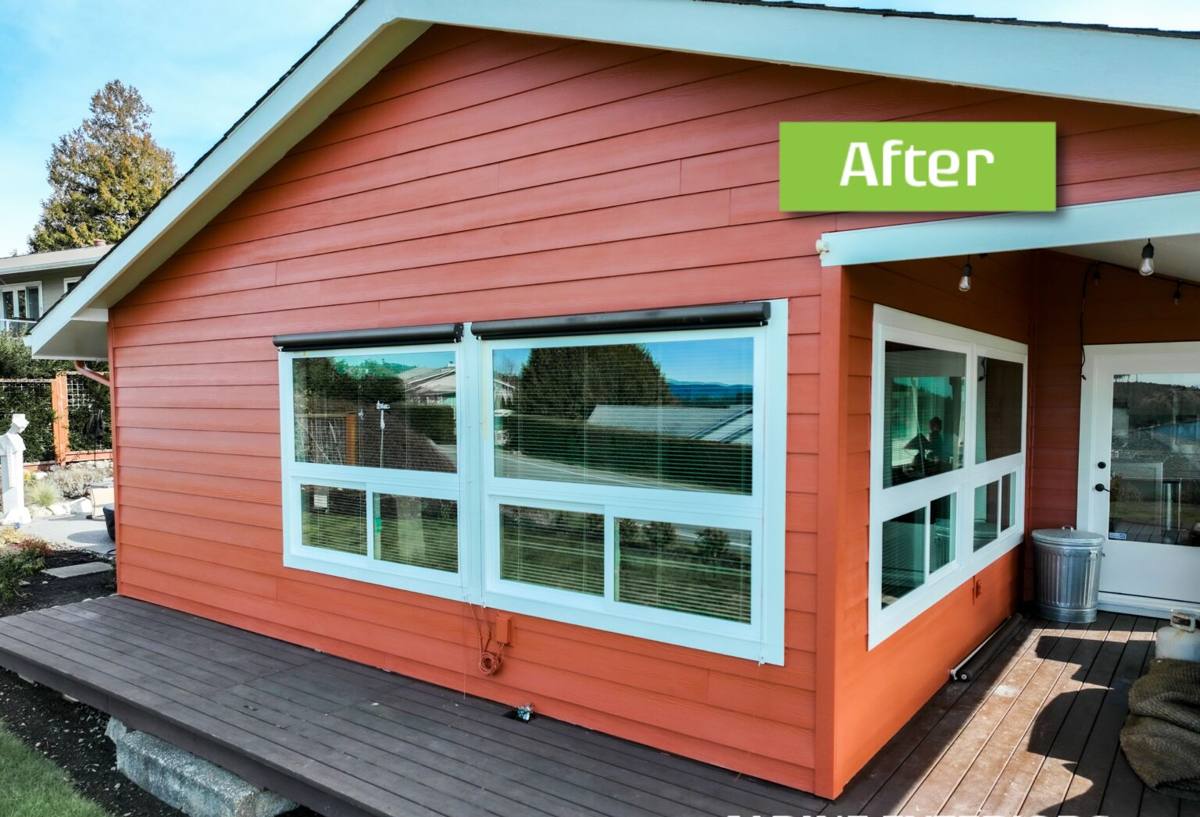
Airborne salt from the surrounding water settles on exterior surfaces and accelerates the breakdown of fasteners, trim, and paint film. On wood and engineered-wood sidings, that means faster edge swelling and finish failure at fastener heads and butt joints. Fiber cement doesn't corrode or absorb salt the way wood fiber can, and James Hardie's factory-applied ColorPlus finish is formulated to hold up under UV and salt exposure far longer than field-applied paint.
Driving Rain
Wind off open water doesn't just fall as rain — it drives sideways into wall assemblies, working its way behind poorly lapped siding, undersized flashing, and gaps at trim and penetrations. This is where installation quality matters more than product choice alone. A correctly lapped, correctly flashed fiber cement wall sheds that water; a rushed install with tight caulk joints instead of proper flashing will eventually let water in no matter what siding is on the outside.
Moss and Algae
Shaded, tree-covered lots — common throughout Point Roberts — stay damp longer after every rain event, which is exactly what moss and algae need to take hold. Moss holds moisture against a wall surface and, on wood or wood-composite siding, feeds ongoing decay. Fiber cement itself doesn't feed mold or rot the way wood does, but a north-facing, shaded wall can still develop surface growth if it's never rinsed. That's a maintenance item, not a structural one — but it matters for how a home looks for the next 30-plus years.
Why We Only Install James Hardie Fiber Cement
We don't carry LP SmartSide, vinyl, Cemplank, Allura, or bare cedar or spruce siding, and on a site like Point Roberts that's a deliberate call, not a limitation of what we know how to install. Fiber cement is non-combustible, dimensionally stable in freeze-thaw and wet-dry cycling, and doesn't rely on a field-applied finish that has to be maintained to keep water out. James Hardie engineers its HardiePlank and HardiePanel lines by climate zone — HZ5 and HZ10 formulations are built around moisture behavior specific to regions like ours, not a one-size-fits-all mix.
The ColorPlus finish system is baked on in a factory environment under controlled conditions, which gives it far more consistent adhesion and UV resistance than a coat of paint applied on a scaffold in variable weather — a real advantage on a peninsula where crews get a narrower weather window than inland jobs. And Hardie's transferable limited warranty is backed by a company with decades of manufacturing history in coastal and marine markets, not just marketing claims about coastal performance.
What a Correct Installation Looks Like Here
The siding product is only part of the equation. On a wind- and rain-exposed site, the install details determine whether that siding lasts 10 years or 40. Our process on Point Roberts homes includes:
- Full removal of failing siding and inspection of the sheathing underneath for hidden moisture damage before anything new goes up
- A weather-resistant barrier installed shingle-style so every seam sheds water downward, with all seams taped or lapped per manufacturer spec
- Correct flashing at every window, door, deck ledger, and roof-to-wall intersection — the spots where driving rain finds its way in first
- Proper starter strip and butt-joint spacing so panels have room to move without opening gaps
- Blind or face nailing per Hardie's fastening schedule for our exposure category, not a generic nailing pattern
- Factory-cut and factory-primed edges wherever possible, with any field cuts back-primed before installation
- Final caulk and touch-up only where Hardie's install guide calls for it — caulk is a detail, not a substitute for flashing
None of this is exotic. It's the difference between following the manufacturer's installation manual to the letter on a house that will take real weather, versus installing the same product with shortcuts that only show up as callbacks two or three winters later.
How Salt Air and Rain Exposure Compare Across the Property
Not every wall on a Point Roberts home takes the same beating. Orientation matters as much as the siding product itself, and it's worth planning around during a re-side.
| Climate Stressor | Where It Hits Hardest | How Correctly Installed Fiber Cement Responds |
|---|---|---|
| Salt-laden wind | Water-facing elevations with no windbreak | Non-corrosive substrate; ColorPlus finish resists salt-driven fade and chalking |
| Wind-driven rain | Corners, window/door trim, any wall facing prevailing storms | Proper flashing and lap sequence sheds water before it reaches sheathing |
| Moss and algae | Shaded, tree-covered, north-facing walls | Doesn't feed decay; surface growth rinses off without damaging the material |
| Freeze-thaw and damp cycling | All elevations through fall and winter | Dimensionally stable fiber cement resists swelling, cracking, and warping |
Why Local Logistics Change How This Job Gets Planned
Because Point Roberts is only reachable by land through Canada, material delivery and crew scheduling can't be treated the same as a job in Blaine or Semiahmoo proper. Border crossing wait times affect when a delivery truck or crew van actually arrives on site, and that has to be built into the schedule up front — not discovered the morning a container of siding is supposed to show up. A crew that hasn't worked this exclave before will often underestimate how much lead time a project needs, which shows up as delays and idle labor days that homeowners end up paying for one way or another.
We also work under the same Whatcom County permitting and building code that governs Semiahmoo and Blaine, so there's no guesswork about inspection requirements — but the physical logistics of getting materials and a crew onto the peninsula, staged, and working efficiently is its own skill set that only comes from doing it repeatedly.
Signs Your Point Roberts Home's Siding Needs Attention
A lot of siding problems on this peninsula develop quietly behind the surface before they're visible from the yard. Worth checking for:
- Soft or spongy spots when you press on siding near the bottom courses or below windows
- Paint that's peeling, bubbling, or chalking faster than it used to, especially on water-facing walls
- Visible gaps opening up at butt joints or trim where caulk has pulled away
- Persistent moss or algae staining that comes back within weeks of cleaning
- Warping, cupping, or delamination, particularly on any wood or composite panel siding
- Musty smell or visible staining on interior walls that share an exterior wall with a rain-exposed elevation
Any one of these on its own isn't necessarily an emergency, but they're worth a professional look before the next storm season adds to the damage.
Our Process, Start to Finish
- On-site inspection of existing siding, trim, and any visible moisture damage, with photos and a written scope
- A straightforward estimate covering material, tear-off, prep, and installation — no vague allowances
- Scheduling that accounts for delivery and crossing logistics specific to Point Roberts, so timelines are realistic from day one
- Full tear-off and sheathing inspection, repairing or replacing any compromised substrate before new siding goes up
- Installation to Hardie's published fastening and flashing specifications for our climate zone
- Final walkthrough so you know exactly what was installed and what maintenance, if any, it needs going forward
Get an Estimate for Your Point Roberts Home
If your siding is showing wear from salt air, driving rain, or a shaded lot's moss season, we're glad to take a look and give you an honest read on what's going on and what it would take to fix it right. Reach out for a free, no-pressure estimate using the form below.