 Semiahmoo Siding
 Window Installation Built for Lynden's Climate, Not Just the Catalog
Lynden sits inland from the Salish Sea, in the Nooksack River valley, but it still gets the full Whatcom County weather package: long stretches of wind-driven rain from fall through spring, heavy morning fog off the river bottoms, and a moss season that seems to start earlier every year. None of that is dramatic on its own. What it does is slow and cumulative — it finds every gap in a window installation that wasn't done right the first time and turns a small oversight into a rotted sill or a moldy jamb a few years down the road.
A window is only as good as its installation. The window unit itself — vinyl, fiberglass, wood-clad — matters less than most homeowners assume. What actually determines whether a window performs for twenty-plus years is how it's flashed, sealed, shimmed, and fastened into the rough opening. That's the part of the job that doesn't show up in a showroom, and it's the part we focus on.
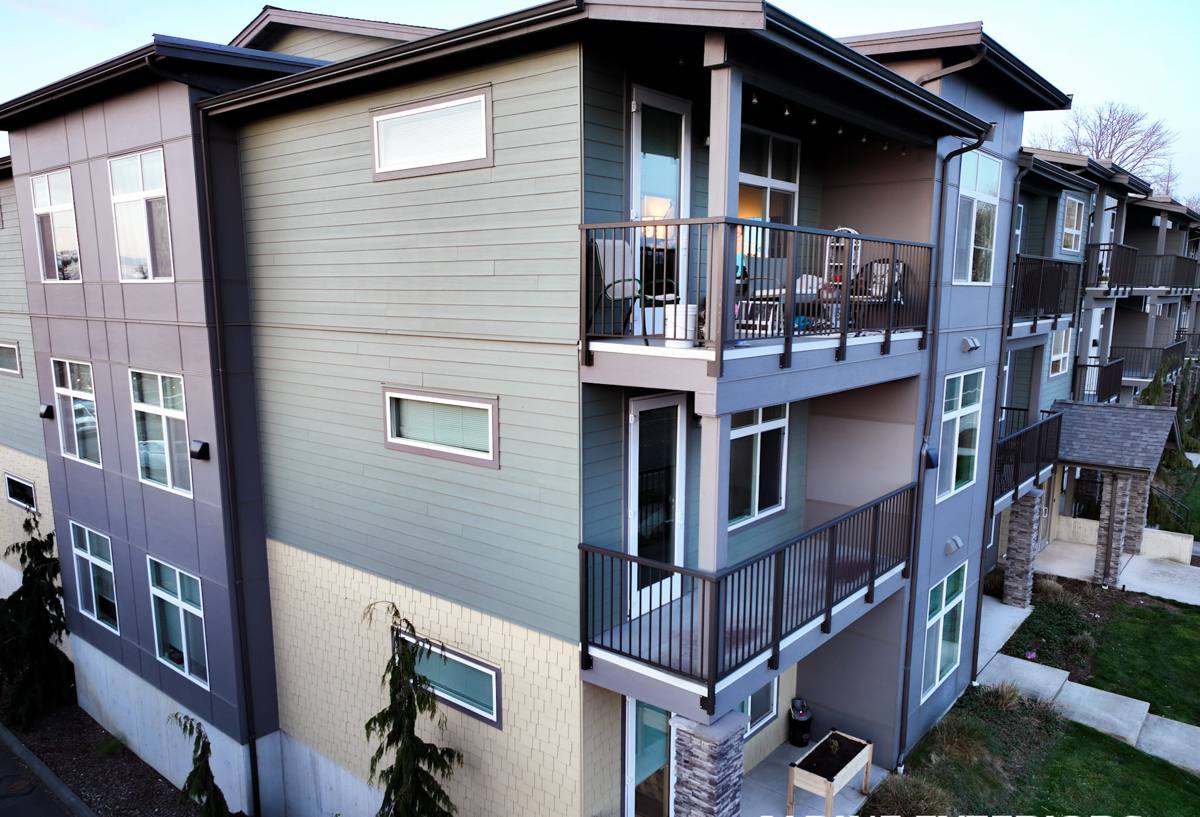
What Whatcom County's Weather Actually Does to Windows Over Time
It helps to understand the mechanism, not just the symptom. Window failure around here rarely happens because glass breaks or a frame cracks. It happens because water gets behind the window and has nowhere to go.
- Driving rain pushes water sideways under normal siding laps and window trim, especially during the wind events that come through the valley in late fall and winter.
- Prolonged damp weather means wood trim, sills, and sheathing rarely get a chance to fully dry out between storms — so a small leak doesn't evaporate away, it soaks in.
- Moss and algae growth on north-facing walls and shaded trim holds moisture against the building longer than bare siding would, accelerating rot at window perimeters that already run damp.
- Temperature swings between summer highs and winter lows cause expansion and contraction that opens up hairline gaps in old caulk and sealant, giving water a new entry point every season.
None of this is unique to Lynden — it's the reality of building envelopes anywhere in the Pacific Northwest's wet marine climate. But it's exactly why window installation here can't follow a generic, dry-climate playbook. Flashing details that are optional in Arizona are not optional in Whatcom County.
Signs a Lynden Home Needs New or Replacement Windows
Homeowners usually notice one of a handful of patterns before they call. Recognizing them early keeps a window problem from becoming a wall or framing problem.
- Soft, spongy, or visibly stained trim or sill wood around the window frame
- Fogging or condensation between panes on double- or triple-pane units — a sign the seal has failed
- Drafts you can feel with a hand near the frame on a windy day, even with the window latched
- Difficulty opening, closing, or locking — often a sign the frame has shifted or swollen
- Paint that keeps peeling or bubbling at the same spot near a window, storm after storm
- Visible daylight or gaps around the frame from outside
- Noticeably higher heating bills in winter with no other explanation
Any one of these on its own might just mean a caulk touch-up. Several together, especially paired with soft wood, usually means the original installation is letting water in and it's worth a real inspection rather than a patch job.
What a Correct Window Installation Actually Involves
This is the part that separates a window that lasts two decades from one that fails in five. It has almost nothing to do with the brand on the sticker.
Flashing and Water Management
Every window opening needs a water-shedding system built in layers, so that any moisture that does get past the exterior finish is directed back out — never trapped behind the siding. That means a properly lapped sill pan at the bottom of the opening, self-adhering flashing tape at the jambs and head that integrates correctly with the house wrap, and a drip cap or head flashing above the window to break the flow of water running down the wall. Skipping the sill pan is one of the most common shortcuts we see in older installations, and it's usually the first place rot shows up.
Air Sealing and Insulation
The gap between the window frame and the rough opening needs to be sealed and insulated correctly — not overpacked with expanding foam (which can bow the frame and cause the window to bind) and not left with gaps that let cold, damp air infiltrate. Low-expansion window-and-door foam or backer rod with sealant, applied evenly around the full perimeter, keeps the window operating smoothly and keeps conditioned air where it belongs.
Fastening and Structural Integrity
The window has to be shimmed level, plumb, and square before it's fastened — an out-of-square frame stresses the sash and accelerates seal failure. Fasteners go through the manufacturer's specified nailing fin or frame locations, at the correct spacing, into solid framing, not just into sheathing.
Get these three things right and the window brand becomes a matter of budget, style, and warranty preference. Get any one of them wrong and even a premium window will underperform.
Window Materials and Styles That Hold Up in This Climate
There's no single "best" window material — the right choice depends on the home, the budget, and how much upkeep an owner wants to take on. Here's how the common options compare for a wet, moss-prone climate like ours.
| Material | Moisture Behavior | Maintenance | Typical Fit |
|---|---|---|---|
| Vinyl | Won't rot; handles damp climates well | Low — occasional cleaning | Most residential replacements; strong value |
| Fiberglass | Very stable in moisture and temperature swings | Low | Higher-end replacements, larger openings |
| Wood-clad | Exterior clad protects the wood, but any cladding breach exposes wood to rot | Higher — clad seams and interior wood need periodic checks | Homes prioritizing a wood-frame interior look |
| Aluminum | Conducts cold and can condense heavily in our humidity | Moderate | Less common for residential; better suited to commercial applications |
For most Lynden homes, we lean toward vinyl or fiberglass for exposed, weather-facing elevations, simply because they don't give moisture anything to feed on. Where a homeowner wants the look of real wood on the interior, wood-clad windows are fine — but they only hold up if the cladding and flashing detailing are done right, since any breach exposes bare wood to a climate that won't let it dry out.
Our Window Installation Process
The process is straightforward, but each step matters.
- On-site assessment. We look at each opening individually — existing rot, flashing condition, siding type, and whether it's a straightforward replacement or a full frame-out job.
- Accurate measuring. Windows are ordered to the actual rough opening, not a catalog assumption, so the fit is tight and shimming needs are minimal.
- Removal and opening inspection. Once the old window is out, we check the sheathing and framing underneath for hidden water damage before anything new goes in. This is often where a "simple" window swap turns into a repair conversation — better to know before the new window is sealed in than after.
- Sill pan and flashing installation. Water management goes in first, in the correct shingle-lap order, integrated with the existing house wrap or building paper.
- Setting, shimming, and fastening. The window is leveled, squared, and fastened per manufacturer specification.
- Insulating and sealing the perimeter. Interior and exterior sealing, done to let the window move slightly with temperature without cracking the seal.
- Trim and finish work. Exterior trim, caulking, and paint or stain to match the home, plus interior trim as needed.
- Final walkthrough. We check operation, locks, and weatherstripping with the homeowner before calling the job done.
What Affects the Cost of a Window Installation
We don't publish flat per-window pricing because the honest answer is "it depends" — but these are the real cost drivers, in rough order of impact.
| Factor | Why It Matters |
|---|---|
| Number and size of openings | Larger and more numerous windows mean more material and labor |
| Hidden rot or framing damage | Discovered once the old window is out; can't be accurately priced until then |
| Material choice | Vinyl is generally the most budget-friendly; fiberglass and wood-clad cost more upfront |
| Full-frame vs. insert replacement | Insert replacements reuse the existing frame and cost less; full-frame replaces everything down to the studs |
| Trim and siding tie-in | Matching existing trim profiles or siding around the new opening adds labor |
| Access and height | Second-story or hard-to-reach windows take longer and may need staging |
The only way to get a real number is a walk-through of the actual openings — anything quoted without seeing the house is a guess.
What to Ask Before Hiring a Window Installer in Lynden
Not every crew that sells and installs windows treats the flashing and water-management details as non-negotiable. A short list of questions upfront can save a homeowner a much bigger repair bill later.
- Do you install a sill pan flashing system on every opening, or only when asked?
- How do you handle it if you find rotted sheathing or framing once the old window is out?
- Are you licensed and insured to do this work in Washington, and can you show proof?
- What's the manufacturer's warranty on the window itself, and what's your separate warranty on the installation labor?
- Do you use low-expansion foam or backer rod for perimeter sealing, and why?
- Can you walk me through how you'll tie the new window flashing into my existing siding or house wrap?
A contractor who can answer these clearly, without hesitating or dismissing the question, is one who actually understands the water-management side of the job — not just the sales side.
Why a Crew That Already Works in Lynden Matters
Window installation done right in Whatcom County looks a little different than it does in a dry climate — more attention to sill pans, more conservative use of sealants that stay flexible through temperature swings, more willingness to slow down and check for hidden moisture damage before closing a wall back up. That's not something you pick up from a manufacturer's install manual alone; it's something a crew learns from years of opening up walls in this specific weather pattern and seeing what actually fails and why.
We work throughout Whatcom County, and jobs in and around Lynden are a regular part of that. Familiarity with the area's building stock, common siding types, and typical framing ages means fewer surprises once an opening is exposed — and a more accurate estimate before we ever start.
Get a Free, No-Pressure Estimate
If your Lynden home has windows showing any of the warning signs above, or you're planning ahead for a replacement project, we're happy to take a look and give you an honest assessment — no pressure, no inflated scare tactics, just a straight read on what your windows actually need. Use the form below to request a free estimate.