 Semiahmoo Siding
 Asphalt Shingle Roofing Built for Laurel's Coastal Climate
Laurel sits close enough to the water off Semiahmoo Bay that homes here take a different kind of weathering than roofs just a few miles inland. The combination of salt-laden air, wind-driven rain off the Strait, and a moss season that can run most of the year puts real, measurable stress on an asphalt shingle roof. A roof that would hold up fine in a dry inland climate can show granule loss, moss colonization, and flashing failures years ahead of schedule out here if it wasn't installed with this specific environment in mind.
This page is about one thing: asphalt shingle roofing for homes in Laurel — new installations, tear-off and replacement, and the detail work that keeps a shingle roof performing through Whatcom County winters. We're not going to give you a generic national overview. We're going to walk through what actually happens to shingle roofs in this pocket of the coast, what a correct job looks like here, and what our process involves when we're on your roof.
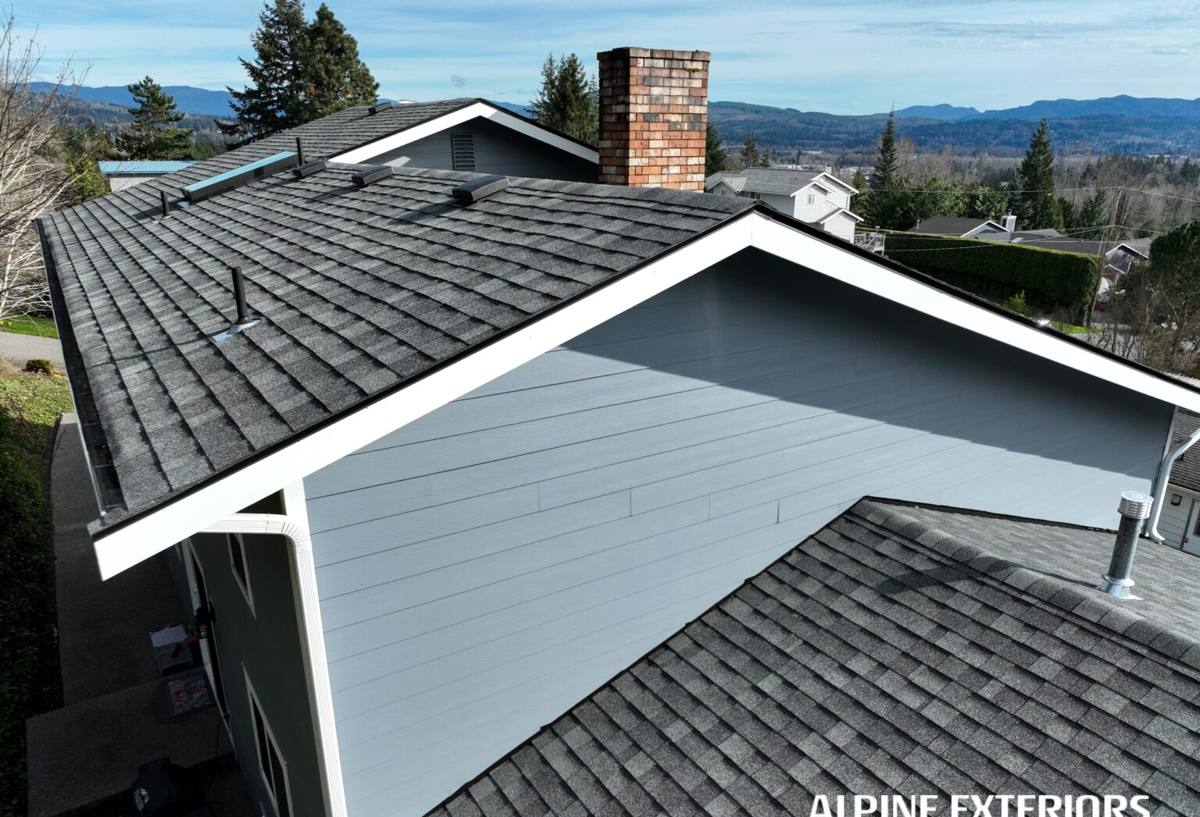
What Salt Air, Rain, and Moss Actually Do to a Shingle Roof
Each of these three factors attacks a roof in a different way, and a roofing job that only accounts for one or two of them is a job that will need premature repair.
Salt Air
Airborne salt from the bay settles on every exterior surface, including your roof. Over time it accelerates the corrosion of exposed metal — nail heads, flashing edges, vent stacks, and gutter hardware. Standard electro-galvanized fasteners and thin flashing can start showing rust streaks and pinholing well before the shingles themselves are due for replacement. The fix isn't a different shingle; it's using corrosion-resistant fasteners and flashing metal in the first place, so the weakest link in the system isn't the hardware.
Driving Rain
Rain that comes in sideways off the Strait doesn't behave like rain falling straight down. It gets pushed up under shingle tabs, into valleys, and around penetrations at angles that a marginal installation simply doesn't account for. This is why underlayment coverage, valley detailing, and shingle nailing pattern matter more here than they would in a calmer inland climate — the margin for error is smaller.
Moss and Organic Growth
Whatcom County's damp, shaded, mild-temperature stretches (especially fall through spring) are close to ideal conditions for moss. Moss doesn't just look bad — it holds moisture against the shingle surface, works its way under tab edges, and lifts shingles enough for wind and rain to find a way in. A north-facing slope or a roof shaded by mature trees can develop a moss problem faster than an owner expects, and once moss is established it accelerates granule loss and shortens the roof's service life.
None of these three problems is dramatic on its own in any given month. What they do is compound, quietly, over years — which is why so many roof failures in this area show up as slow leaks and soft decking rather than a single catastrophic event.
What a Correct Asphalt Shingle Job Involves
A shingle roof is a system, not a single product. Skipping or shortcutting any one layer undermines the whole thing, and it's the layers underneath the shingles — not the shingles themselves — that fail first in coastal, high-moisture climates like this one.
- Deck inspection and repair — plywood or plank decking is checked for soft spots, delamination, and moisture damage before anything new goes down; damaged sections get replaced, not covered over.
- Ice-and-water or synthetic underlayment — full or targeted coverage depending on roof pitch and exposure, with extra protection at eaves, valleys, and any low-slope transitions where wind-driven rain concentrates.
- Drip edge and starter course — properly lapped metal drip edge at eaves and rakes, with a true starter strip so the first course of shingles has full adhesive contact and wind resistance from day one.
- Valley and flashing work — corrosion-resistant metal at valleys, chimneys, skylights, and wall intersections, installed so water sheds over laps rather than into them.
- Shingle installation to manufacturer nailing spec — correct nail count, placement, and fastener type for the wind zone, not just "enough to hold it down."
- Ventilation check — intake and exhaust airflow through the attic, since trapped moisture from the inside is just as damaging to decking and shingles as rain from the outside.
Any one of those steps done wrong is invisible on installation day and expensive three to seven years later. That's the trap with roofing — a bad job and a good job can look identical the day the crew leaves.
Our Process on a Laurel Roof
1. Inspection and Honest Assessment
We start by getting on the roof, not just looking at it from the ground. We check the shingle condition, decking, flashing, ventilation, and any moss or growth pattern, and we tell you plainly whether you're looking at a repair, a partial replacement, or a full tear-off. If a repair is the honest answer, that's what we recommend.
2. Tear-Off and Deck Prep
For a full replacement, we remove the existing roofing down to the deck so we can actually see what's there. This is the point where hidden moisture damage or rot gets found and fixed — not hidden under a second layer.
3. Underlayment, Flashing, and Detail Work
This is where most of the roof's long-term performance is decided. We pay particular attention to valleys, penetrations, and eaves, since those are the spots where driving rain and ice find weaknesses first.
4. Shingle Installation
Shingles go down to manufacturer specification for the wind exposure of your specific site, with corrosion-resistant fasteners appropriate for the coastal air.
5. Cleanup and Final Walkthrough
We clean up debris and nails, and walk the job with you so you know what was done and what to watch for going forward.
Choosing an Asphalt Shingle for a Whatcom County Roof
Not all asphalt shingles perform the same in a coastal, moss-prone climate. The table below is a general guide to the tiers of shingle we work with and how they hold up under Laurel conditions — treat the cost ranges as broad planning figures, not a quote.
| Shingle Tier | Typical Lifespan | Coastal / Moss Performance | Relative Cost |
|---|---|---|---|
| 3-Tab | 15–20 years | Lower wind rating; moss and rain intrusion show up sooner without diligent maintenance | $ |
| Standard Architectural | 25–30 years | Better wind resistance and tab thickness; good balance for most homes here | $$ |
| Premium / Algae-Resistant Architectural | 30+ years | Copper- or zinc-infused granules slow moss and algae growth; best option for shaded or north-facing roofs | $$$ |
For homes in Laurel with mature tree cover or shaded roof slopes, algae-resistant shingles are usually worth the upgrade — they don't make moss impossible, but they meaningfully slow it down, which buys years of service life and reduces how often the roof needs cleaning.
Repair, Partial Replacement, or Full Replacement?
This is the question every homeowner actually wants answered, and it depends on a handful of concrete factors rather than the roof's age alone.
| Factor | Leans Toward Repair | Leans Toward Replacement |
|---|---|---|
| Age of roof | Under 10–12 years | Approaching or past the shingle's rated life |
| Extent of damage | Isolated area (one slope, one flashing point) | Widespread granule loss or multiple leak points |
| Decking condition | Solid, no soft spots found | Soft decking or rot discovered during inspection |
| Moss history | Light, manageable with cleaning | Heavy, recurring, lifting shingle tabs |
| Underlying system | Underlayment and flashing still sound | Underlayment failing or flashing corroded |
We'll always tell you honestly which side of this table your roof falls on. A roof with a solid deck and isolated damage doesn't need a full replacement just because it's convenient to sell one.
Maintenance That Actually Extends a Shingle Roof's Life Here
A well-installed roof still needs some upkeep in this climate — mainly because of the moss and rain, not the shingles wearing out on their own.
- Keep gutters and downspouts clear so water isn't backing up under the eaves during heavy rain events.
- Trim back tree limbs that shade roof slopes and drop debris, since shade and organic debris are what feed moss growth.
- Have moss treated or removed before it establishes under shingle tabs, rather than after it's already lifted them.
- Check flashing around chimneys, vents, and skylights periodically for corrosion or sealant failure, especially given the salt air.
- After major windstorms, do a visual check (from the ground is fine) for lifted or missing shingles rather than waiting for a leak to show up inside.
Why a Crew That Already Works Laurel Matters
Roofing crews that mostly work drier, inland climates tend to under-detail the parts of the job that matter most out here — underlayment coverage, flashing metal choice, fastener corrosion resistance — because those shortcuts don't show up as failures in their usual climate. A crew that regularly works Laurel and the surrounding Semiahmoo-area coastline already knows which slopes take the worst of the driving rain, which roof orientations develop moss fastest, and which flashing details actually hold up against salt air over time. That local pattern recognition is the difference between a roof that needs attention again in five years and one that goes the full distance of its rated life.
What to Expect From a Warranty on Your New Roof
Asphalt shingle roofs typically carry two separate types of coverage: a manufacturer's material warranty on the shingles themselves, and a workmanship warranty from the contractor covering the installation. It's worth understanding both before work starts — the material warranty protects against manufacturing defects, but it won't cover a leak caused by poor flashing or underlayment work. Ask any contractor, including us, to spell out exactly what each warranty covers and for how long before you sign anything.
Get an Honest Look at Your Roof
If you're dealing with moss buildup, aging shingles, or a leak that started after the last big storm off the Strait, we're happy to come take a look. We'll give you a straight assessment of what's actually going on with your roof and what it would take to fix it right — no pressure, no upsell. Reach out for a free estimate using the form below.