 Semiahmoo Siding
 Decking Built for Laurel's Weather, Not Against It
Laurel sits inland from Semiahmoo and Drayton Harbor, but it doesn't escape the marine air that moves off the water and settles across Whatcom County for most of the year. Homeowners here deal with a specific combination: salt-tinged moisture in the air, driving rain that comes in sideways during winter storms, and long stretches of shade and dampness that keep moss and algae established on outdoor surfaces from fall through spring. A deck in Laurel isn't just outdoor furniture — it's a structure that has to survive months of standing dampness every year without rotting, warping, or growing a slip hazard on its surface.
Composite decking exists for exactly this kind of climate. It doesn't absorb water the way wood does, it doesn't need annual staining to keep from cupping, and the better products resist the surface staining that comes from years of moss and organic debris sitting on a damp board. But composite isn't automatically maintenance-free or install-proof — how it's framed, fastened, and ventilated underneath matters just as much as the board you choose. That's the part that gets skipped when a deck is installed fast instead of correctly.
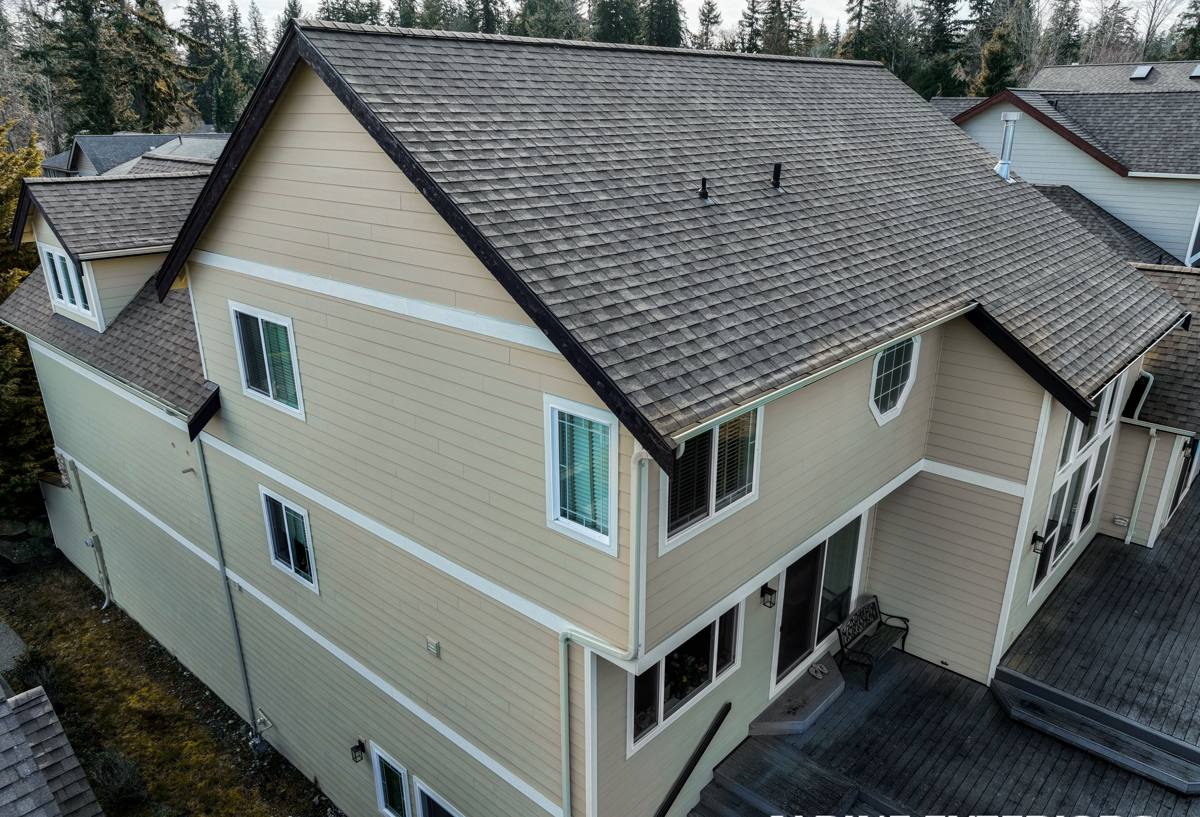
What Laurel's Climate Actually Does to a Deck
Salt Air and Metal Fasteners
The salt content in the air around Semiahmoo Bay and the Strait of Georgia accelerates corrosion on anything metal — screws, joist hangers, structural brackets. A deck that looks fine on the surface can have hardware quietly rusting underneath within a few seasons if the wrong fasteners were used. This is invisible until it isn't, usually showing up as a soft spot, a squeak, or in the worst cases a structural failure at a ledger board or stair stringer.
Driving Rain and Water Intrusion
Whatcom County storms don't always fall straight down. Wind-driven rain gets pushed under railings, into ledger connections at the house, and into any gap where flashing was skipped or done poorly. Once water gets behind a deck board or into a ledger connection, it has nowhere to go and nowhere to dry out quickly given how long our wet season runs.
The Long Moss Season
Moss and algae need shade, moisture, and time — Laurel's climate provides all three for roughly half the year. On a wood deck this means staining and rot in shaded corners. On composite decking it means the surface needs the right texture and ventilation underneath to keep from becoming a green, slick surface by late winter. Airflow under the deck is what keeps moss from taking hold on the underside of boards and around framing.
Why We Recommend Composite for Most Laurel Homes
Wood decking still has its place, and we'll tell you honestly when it's the right call for your budget or the look you want. But for a Whatcom County deck that sees this much standing moisture, composite generally holds up with far less annual work. It won't need sanding, staining, or sealing on a yearly cycle, and quality composite boards are engineered specifically to resist moisture absorption at the core — which matters when a deck spends a third of the year damp.
The trade-off is upfront cost and installation sensitivity. Composite has to be installed with the manufacturer's specified gapping, fastening, and joist spacing, or you lose the performance you paid for. A composite deck installed like a wood deck — tight boards, wrong fastener spacing, no ventilation gap — will trap moisture and can void the product warranty entirely. This is where an installer's experience with the material matters more than the material itself.
| Decking Type | Moisture Resistance | Annual Maintenance | Upfront Cost |
|---|---|---|---|
| Standard Wood (cedar, pressure-treated) | Absorbs moisture; needs sealing to resist it | Cleaning, staining/sealing yearly | Lowest |
| Wood-Plastic Composite | Good — resists rot and swelling | Periodic cleaning, no staining | Mid-range |
| Capped Composite / PVC | Best — capped surface sheds moisture and resists staining | Occasional wash-down | Highest |
What a Correct Composite Installation Involves
The board is the visible part. The framing underneath is what determines whether the deck lasts fifteen years or thirty in this climate. A proper install in Laurel's conditions includes:
- Joist spacing matched to the specific composite board's span rating — composite typically needs tighter spacing than wood to prevent sagging over time
- Corrosion-resistant, coated or stainless fasteners rated for marine or coastal-adjacent exposure, not standard exterior-grade hardware
- Proper ledger board flashing at the house connection, sealed against wind-driven rain rather than caulked and hoped for
- A ventilation gap and clearance under the deck framing so air can circulate and dry out the structure between storms
- Board gapping set to the manufacturer's spec for expansion, drainage, and airflow across the surface — not tightened for looks
- Hidden fastener systems installed correctly so boards aren't over-tightened, which restricts the natural expansion composite needs
- Stair stringers and railing posts anchored with hardware sized for the added wind and moisture load of an exposed Whatcom County lot
Skip any one of these and the deck can still look right for a year or two. The problems that show up later — soft framing, board movement, hardware rust — usually trace back to a shortcut taken during framing or fastening, not the composite board itself.
Our Process for Laurel Deck Projects
1. On-Site Assessment
We look at your lot's specific exposure — how much shade it gets, which direction the prevailing wind and rain come from, and what's happening with any existing deck or ground contact framing. This tells us how much ventilation and drainage detail the new deck actually needs.
2. Removal and Framing Check
If we're replacing an existing deck, we check the ledger board and any structural framing being reused for hidden rot or corrosion before building on top of it. A new composite deck on compromised old framing just moves the problem underneath a nicer surface.
3. Framing and Flashing
This is where the real durability gets built in — correct joist spacing, corrosion-resistant hardware, and proper flashing at every point where the deck meets the house or penetrates through to grade.
4. Board Installation
Boards go down to the manufacturer's specified gapping and fastening pattern, not by eye. This preserves both the warranty and the drainage performance the board is designed for.
5. Final Walkthrough
We walk the finished deck with you, point out anything you should know for basic upkeep, and make sure railings, stairs, and transitions are solid before we call it done.
Living With a Composite Deck Through Moss Season
Composite decking cuts down on maintenance, but "low maintenance" isn't "no maintenance" in a climate like ours. A rinse with a hose or a soft-bristle brush a couple of times during the wet season keeps organic buildup from ever getting a foothold, which is far easier than removing established moss later. Keeping nearby vegetation trimmed back so more light and air reach the deck surface also makes a real difference — moss needs shade and stagnant air, and a deck that gets some sun exposure through the year will stay cleaner with less effort.
If your deck is under a covered patio or heavy tree canopy, common in parts of Laurel, plan on more frequent cleaning regardless of the decking material — the ventilation and gapping we build in during installation is what keeps this manageable rather than a constant battle.
What to Check Before Hiring a Deck Contractor
A composite deck is a big enough investment that it's worth a few direct questions before signing anything:
- Are they licensed and insured to do structural deck work in Washington, not just cosmetic repairs?
- Do they follow the specific composite manufacturer's installation guide for joist spacing, fastening, and gapping — and can they explain why?
- Do they use corrosion-resistant hardware appropriate for a coastal-influenced climate, or standard exterior fasteners?
- Will the ledger board connection to your house be properly flashed, not just sealed with caulk?
- Have they worked on decks in Whatcom County or similar marine-climate areas before, or is this their first exposure to these conditions?
Why Local Experience in Laurel Matters
A contractor who works this specific stretch of Whatcom County knows how the moss builds up on north-facing framing, how far the wind-driven rain travels off Semiahmoo Bay, and which fastener grades actually hold up here versus what's sold as standard hardware elsewhere. That's not something you get from a general contractor passing through — it comes from building and maintaining decks in this exact climate season after season. It shows up in the small decisions: where we add an extra ventilation gap, which hardware grade we spec by default, how we flash a ledger board on a home that catches the prevailing wind.
If you're weighing a new composite deck or replacing one that's showing its age, we're glad to walk your property, look at your specific exposure, and give you a straightforward assessment of what the job actually needs. Reach out for a free, no-pressure estimate using the form below.