 Semiahmoo Siding
 What Sumas Homes Are Up Against
Siding in this part of Whatcom County doesn't get an easy ride. Homes near Sumas deal with a long wet season, driving rain that comes in sideways during winter storms, salt-influenced air moving in off the water, and a moss season that can stretch for months if a house sits under any tree cover or in a shaded, north-facing spot. None of that is unusual for this region — but it means siding material and installation quality matter more here than they would in a drier, calmer climate.
Cheap or poorly installed siding doesn't fail all at once in a climate like this. It fails slowly: a little swelling at a butt joint, a soft spot where water sat against an unflashed seam, a streak of moss creeping up from a shaded corner. By the time it's visible, moisture has usually been working behind the surface for a while. That's the backdrop for every decision we make on a Sumas siding job — material choice, flashing detail, and fastening all get evaluated against "what does this look like after ten wet winters," not just "what does this look like on install day."
Moisture Is the Real Enemy
Driving rain doesn't just wet the face of a wall — wind pressure pushes water sideways and upward into laps, seams, and penetrations that a calmer climate would never test. Siding systems that rely on caulk and paint film alone to stay watertight tend to show it first at these stress points: window and door trim, butt joints, and anywhere two materials meet.
Moss and Organic Growth
A long moss season means any siding with a porous or rough surface, or any siding that traps moisture against its face, becomes a host surface faster here than in most parts of the country. Moss and algae aren't just cosmetic — sustained organic growth holds moisture against the substrate longer, which accelerates whatever failure mode that substrate is already prone to.
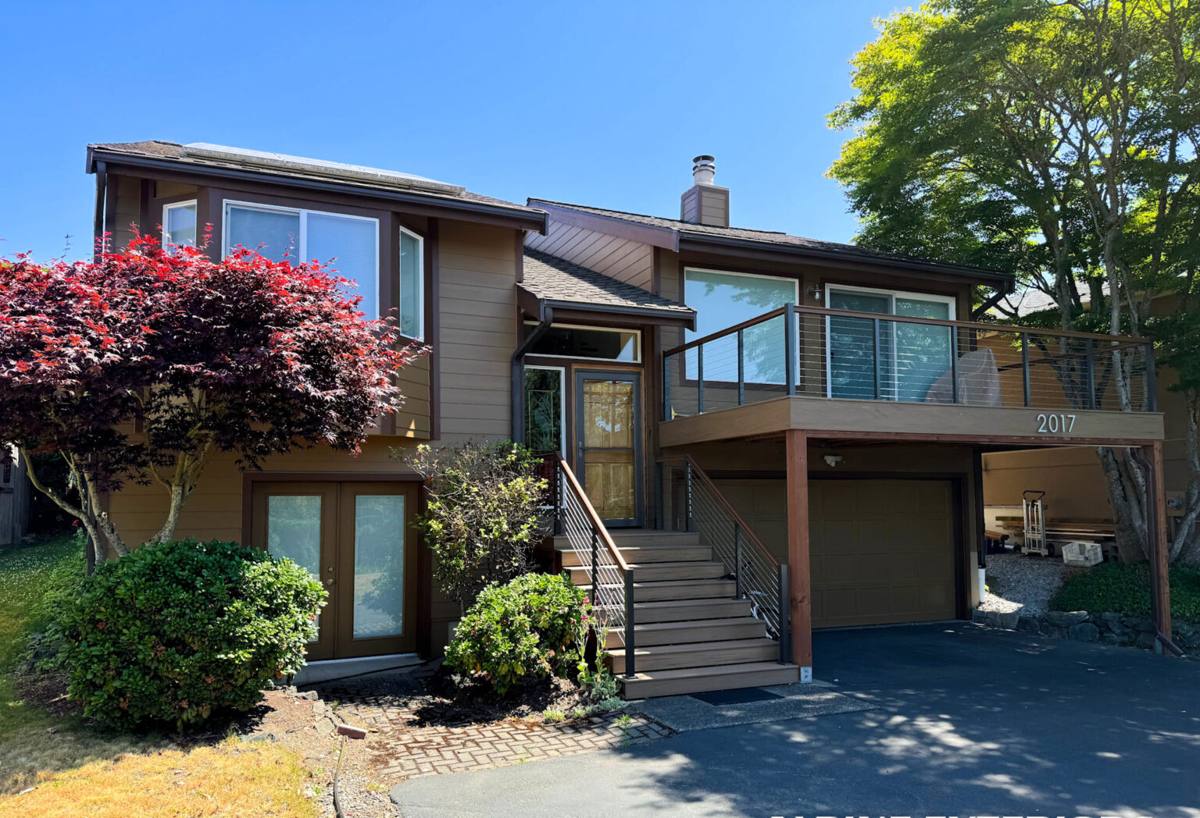
Why This Crew Installs Only James Hardie
We made a decision to stop installing vinyl siding, LP SmartSide, and other fiber-cement alternatives like Cemplank or Allura, and to stop offering primed spruce or cedar as a siding option. That's not a marketing position — it's a standard we hold because of what we've seen these materials do, and not do, in wet Pacific Northwest conditions over time.
Vinyl expands and contracts significantly with temperature swings, and its seams and J-channels give water plenty of paths inward if installation tolerances aren't tight. Wood-based composite sidings and real wood are only as good as their factory or field-applied coating, and once that coating is compromised — by a nail pop, a scratch, or years of moss holding moisture against the surface — the wood substrate underneath is vulnerable to swelling and rot. Other fiber cement brands may be dimensionally similar to Hardie, but we don't have the same track record with their coating systems, warranty structure, or regional engineering, and we'd rather stand behind one product we know thoroughly than offer several we don't.
James Hardie is non-combustible, doesn't support the same rot pathway as wood-based products, and comes from the factory with a baked-on ColorPlus finish rather than a job-site paint job. That combination is why it's the only siding we put on houses.
The Right Hardie System for This Area
James Hardie makes climate-engineered product lines, and the version that matters here is HZ5 — engineered for wetter, cooler climates like the Pacific Northwest, as opposed to HZ10 which is formulated for hot, dry regions. Getting this specification right isn't cosmetic; the engineering affects how the board handles moisture cycling over decades.
| Product Line | Best Use on a Sumas Home | Why It Fits |
|---|---|---|
| HardiePlank lap siding | Primary wall siding, most common choice | Traditional lap profile, wide color and texture range, proven in wet climates |
| HardiePanel vertical siding | Accent walls, gables, modern facades | Clean vertical lines, pairs well with lap siding for a layered look |
| HardieShingle siding | Accent gables, Craftsman and cottage-style homes | Shingle look without the moisture vulnerability of real wood shingles |
| HardieTrim boards | Corners, window and door trim, fascia | Matches siding durability so trim doesn't become the weak point |
ColorPlus factory finish matters as much as the board profile. A factory-baked finish resists fading and chipping far better than field-applied paint, and it means touch-up, when it's ever needed, uses a matched ColorPlus formula rather than a guessed-at paint mix. In a climate with this much sun-to-rain cycling, a finish that isn't fighting UV breakdown and moisture absorption at the same time holds its look longer.
What a Correct Installation Actually Involves
Hardie siding's reputation is built on the material, but its real-world performance depends heavily on installation. A correctly installed Hardie job and a poorly installed one can look identical on the day it's finished and behave completely differently five winters later.
- Proper starter strip and clearance at the foundation so siding doesn't wick moisture from grade
- Correct fastener type, spacing, and depth — over-driven or under-driven nails are one of the most common Hardie installation defects
- Flashing integrated at every window, door, and penetration, not just caulk relied on alone
- Proper gaps at butt joints and trim per Hardie's fastening and clearance specifications
- Rain screen or drainage plane detailing appropriate to the wall assembly
- Factory-cut edges primed or sealed where field cuts expose raw material
- Caulking used to manage water at joints, not as a substitute for correct flashing
Every one of those details is inspectable, and every one of them is also easy to skip and invisible until moisture finds the gap. That's the gap between a siding job that looks fine at handoff and one that's still performing in a decade of Whatcom County winters.
Our Process on a Sumas Project
Assessment and Measurement
We start by walking the exterior to look at existing siding condition, moisture staining, moss patterns, and any trouble spots around windows, roof lines, and grade-level areas. This tells us where the current envelope is already struggling, not just what color siding the homeowner wants.
Product and Color Selection
We help homeowners choose HZ5-engineered products and ColorPlus colors and profiles suited to the house style and to how the wall assembly will manage water. This is also where we flag any structural or moisture issues under the existing siding that need addressing before new siding goes on — new siding installed over an unresolved moisture problem just hides it again.
Installation
Installation follows Hardie's published fastening, clearance, and flashing specifications rather than shortcuts. We don't treat those specs as a suggestion — they're the difference between a warrantable installation and one that isn't.
Final Walkthrough and Warranty Registration
We walk the finished job with the homeowner and handle Hardie's product warranty registration, which requires the installation to meet Hardie's documented standards. A registered, correctly documented installation is what gives that warranty its teeth.
Cost Factors Worth Understanding
Every Hardie project is different, but the same handful of factors drive most of the cost variation on Whatcom County homes.
| Factor | Why It Moves the Price |
|---|---|
| Existing siding removal and disposal | Tear-off, hauling, and any substrate repair add labor beyond a straightforward install |
| Wall complexity | Multiple gables, dormers, and cut lines take more time and trim than a simple rectangular wall |
| Product line mix | Combining lap siding with shingle or panel accents costs more than a single uniform product |
| Moisture or rot repair | Any sheathing or framing damage found once old siding comes off needs to be fixed before new siding goes on |
| Trim and detail work | Full HardieTrim corner and window trim packages add cost but reduce long-term maintenance |
We give straightforward, itemized estimates rather than vague lump-sum numbers, so homeowners can see exactly what they're paying for and where the cost is coming from.
Why a Crew That Already Works This Area Matters
A siding crew that regularly works homes around Semiahmoo and Sumas has already seen how local wall assemblies behave over multiple wet seasons — which orientations moss first, where driving rain tends to find weak flashing, and what older homes in this area typically have hiding under their existing siding. That's institutional knowledge a crew unfamiliar with this specific climate doesn't have on day one, and it shows up in fewer surprises once tear-off starts and in installation choices that account for this area's weather rather than a generic spec sheet.
It also matters for warranty follow-through. A local crew that stands behind its work is easier to reach if a question comes up years down the line than a company that moved on to another region.
Maintenance in a Wet, Salt-Influenced Climate
Correctly installed James Hardie siding is low-maintenance, not zero-maintenance. In this climate, that means periodically rinsing off accumulated moss, pollen, and grime — especially on shaded or north-facing walls where moss establishes fastest — and doing a visual check after major windstorms for any loose trim or caulk that's pulled away at a joint. Salt-influenced air can accelerate wear on fasteners and metal flashing components over many years, so it's worth having those checked during any routine exterior inspection. None of this is heavy upkeep, but staying ahead of it is what keeps a Hardie installation looking and performing like new well past the point where lesser siding would already be showing problems.
If your Sumas home's siding is aging, showing moisture damage, or you're just planning ahead, we're happy to take a look and give you a straightforward, no-pressure estimate — use the form below to get started.