 Semiahmoo Siding
 Siding Built for Laurel's Coastal Climate, Not Just Any Climate
Homes in the Laurel area sit close enough to the water and open farmland that they take weather most inland houses never see. Salt-laden air moves in off the water and works on anything metal or poorly sealed. Driving rain comes in sideways during winter storms, not just straight down, which means siding has to shed water at seams and laps, not just on flat faces. And the long stretch of cool, damp months between fall and spring gives moss and algae months to establish themselves on anything that stays shaded and wet. Siding that was never engineered for this combination — salt exposure, wind-driven rain, and a moss season that can run half the year — tends to show it early: swelling at the edges, chalky or peeling paint, soft spots at the bottom courses, and dark streaking that keeps coming back no matter how often it gets washed.
A siding job done right for a Laurel home isn't just about picking a good-looking product. It's about the water management underneath it, the fasteners holding it on, and the finish that has to survive years of this specific climate without cracking or fading.
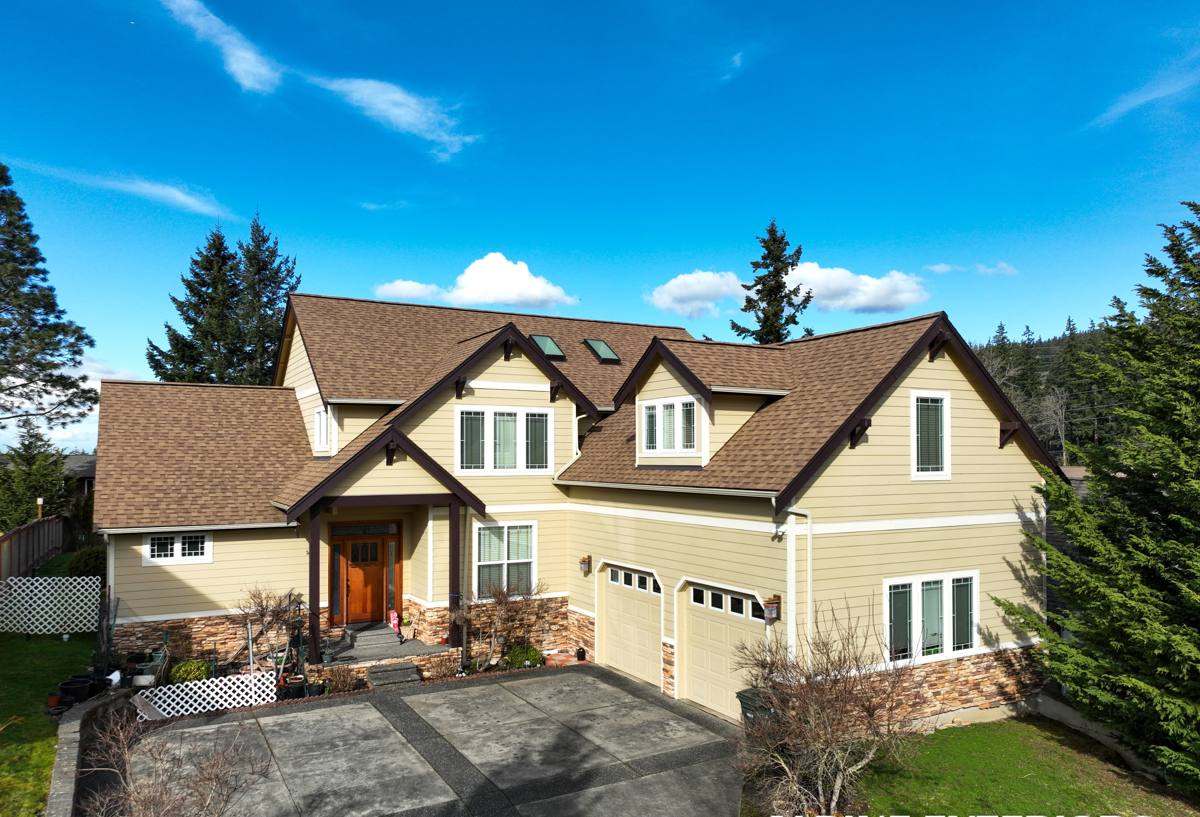
Why We Install Only James Hardie Fiber Cement
We don't offer vinyl, LP SmartSide, Cemplank, Allura, primed spruce, or cedar as options on Laurel homes. That's not a marketing line — it's a standard we set because of what we've seen these products do over time in exactly this kind of climate. Vinyl expands and contracts with temperature swings and can crack or warp in sustained wind exposure. Engineered wood products depend entirely on an intact factory coating; once that's compromised at a cut edge or fastener hole, moisture gets into the wood fiber core and the clock starts. Cedar and primed spruce are natural materials that need ongoing maintenance — staining, painting, caulking — to keep moisture out, and in a climate with this much sustained dampness, that maintenance window shrinks fast.
James Hardie fiber cement is non-combustible, dimensionally stable across temperature and humidity swings, and factory-finished with ColorPlus technology, which is baked on rather than field-applied. That finish is engineered to resist fading and hold up against exactly the kind of coastal moisture cycling that breaks down field paint. It's also backed by a strong transferable warranty when installed to the manufacturer's specifications — which matters more than the product itself, since most siding failures we see trace back to installation shortcuts, not the material.
The Right Hardie System for Laurel Homes
HardiePlank Lap Siding
For most Laurel homes, HardiePlank lap siding in a traditional or beaded profile is the right call. It gives you the classic Pacific Northwest lap look while providing a continuous, engineered water-shedding surface — each course overlaps the one below it by a manufacturer-specified amount, which is what actually keeps wind-driven rain from finding its way behind the siding.
HZ5 Climate Engineering
James Hardie manufactures its siding in different formulations for different climate zones. Whatcom County falls in a zone where the HZ5 product line is appropriate — it's engineered for regions with significant moisture exposure and freeze-thaw cycling, which describes a typical Semiahmoo-area winter well. Using the correct HZ formulation isn't cosmetic; it affects how the board handles moisture absorption and expansion over its life.
ColorPlus Factory Finish
Because repainting siding on a home exposed to salt air and constant damp is a real ongoing cost, we push clients toward ColorPlus colors rather than field-primed-and-painted boards wherever it fits the design. It removes an entire maintenance category from the homeowner's plate for years at a stretch.
| Siding Option | How It Handles Salt Air & Moisture | Maintenance Burden Locally |
|---|---|---|
| James Hardie (ColorPlus) | Non-combustible, dimensionally stable, factory-sealed finish | Periodic rinse, minor caulk checks |
| Vinyl | Can warp or become brittle with wind and temperature swings | Low, but limited to lifespan of the panel itself |
| Engineered wood (LP-type) | Depends on intact factory coating; vulnerable at cuts/holes | Coating inspection, moisture monitoring |
| Cedar / primed spruce | Natural material, absorbs moisture without upkeep | Regular staining or repainting, sealing |
What Correct Installation Actually Involves in This Climate
The product only performs as well as the installation behind it. In a climate that pushes wind-driven rain against every wall, the details that get skipped on a rushed job are exactly the details that cause the failures we get called out to fix years later.
- A proper rainscreen gap or drainage plane behind the siding so any moisture that does get past the surface has somewhere to drain and dry out
- Correct flashing at every window, door, and roofline transition, plus a properly installed weep screed at the base of the wall
- Corrosion-resistant fasteners driven at the manufacturer's specified pattern and depth — not overdriven, not underdriven
- Factory-cut ends and field cuts sealed per manufacturer instructions before installation, not after
- Caulk used only where Hardie's install guide calls for it — at penetrations and trim, not stacked at every panel joint as a substitute for proper flashing
- Minimum clearance maintained between the bottom of the siding and grade, decks, or roof lines to keep splash-back and standing water away from the board edge
Skip any one of these and you can still end up with a house that looks right for the first year or two. In a climate like this one, the problems just take longer to surface — and by the time they do, they're usually behind the siding, not on top of it.
Our Process for a Laurel Siding Project
- On-site assessment — we look at existing siding condition, wall orientation relative to prevailing wind and rain, and any trouble spots like water staining or soft trim
- Moisture check on tear-off — once old siding comes off, we check the sheathing underneath for hidden rot or moisture damage before anything new goes up
- Water-resistive barrier and flashing repair — any compromised house wrap, flashing, or sheathing gets addressed before siding installation begins, not covered over
- HardiePlank installation — installed to manufacturer spec, including rainscreen, fastener pattern, and flashing details specific to this climate
- Trim, caulk, and touch-up — finished with a walkthrough so nothing gets missed at corners, penetrations, or transitions
- Site cleanup — old material, cutoffs, and job debris hauled off, yard and landscaping left clean
Living With Hardie Siding in a Salt-Air, High-Moss Climate
Correctly installed James Hardie siding is low-maintenance, not no-maintenance. A shaded north-facing wall near trees or dense landscaping in the Laurel area can still pick up moss and algae growth over a damp winter, same as a roof would. An annual rinse with a garden hose and soft brush — never a pressure washer aimed directly at seams or up under laps — keeps that from building up into staining that's harder to remove later. It's also worth keeping gutters and downspouts clear so overflow isn't running down the face of the siding, and checking caulk at trim and penetrations every couple of years, since caulk is the one component in the system that does wear out before the siding itself does.
What Drives Cost on a Laurel Siding Job
| Factor | Why It Matters |
|---|---|
| Home size and wall complexity | More corners, gables, and transitions mean more cutting, flashing, and labor time |
| Tear-off vs. existing siding condition | Full removal and sheathing repair adds cost but is often necessary once walls are opened up |
| Trim and corner detailing | Custom trim packages and corner treatments affect both material and labor |
| Site accessibility | Tight lots, slopes, or limited staging area can add time to material handling and setup |
| Hidden moisture or rot repair | Damaged sheathing or framing found during tear-off has to be corrected before new siding goes on |
We give straightforward, itemized estimates so you know what you're paying for and why — including any repair work that comes to light once the old siding is off.
Why Hiring a Crew That Already Works in Semiahmoo Matters
A crew that regularly works Whatcom County's coastal side already knows how prevailing wind and rain patterns hit a typical wall orientation out here, what moss growth actually looks like on a two-year-old install versus a poorly ventilated one, and how the local building department handles siding and weatherization permitting. That familiarity shows up in small decisions — where extra flashing attention is worth it, which wall faces need the most rainscreen airflow, how tight to keep clearances at grade — that a crew unfamiliar with this specific stretch of coastline might not think twice about. It's the difference between a siding job that looks right on day one and one that's still performing correctly a decade later.
If you're planning a siding project on a Laurel-area home, we're happy to walk the property, look at what you're currently dealing with, and put together a clear, no-pressure estimate for a correctly installed James Hardie system. Use the form below to get started.