 Semiahmoo Siding
 Blaine Harbor Sits in a Tough Spot for Siding
Homes around Blaine Harbor take on a mix of exposures that most siding products were never engineered for. There's the marine air coming off the harbor and the wider Strait of Georgia, carrying salt that settles on exterior surfaces and slowly works into seams, fasteners, and any gap in a coating system. There's driving rain that comes in sideways during winter storms, hitting walls at an angle instead of falling straight down, which stresses every joint and butt seam a siding installer makes. And there's the long, damp shoulder season — Whatcom County stays cool and wet for much of the year, which is exactly the kind of environment moss and algae need to take hold on a north-facing or shaded wall.
None of this is unusual for the area. It's just the normal cost of living close to the water in this part of Washington. But it means siding choice and installation quality matter more here than they would on a home fifty miles inland. A product or a install method that would be fine in a drier climate can fail early in Blaine Harbor if it wasn't built and installed with this exposure in mind.
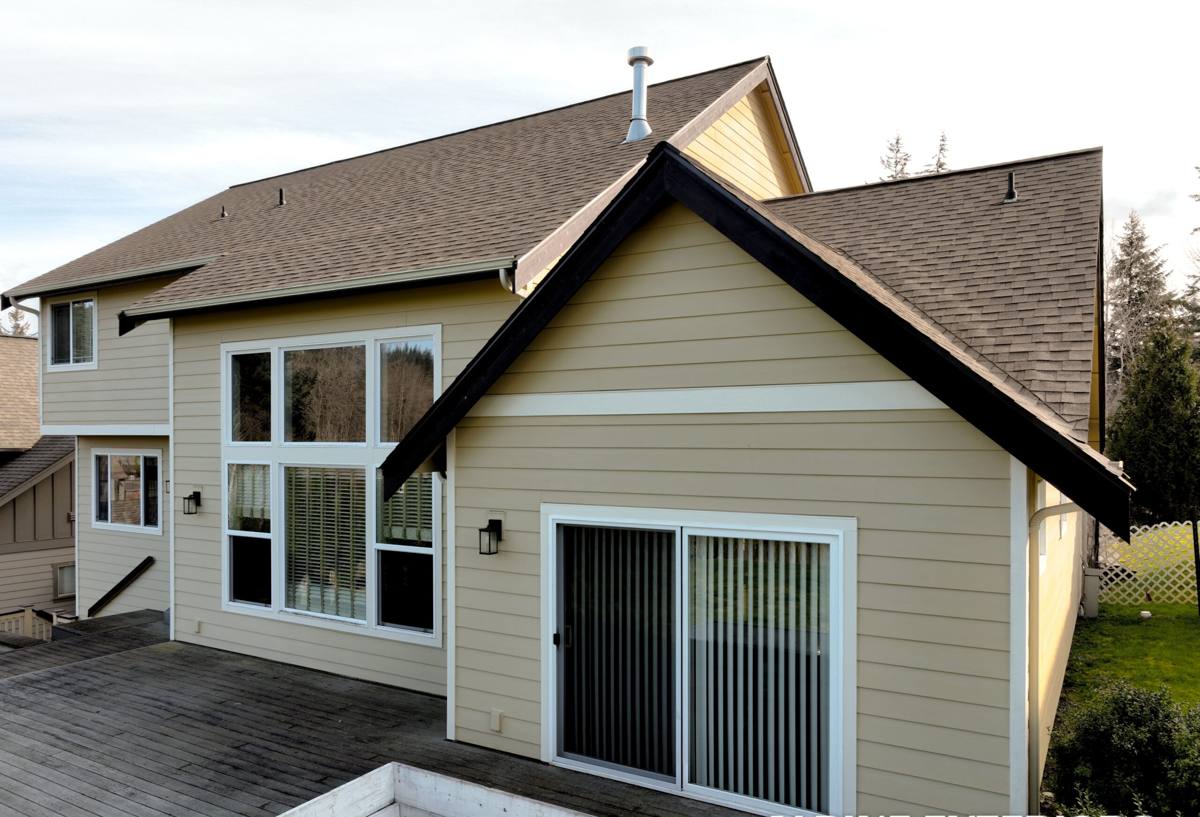
What Salt Air, Rain, and Moss Actually Do to a Wall
Salt Air
Airborne salt is corrosive to metal fasteners, flashing, and trim, and it can accelerate the breakdown of coatings that aren't rated for coastal exposure. Over years, a siding product with a weak factory finish will chalk, fade, or lose adhesion faster near the harbor than it would just a few miles away from the water.
Driving Rain
Wind-driven rain doesn't just wet the face of a wall — it pushes moisture toward every horizontal seam, window head, and butt joint looking for a way in. If flashing, caulking, or clearances are done wrong, that water finds its way behind the siding and into the wall assembly, where it can sit for months before anyone notices a problem.
Moss and Algae
Shaded, north-facing, and tree-covered walls in this climate rarely dry out completely between rain events. That constant low-level dampness is what moss and algae need. On absorbent or poorly finished siding, growth can take hold within a few years and keep coming back even after cleaning, because the surface itself is holding moisture.
Why James Hardie Fits This Exposure
We install James Hardie fiber cement exclusively, and Blaine Harbor is a good example of why. Hardie's HZ5 product line is engineered specifically for climates with heavy moisture exposure — it's built to resist moisture-related damage in wet, freeze-prone regions rather than the milder-climate spec used elsewhere in the country. Fiber cement itself doesn't absorb and swell the way wood-based products can, and it doesn't get brittle or crack under UV and temperature swings the way vinyl can over time.
Just as important is the factory finish. Hardie's ColorPlus coating is baked on in a controlled factory environment, not sprayed or brushed on site, which gives it more consistent coverage and better long-term adhesion than field-applied paint. That matters directly for salt air resistance — a factory finish that's holding up well is your first line of defense against the coastal fading and chalking we mentioned above. It also means less surface for moss to grip onto compared to more porous or absorbent siding materials.
Fiber cement is also non-combustible, which isn't a Blaine Harbor-specific issue, but it's part of why we standardized on Hardie across every home we work on: it's one less trade-off homeowners have to weigh once the siding is up.
How James Hardie Compares in This Climate
Homeowners near the harbor often ask how Hardie stacks up against other common siding materials given what this location deals with. Here's an honest comparison based on how these materials typically perform under sustained marine exposure, not on brand claims.
| Material | Salt Air / Coastal Exposure | Moisture & Moss Resistance | Long-Term Maintenance |
|---|---|---|---|
| James Hardie fiber cement (HZ5) | Engineered for wet coastal climates; factory finish resists fading and chalking | Doesn't absorb moisture like wood; less prone to hosting sustained moss growth | Occasional wash; recoating intervals are long due to factory finish |
| Vinyl siding | Can become brittle and discolor faster under UV and salt exposure over time | Non-absorbent, but seams and J-channels are common water entry points | Low, but color and shape can degrade; hard to repair invisibly |
| Cedar or primed wood siding | Salt air accelerates coating breakdown; needs frequent recoating near water | Absorbs moisture readily; prone to rot and moss without diligent upkeep | High — regular painting/staining and moisture monitoring |
| LP SmartSide (engineered wood) | Coating and edge sealing must be maintained to prevent moisture entry | Wood-based core is more moisture-sensitive than fiber cement | Moderate to high — edge sealing and touch-up are ongoing needs |
This isn't a knock on every one of these products in every setting — vinyl and engineered wood both have legitimate uses elsewhere. It's why, for the exposure homes get around Blaine Harbor specifically, we only put Hardie fiber cement on the wall.
What a Correct Installation Involves Here
Product choice is half the equation. The other half is installation, and in a driving-rain, salt-air environment, the details matter more than usual. A correct James Hardie install for this area includes:
- A drainable weather-resistive barrier and rainscreen gap behind the siding, so any moisture that does get past the surface has a path to drain and dry out instead of sitting against the sheathing
- Corrosion-resistant fasteners and flashing appropriate for coastal exposure, not standard interior-grade hardware
- Proper flashing and head flashing at every window, door, and horizontal trim transition — the most common failure points for wind-driven rain
- Correct fastener spacing and clearance from siding edges, per Hardie's published installation specs, so panels aren't stressed or prone to cracking at fastener points
- Field-cut edges sealed with the correct primer where the factory finish has been cut through
- Proper clearance between the siding's bottom edge and grade, decks, roofs, and walkways to prevent standing water and splash-back from sitting against the material
- Caulking only at the joints Hardie specifies — not as a substitute for correct flashing and clearances
Skip any one of these and you can end up with a wall that looks right for a year or two, then starts showing staining, streaking, or soft spots exactly where water was able to get behind the material. Fiber cement is a durable product, but it's not installer-proof — the manufacturer's own warranty depends on the installation following spec.
Our Process on a Blaine Harbor Home
We walk every home before quoting anything, because siding scope depends on what's actually going on behind the current cladding, not just what it looks like from the curb. That includes checking for existing moisture damage, evaluating current flashing and trim conditions, and looking at how exposed different sides of the house are to prevailing wind and rain.
From there, our process is straightforward: remove the old siding and inspect the sheathing and framing underneath, address anything that needs repair before covering it back up, install a proper drainage plane and rainscreen system, then install James Hardie panels or lap siding to spec with corrosion-resistant fasteners and correct flashing at every penetration. We finish with trim, caulking only where it belongs, and a final walk-through so you know exactly what was done and why.
Living With Hardie Siding in a Moss-Prone Climate
No siding material makes moss and algae impossible in a climate this damp — anything exposed to shade and moisture long enough can pick up surface growth. What Hardie's factory finish does is make that growth easier to prevent and easier to remove when it happens, because the surface isn't absorbing moisture the way wood or some coated products do. A periodic gentle wash on shaded or north-facing walls, along with keeping nearby vegetation trimmed back so walls get airflow and some sun exposure, goes a long way toward keeping growth from establishing itself in the first place.
This is also where correct installation pays off years later. A wall with a working rainscreen behind it dries out between rain events; a wall without one stays damp longer and gives moss more opportunity to take hold, regardless of what siding material is on the surface.
Why the Installer Matters as Much as the Product
We only install James Hardie, and we work in this specific climate regularly, which means we're not guessing at flashing details or fastener specs for a marine environment — it's the exposure we plan for by default. A crew that mostly works drier inland areas may not think twice about rainscreen gaps or coastal-grade fasteners, because most of their jobs don't demand it. Around the harbor, those details are the difference between siding that holds up for decades and siding that needs attention again in five or six years.
Before hiring anyone for a siding job in this area, it's worth asking directly how they handle drainage planes, flashing at penetrations, and fastener selection for coastal exposure. A contractor who can answer specifically — not just "we follow code" — is one who's actually thought about what this climate does to a wall.
Get an Honest Look at Your Home
If your siding is showing staining, moss buildup, soft spots, or just age, we're glad to come take a look and give you a straight assessment of what's going on and what it would take to fix it right. There's no cost and no pressure — just a real evaluation from a crew that installs James Hardie siding on homes in this exact climate. Use the form below to request a free estimate.