 Semiahmoo Siding
 Why Drayton Harbor Roofs Wear on a Different Schedule
Homes along Drayton Harbor and the Semiahmoo waterfront don't age like roofs twenty miles inland. The harbor sits right where salt air off the Strait of Georgia meets the wind funnel between Blaine and the Canadian border, and that combination is hard on a roof system in ways that aren't always obvious from the ground. Metal fasteners and flashing corrode faster in salt-laden air. Driving rain off the water gets pushed sideways under shingle tabs and around penetrations that would stay dry in a calmer setting. And the tree cover and marine humidity that make this stretch of Whatcom County beautiful also make it one of the better moss-growing climates in the state, with a moss season that can run most of the year on shaded, north-facing slopes.
None of that means Drayton Harbor homes need exotic roofing. It means the standard details — flashing metal, fastener choice, underlayment, ventilation — have to be done correctly, not just adequately. A roof that's "fine" in a dry inland town can fail early here if those details were shortcuts the first time around.
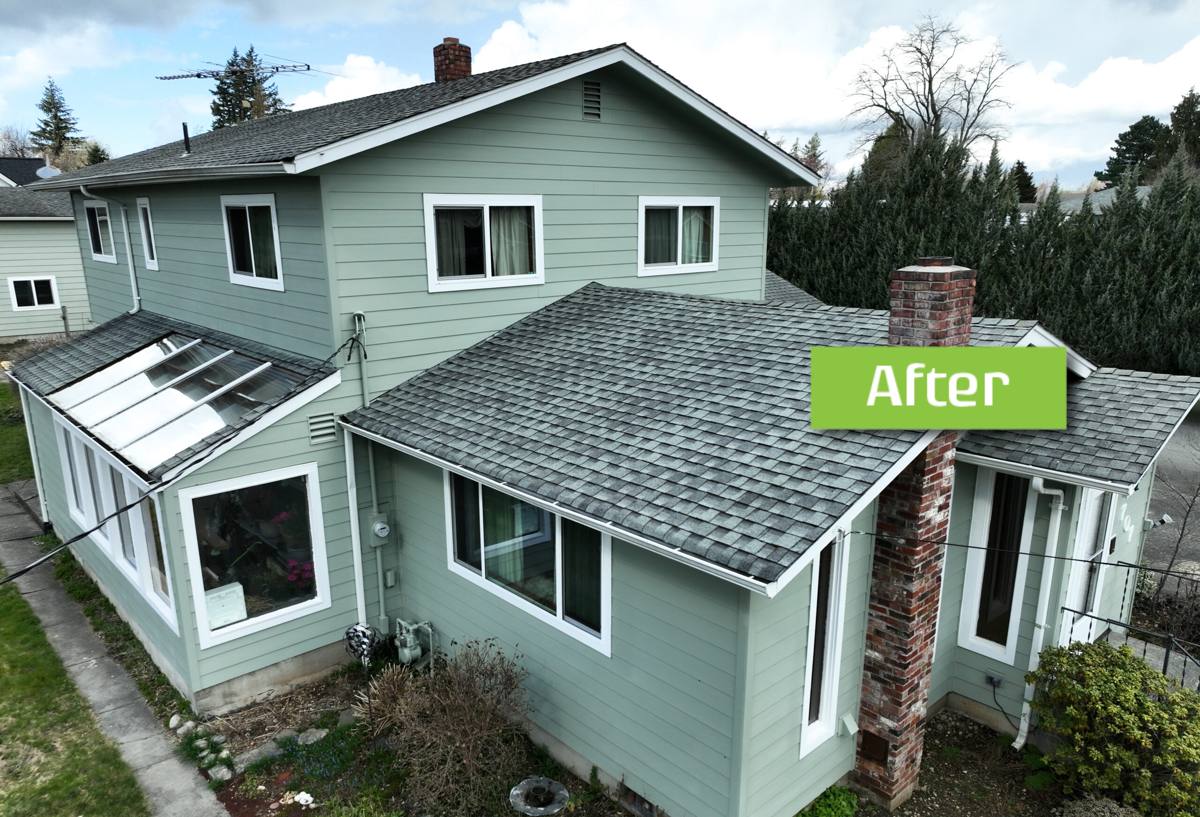
Repair or Replace? Reading the Signs Correctly
Not every aging roof on the harbor needs a full replacement, and we'd rather tell you that up front than sell you a job you don't need yet. But there's a point where patch repairs stop being cost-effective and start being a way to spend money without solving the underlying problem. The signs we look for on a waterfront or near-waterfront home include:
- Granule loss heavy enough that you can see bare fiberglass mat on shingle faces, especially on south and west-facing slopes that take the most weather
- Moss mats thick enough to hold moisture against the shingle surface rather than just staining it
- Rusted or failing flashing at chimneys, vents, and valleys — often the first thing to go in salt air, well before the field shingles
- Soft decking or sagging felt in the attic, visible as dark staining, sagging insulation, or daylight around penetrations
- Shingles cupping, curling, or cracking at the tabs, which usually means the roof has already outlived its underlayment even if it looks okay from the street
- A roof original to the home and now 20-25+ years old, which for most asphalt systems in this climate is past the point where repair makes financial sense
If you're seeing one or two of these, a repair may still buy you real years. If you're seeing several at once, or the roof is old enough that the underlayment is likely as tired as the shingles, replacement is usually the more honest recommendation — and we'll tell you which situation you're in during the estimate, not after the invoice.
What a Correct Roof Replacement Actually Involves Here
Full tear-off, not an overlay
We don't recommend roofing over an existing layer on Drayton Harbor homes. An overlay traps moisture between layers, hides deck damage that salt air and rain have already started, and gives you no chance to correct the flashing and ventilation issues that caused problems in the first place. A full tear-off lets us inspect the decking, replace anything soft or delaminated, and start fresh with materials matched to this climate.
Underlayment built for wind-driven rain
Standard felt underlayment is a minimum-code product, not a climate-matched one. On harbor-facing and wind-exposed roofs we use synthetic underlayment with better tear resistance and water-shedding performance, plus self-adhered ice-and-water membrane at valleys, eaves, and around every penetration — the spots where wind-driven rain actually gets in.
Flashing metal and fasteners that resist salt corrosion
This is the detail that separates a roof that lasts from one that doesn't near the water. We use corrosion-resistant flashing and fastener specifications sized for the exposure, not the cheapest option that meets code. Cutting corners here is the single most common reason we see premature flashing failure on harbor-area homes.
Ventilation that matches the home, not a generic formula
Balanced intake and exhaust ventilation keeps moisture from condensing in the attic, which matters even more in a marine humidity climate. We calculate net free ventilation area for the actual attic, not just the roof deck's square footage, and correct under-ventilated systems as part of the replacement rather than leaving the original setup in place.
Choosing Materials for Salt Air and a Long Moss Season
There's no single "best" roofing material for every home on the harbor — the right choice depends on your roof's exposure, slope, budget, and how much upkeep you want to take on. Here's how the common options actually perform in this specific climate, based on what we see maintaining and replacing roofs in the area.
| Material | Salt air / corrosion behavior | Moss resistance | Maintenance in this climate |
|---|---|---|---|
| Architectural asphalt shingle | Good when paired with corrosion-resistant flashing; the shingle itself doesn't corrode | Moderate — benefits from copper or zinc strips and regular cleaning on shaded slopes | Low to moderate; periodic moss treatment recommended |
| Standing seam metal | Very good with marine-grade coatings and fasteners; poor if a lower-grade coating is used near salt spray | Excellent — moss struggles to hold on a smooth metal surface | Low; occasional rinse and fastener check |
| Cedar shake | Neutral to corrosion, but the wood itself absorbs and holds moisture in this climate | Poor without diligent upkeep — cedar is one of the most moss-prone materials here | High; regular treatment and inspection required |
| Composition (3-tab) shingle | Fine with proper flashing, but a shorter-lived product overall | Moderate, similar to architectural shingle | Low to moderate; shorter service life offsets lower material cost |
Most Drayton Harbor homes we replace roofs on choose either a quality architectural shingle or standing seam metal. Cedar can still be the right look for a home where it matters aesthetically, but we're upfront that it's the highest-maintenance option in a climate with this much moss pressure and moisture.
Flashing, Penetrations, and the Details That Actually Fail First
When a roof replacement goes wrong near the water, it's rarely the shingle field that fails first — it's the details. We pay particular attention to:
- Chimney flashing and step flashing, re-formed and installed new rather than reused, even if the old metal looks salvageable
- Valley construction, using a metal or membrane approach sized for the volume of water this roof actually sees in a heavy rain event
- Vent boot and pipe penetration seals, which are a common leak point once the rubber gaskets age in UV and salt exposure
- Drip edge at eaves and rakes, sized and fastened to handle wind uplift in exposed locations
- Kick-out flashing at roof-to-wall transitions, which is frequently missing on older homes and a major source of hidden wall rot when it is
Our Process, Start to Finish
We keep the process straightforward because a roof replacement is disruptive enough without added surprises.
- On-site inspection and estimate — we walk the roof (or use a ladder assessment where pitch or access requires it), check the attic for ventilation and moisture issues, and give you an honest read on repair versus replace
- Written scope and material selection — you'll know exactly what's being torn off, what underlayment and flashing spec is going in, and what the finished material will be before work starts
- Tear-off and deck inspection — old roofing comes off, decking is inspected board by board, and any soft or damaged sheathing is replaced before anything new goes down
- Underlayment, flashing, and ventilation installation — the parts of the job that determine how long the roof actually lasts in this climate
- Final material installation — shingles, metal panels, or your chosen material installed to manufacturer spec
- Cleanup and magnetic nail sweep — the property is cleared of debris and swept for stray fasteners before we consider the job done
Why a Crew That Already Works Drayton Harbor Matters
A roofing crew that mainly works dry, inland neighborhoods can still do competent work — but they're often making climate decisions on the fly that a crew already familiar with Semiahmoo's waterfront exposure has already worked out. That shows up in small ways: which flashing spec actually holds up here, where moss tends to build fastest on a given roof orientation, how much ventilation a marine-humidity attic really needs versus the textbook number, and which materials are worth the upgrade cost given how hard the salt air and wind actually push on a harbor-facing roof. Local experience doesn't replace good workmanship, but it does mean fewer guesses and fewer callbacks.
Maintaining Your New Roof in This Climate
A correctly installed roof still benefits from a bit of seasonal attention here, more than it would in a drier region:
- Clear debris and moss growth from valleys and gutters at least twice a year, more often under heavy tree cover
- Have flashing and penetration seals checked every few years rather than waiting for a visible leak
- Keep gutters and downspouts flowing freely — standing water backing up under the eave is one of the most common causes of edge rot on harbor-area homes
- Trim back overhanging branches where practical to reduce shade, debris, and moss pressure on the roof
If your roof on or near Drayton Harbor is showing its age, or you just want an honest opinion on where it stands, we're glad to take a look. The estimate is free, there's no pressure attached to it, and you'll get a straight answer about whether you need a repair or a full replacement — just fill out the form below to get started.