 Semiahmoo Siding
 Why Bellingham Decks Wear Out Faster Than Homeowners Expect
If you own a home in Bellingham, you already know decks here don't age the way they do further inland. Between the salt-laden air coming off the water, the long stretches of driving rain that define a Whatcom County winter, and a moss season that seems to start earlier every year, a deck built for a drier climate simply doesn't hold up. Manufacturers write their maintenance schedules and warranty terms assuming average exposure. Bellingham isn't average exposure.
We replace a lot of decks in this area that are less than fifteen years old — sometimes younger — not because the homeowners neglected them, but because the deck was never really matched to the conditions it had to survive. Fasteners corrode faster near the coast. Framing that isn't properly vented stays damp for weeks at a time. Boards that trap moisture under a surface film of moss and algae rot from the top down, quietly, until a soft spot gives way underfoot.
A deck replacement done right for Bellingham isn't just swapping old boards for new ones. It's an opportunity to fix the parts of the original build that were never suited to this climate in the first place.
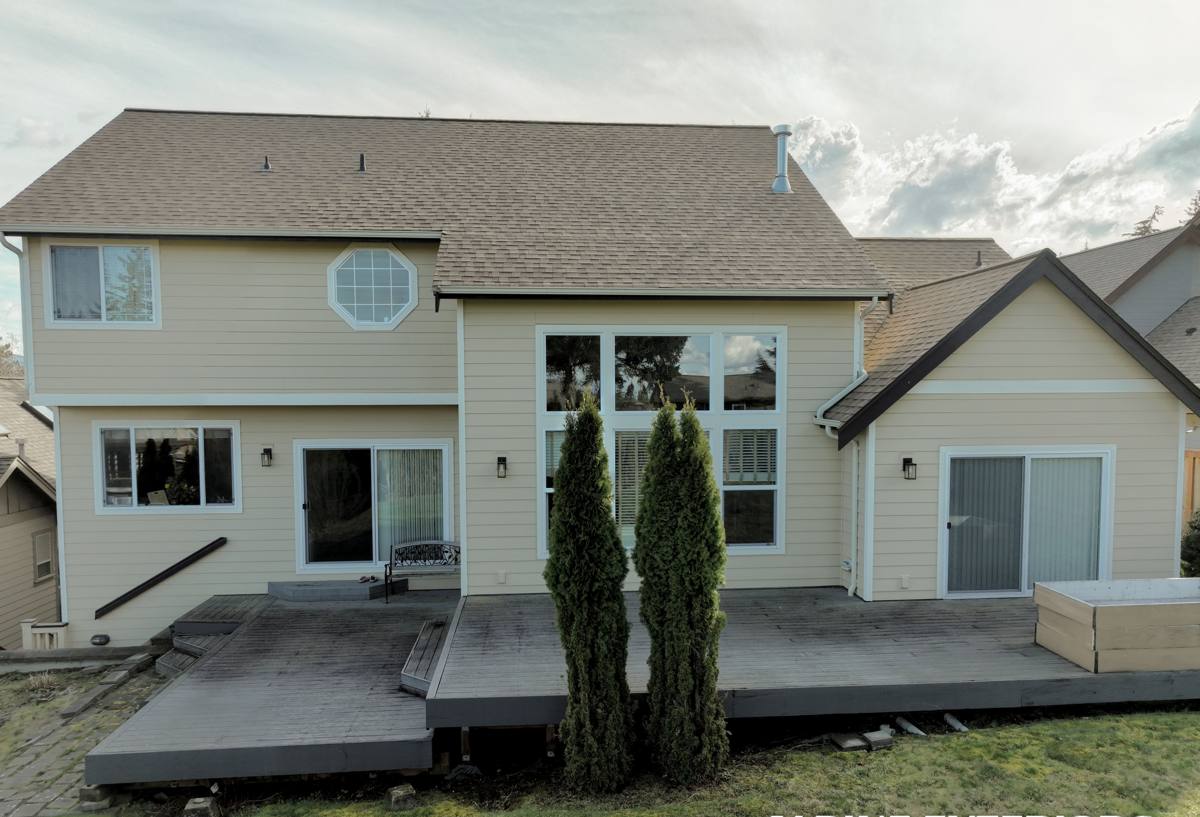
What Salt Air, Rain, and Moss Actually Do to a Structure
Salt air and fasteners
Homes closer to the water deal with airborne salt that settles on every exposed surface, including the metal holding your deck together. Standard fasteners and connectors corrode faster under this kind of exposure. Corroding hardware doesn't just look bad — it loses holding strength over time, which matters most in the ledger board connection and post bases, the two spots where deck failures are most dangerous.
Driving rain and end-grain saturation
Wind-driven rain doesn't fall straight down — it gets pushed sideways into board ends, fastener holes, and any gap where a cut edge was left unsealed. Wood and composite decking both handle face-on moisture reasonably well; it's the cut ends and drilled holes where water gets in and stays. Over a few wet seasons, that's where you see swelling, splitting, and the first real rot.
Moss and the moisture it holds against the deck
Moss and algae aren't just a slippery nuisance — they hold moisture directly against the decking surface for days after the rain has stopped. On wood decking, that constant dampness accelerates decay. On the substructure below, poor airflow lets that moisture linger even longer. A deck built low to the ground with little ventilation underneath is set up for exactly this problem before a single board rots.
Signs Your Deck Needs Replacing, Not Just Repairing
Not every problem deck needs a full replacement. But there's a point where patching individual boards is throwing money at a structure that's already compromised underneath. Here's how we tell the difference on a Bellingham deck:
- Soft, spongy spots in the decking surface, especially near board ends or where two boards butt together
- Visible rust or corrosion on joist hangers, post bases, or structural screws
- Persistent moss or algae growth that returns within weeks of cleaning
- Any movement or bounce in the frame when you walk across it, not just the surface boards
- Ledger board area showing staining, gaps, or soft wood where the deck meets the house
- Railing posts that wiggle at the base — often a sign the post connection has already failed
- A deck older than 15-20 years that has never had the substructure inspected
If what you're seeing is limited to surface boards and the frame underneath is solid, a resurfacing or partial repair may be the honest answer — we'll tell you that instead of selling a full replacement you don't need. But once the framing, ledger connection, or posts are compromised, repair work is just delaying a bigger problem.
What a Correct Deck Replacement Actually Involves
A deck is only as good as what's underneath it. The decking material gets all the attention, but the framing, flashing, and connections are what actually determine whether the new deck lasts through Bellingham's wet seasons or starts failing again in a decade.
The ledger and flashing
Where the deck attaches to the house is the single most important — and most commonly done wrong — connection on the whole structure. Proper flashing that directs water away from the house band joist, combined with a correctly bolted ledger, is what keeps a rain-driven climate from rotting your house from the deck inward. This is not a place to cut corners, and it's not always visible once the decking is down, which is exactly why it needs to be done right the first time.
Framing and hardware
For this climate, we favor corrosion-resistant fasteners and connectors rated for the exposure, not just whatever's cheapest at the yard. Joist hangers, structural screws, and post bases all take the same coastal air the decking does, and undersized or standard-grade hardware is a common reason we find failing decks that "look fine" from the surface.
Ventilation underneath
Low decks with poor airflow underneath trap moisture against the framing long after a storm passes. Where the design allows it, proper spacing and grading beneath the deck helps the structure actually dry out between rain events instead of staying damp all winter.
Board spacing and drainage
Correct gapping between boards lets water drain through instead of pooling, and it gives the decking room to expand and contract without buckling. Tight, inconsistent spacing is a small thing that causes big problems two or three winters later.
Decking Material Options for Bellingham's Climate
There's no single "best" decking material — there's a best fit for your budget, your maintenance appetite, and how exposed your deck is to weather. Here's how the common options actually perform in this climate specifically.
| Material | Moisture Performance | Maintenance | Typical Lifespan Here |
|---|---|---|---|
| Pressure-treated wood | Good if sealed and maintained; end-grain and fastener holes are the weak point | Annual cleaning, periodic re-sealing | 10-20 years, shorter if maintenance lapses |
| Cedar | Naturally rot-resistant but still needs sealing against driving rain | Regular sealing, moss treatment | 15-20 years with upkeep |
| Composite decking | Resists rot and moisture absorption; won't splinter or soften | Periodic cleaning to prevent moss/algae buildup on the surface | 25-30+ years |
| PVC decking | Fully moisture-resistant surface; no organic material for rot to take hold in | Lowest maintenance; occasional cleaning | 25-30+ years |
We install all of these depending on what a homeowner wants, but for decks exposed to direct weather near the water, we steer most Bellingham customers toward composite or PVC decking on the walking surface, paired with wood or engineered framing underneath that's protected properly during the build. It's not that wood decking is a bad product — it's that it demands a maintenance commitment a lot of busy homeowners don't keep up with, and this climate is unforgiving toward decking that gets neglected even for a season or two.
Our Process, Start to Finish
- On-site assessment. We look at the existing structure, not just the decking surface — ledger connection, framing condition, post bases, and drainage.
- Honest scope. We tell you what actually needs replacing versus what's still sound, and why.
- Material selection. We walk through the trade-offs above based on your budget, how the deck gets used, and how much maintenance you want to take on.
- Demo and structural rebuild. Old decking, framing, and hardware come out; ledger flashing, framing, and connections get rebuilt to hold up under coastal exposure.
- Decking installation. Boards go down with correct spacing, fastening, and end-cut sealing.
- Final walkthrough. We go over the finished deck with you and explain what maintenance, if any, it needs going forward.
We schedule around Whatcom County's weather windows rather than fighting them — a deck rebuild done during a stretch of driving rain doesn't get built right, no matter how good the crew is.
Maintaining a New Deck Through a Bellingham Winter
Even the right materials installed correctly benefit from some basic upkeep. This isn't a demanding list, but skipping it is how a 25-year composite deck starts looking rough at year eight.
- Sweep debris off the deck regularly through fall, before it decomposes into the surface
- Clean moss and algae buildup at least once a year, more often on shaded sections
- Check that gaps between boards stay clear so water keeps draining freely
- Inspect railing posts and stair connections annually for any looseness
- For wood decking, keep to the sealing schedule — this is the single biggest factor in how long wood lasts here
- Keep gutters and downspouts near the deck clear so runoff isn't dumping extra water onto the structure
Why a Crew That Already Works Bellingham Makes a Difference
Deck-building fundamentals don't change from region to region, but the judgment calls do. Knowing how much ventilation a low deck actually needs in this climate, which hardware grade is worth the extra cost near the water, and how to sequence a rebuild around a Whatcom County winter isn't something you get from a general contractor passing through. It comes from having built and replaced decks in this specific area, on homes dealing with this specific combination of salt air, rain, and moss.
We work in and around Semiahmoo and Bellingham regularly, which means we're not guessing at how a deck holds up here — we're the ones who get called back to fix it if it doesn't, and we build accordingly the first time.
If your deck is showing soft spots, corroded hardware, or moss that keeps coming back no matter what you do, we're happy to take a look. Fill out the form below for a free, no-pressure estimate — we'll tell you honestly whether you need a full replacement or something less.