 Semiahmoo Siding
 Why Decks in Custer Wear Out Faster Than the Manual Says
Every deck material comes with a service-life estimate from the manufacturer, and almost none of those numbers account for what a deck actually faces in Custer. This part of Whatcom County sits close enough to Semiahmoo Bay and the open water beyond it that salt-laden air is a constant, low-grade stressor on anything metal or painted. Add in a rainy season that runs long and heavy, plus tree cover that keeps decks shaded and damp for weeks at a time, and you get a climate that's genuinely harder on outdoor structures than most manufacturer specs assume.
None of this means a deck is doomed. It means the maintenance and repair schedule needs to match local conditions, not a generic timeline written for a drier climate. A deck that would go a decade without attention somewhere inland may need real intervention in half that time here — not because it was built wrong, but because the environment is doing more work against it.
The Three Forces at Play
- Salt air: accelerates corrosion on fasteners, brackets, and any exposed metal hardware, even when the wood itself looks fine.
- Driving rain: wind-blown rain gets pushed sideways and up under railings, ledger boards, and joints that were designed for water falling straight down.
- Moss and prolonged dampness: months of shade and moisture keep deck boards from ever fully drying out, which is the single biggest driver of rot in this region.
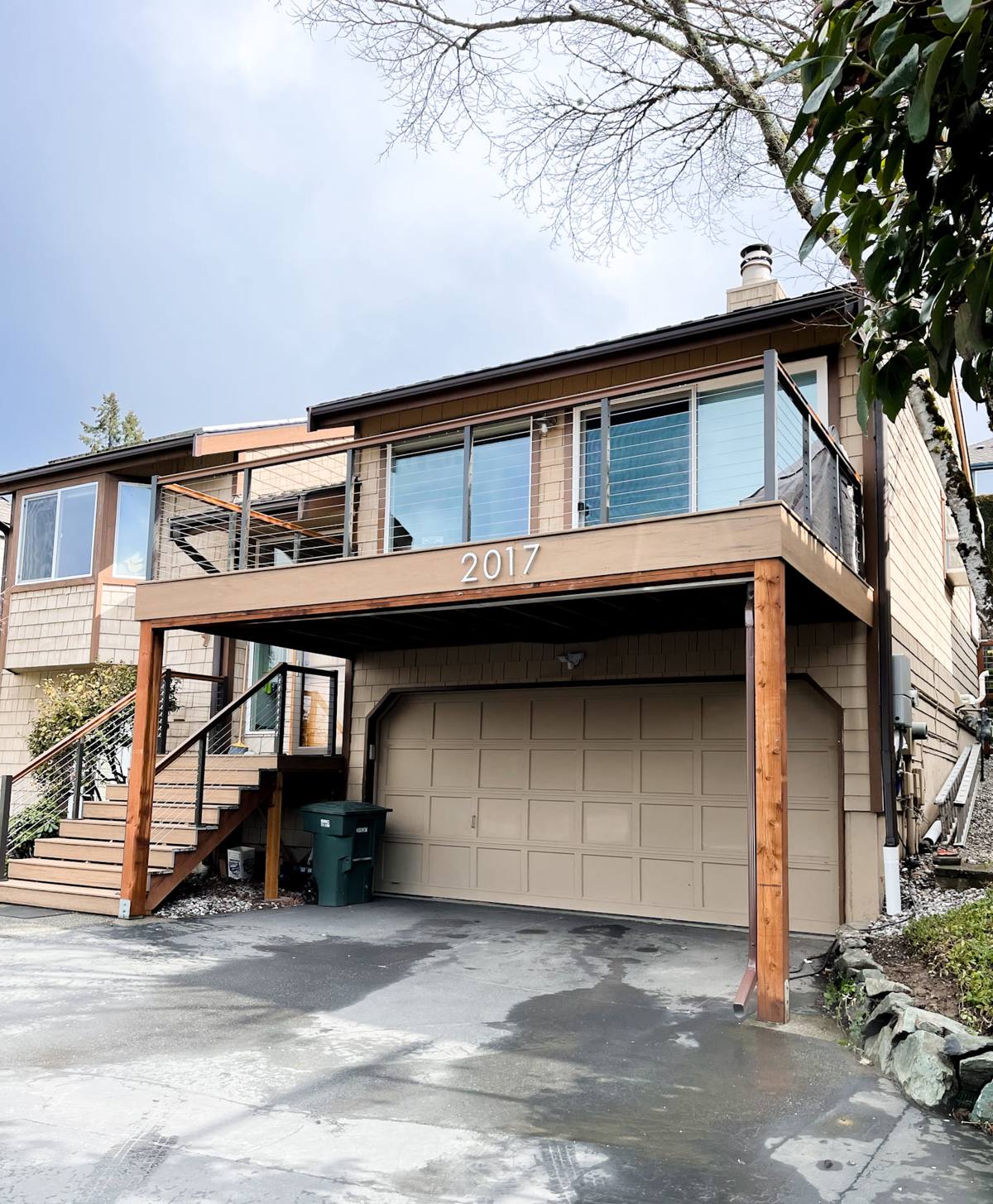
What Deck "Repair" Actually Covers
Homeowners often use "repair" loosely, but a proper repair job is specific: it addresses the structural and surface problems that are already present, stops the damage from spreading, and restores the deck to a safe, usable condition without necessarily replacing the whole structure. That's different from a full rebuild, and it's different from a coat of stain that just hides a problem for a season.
Signs a Custer Deck Needs Repair, Not Just Cleaning
- Soft, spongy, or springy spots when you walk across the deck
- Visible gaps or splitting where boards meet the ledger board (the board bolted to the house)
- Rust streaks running down from screws, bolts, or joist hangers
- Railings or posts that wiggle when pushed
- Green or black film on boards that doesn't scrub off easily, especially on the shaded side
- Standing water that takes more than a day to dry after rain
Any one of these on its own might be minor. Two or three together, especially near the ledger board or stairs, usually means water has gotten past the surface and is working on the structure underneath.
How We Approach a Repair in This Area
A repair that only fixes what's visible on top tends to fail again within a year or two, because it doesn't address why the damage happened in the first place. Our process is built around finding the actual water and moisture pathway, not just patching the symptom.
Step 1: Inspection From the Ground Up
We look underneath the deck, not just across the surface. Joists, beams, posts, and the ledger connection tell us more about a deck's real condition than the boards people walk on. In Custer specifically, we pay close attention to the ledger board and any spot where the deck meets the house siding, since that's where driving rain most often finds a way in.
Step 2: Isolate the Cause, Not Just the Damage
A rotted board is a symptom. The cause might be a missing or failed flashing detail, a fastener that's corroded and no longer holding tight, poor drainage underneath the deck, or moss buildup that's kept a section wet for too long. We identify the cause so the repair actually holds.
Step 3: Repair the Structure Before the Surface
Joists, ledger connections, posts, and framing get addressed first. Structural hardware showing corrosion gets replaced with fasteners rated for coastal or high-moisture exposure, not standard interior-grade hardware.
Step 4: Replace Damaged Boards and Restore Surfaces
Only after the structure is sound do we move to decking boards, railings, and stair treads — replacing what's damaged and matching material and fastening method to what's already there where that makes sense.
Step 5: Address Drainage and Airflow
Where we can improve how water sheds off and away from the deck, or how air moves underneath it, we'll point that out. A deck that dries out faster between rain events ages far more slowly than one that stays damp.
Common Repair Issues We See in This Region
| Issue | Typical Cause Here | What the Repair Involves |
|---|---|---|
| Rusted or corroded fasteners | Salt air exposure over time | Remove and replace with coastal-rated stainless or hot-dip galvanized hardware |
| Soft or rotted ledger board | Water intrusion at the house connection during driving rain | Cut out and replace affected section, correct flashing detail |
| Persistent moss or algae film | Extended shade and moisture, long moss season | Clean, treat, and address airflow or drainage where possible |
| Loose or wobbly railing posts | Moisture-weakened post connections | Reinforce or replace post base and hardware |
| Cupped or warped boards | Uneven drying cycles from prolonged dampness | Replace individual boards; assess underlying moisture source |
| Gaps or separation at stairs | Repeated wet/dry movement over multiple seasons | Re-secure or rebuild stringer connections as needed |
Repair or Replace? The Honest Cost Factors
Not every deck problem justifies a full rebuild, and not every deck is worth repairing indefinitely. The decision usually comes down to how much of the structure is affected versus how much is still sound.
| Factor | Leans Toward Repair | Leans Toward Replacement |
|---|---|---|
| Extent of damage | Isolated to a few boards, one railing section, or the ledger | Widespread rot across multiple joists or the main frame |
| Age of deck | Under 15-20 years with a sound frame | Original hardware and framing near end of expected life |
| Underlying structure | Posts and beams still solid when tested | Posts or beams show soft spots or significant give |
| Budget goals | Extending usable life at lower cost | Wanting a longer-term reset, or a design/layout change |
Broadly, targeted repairs on an otherwise sound deck often run a modest fraction of what a full rebuild costs, but the actual number depends entirely on what we find once we're underneath the structure — we won't quote a real figure until we've inspected it in person.
Materials and Hardware: Why We Don't Cut Corners on Fasteners
In a coastal-influenced climate like Custer's, the fastener is often the weak link, not the wood or composite decking itself. Standard interior-grade screws and brackets corrode faster here than they would inland, and a single rusted-through fastener can undo an otherwise good repair. We use stainless steel or hot-dip galvanized hardware rated for exterior, high-moisture use on every repair, even when it costs more than the standard option — because replacing a board is a lot cheaper than replacing a board twice.
For decking material itself, both quality wood and composite have a place in a proper repair, and the right choice depends on what's already installed, the homeowner's maintenance preference, and the specific area of the deck being fixed. We'll walk through the honest trade-offs — maintenance burden, moisture behavior, and appearance over time — rather than pushing one material as universally better.
Maintenance Checklist to Protect the Repair
A repair holds longer when it's paired with a few habits suited to this climate. This is the same list we leave with homeowners after a job:
- Clear leaves and debris from between boards before the wet season sets in
- Rinse or sweep moss growth off shaded areas regularly rather than letting it establish
- Check railing posts and stair connections for movement once or twice a year
- Keep gutters and downspouts clear so runoff isn't draining directly onto or under the deck
- Inspect the ledger board area annually, since that's where driving rain does the most damage
- Re-seal or re-stain wood decking on the manufacturer's recommended cycle, not just when it looks faded
Why It Matters to Hire a Crew That Already Works This Area
Deck repair looks similar on paper anywhere in the Pacific Northwest, but the details that actually matter — how far the driving rain pushes water sideways under a railing, how long moss takes to establish on a shaded north-facing section, which fastener grade actually holds up near the water — are things a crew learns by working Custer and the surrounding Semiahmoo-area properties repeatedly, not from a general specification sheet. A crew that's already familiar with how local homes are built and how the weather here behaves spends less time diagnosing and more time fixing, and is less likely to miss a moisture pathway that isn't obvious on a first look.
Local familiarity also means realistic scheduling. We know the rainy stretches to work around and the drier windows that make for a cleaner repair, particularly when boards need time to dry before staining or sealing.
What to Expect During the Project
Most deck repairs in this size range move through a predictable sequence: an in-person inspection to scope the work, a straightforward written plan covering what's being repaired and why, the repair work itself, and a final walkthrough. Timelines vary with the extent of damage and the weather window we're working in, but we'll give a realistic estimate up front rather than a best-case number that assumes perfect conditions.
If you're seeing soft spots, rust stains, or persistent moss on a deck in the Custer area, it's worth having someone look at it before another wet season adds to the damage. We offer a free, no-pressure estimate — use the form below to get a local crew out to take a look and give you a straight answer on what it needs.