 Semiahmoo Siding
 Why Lynden's Climate Is Hard on Decks
Lynden sits inland from the water, but it still shares the same weather pattern that shapes decks all across Whatcom County: long stretches of steady rain from fall through spring, heavy dew and fog in the low-lying farmland around town, and short, mild summers that never fully dry things out before the next wet season starts. Homes right on the water at Semiahmoo or Blaine deal with direct salt spray on top of that; Lynden gets less of the salt exposure, but it gets just as much moisture, and moisture is what actually breaks a deck down over time.
Wood decking in this climate is a maintenance treadmill. Boards absorb water, swell, dry, and shrink through dozens of cycles every year. Fasteners work loose, boards cup and split, and anything that stays shaded or doesn't get airflow underneath starts growing moss and algae within a season or two. A lot of the deck calls we get in Lynden aren't about a deck that was built badly — they're about a wood deck that simply reached the end of what wood can reasonably handle here.
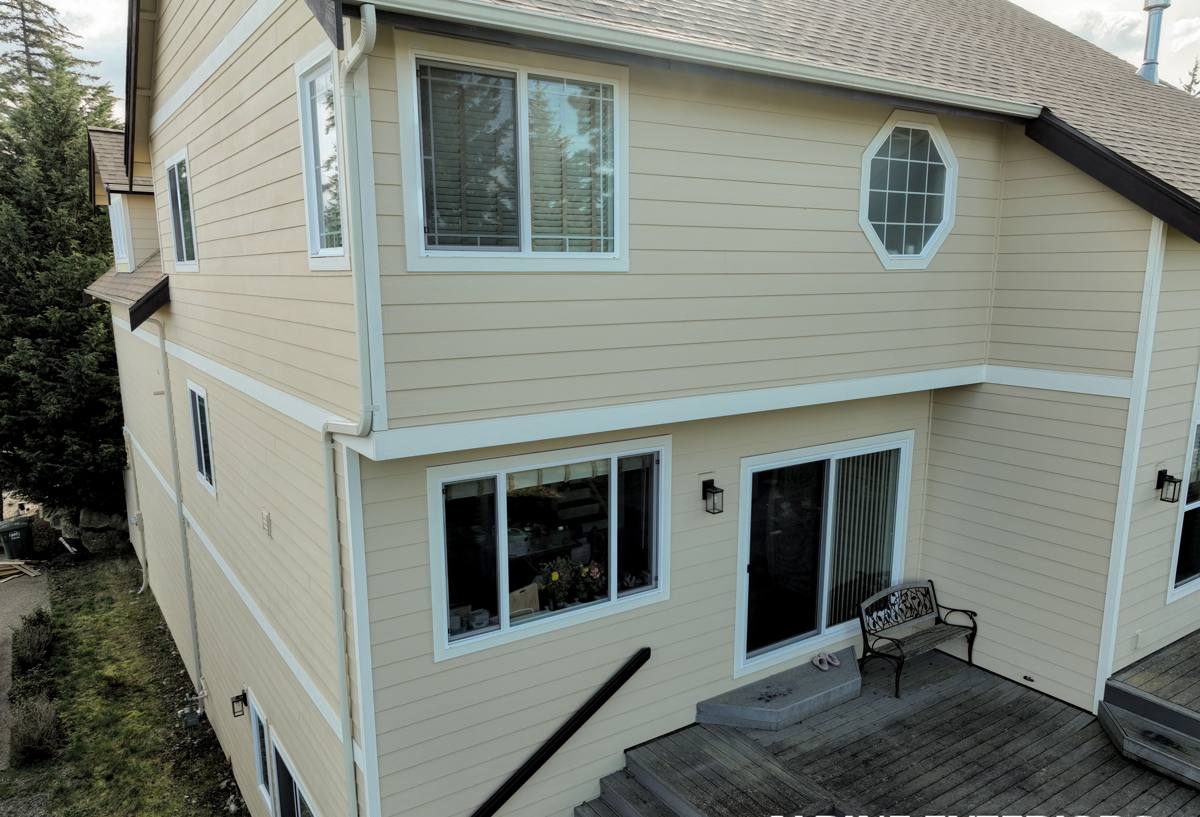
What Composite Decking Actually Solves
Composite decking — a blend of wood fiber and recycled plastic, usually with a protective cap layer — doesn't absorb water the way solid wood does. That single difference changes almost everything about how a deck performs in a place like Lynden:
- No swelling, cupping, or splitting from repeated wet-dry cycles
- No annual sanding, staining, or sealing
- Much slower moss and algae growth on the board surface itself, since there's no exposed wood grain to root into
- Consistent color and structure even after years of Pacific Northwest rain
Composite isn't maintenance-free — nothing that lives outside in this climate is — but it removes the recurring wood maintenance cycle that owns most homeowners' weekends every spring.
Composite Isn't All the Same: What to Look For
Capped vs. Uncapped Boards
Capped composite has a plastic shell wrapped around the wood-plastic core, which is what actually blocks moisture absorption and resists staining. Uncapped composite (mostly older or budget-tier product) is closer to the original composite decking from decades ago — it can still absorb moisture at the surface and is more prone to mold and fading. For a wet climate like ours, we install capped composite as our standard; it's the product built for exactly the conditions Lynden deals with.
Solid vs. Grooved-Edge Boards
Grooved-edge boards use hidden fastener clips, which give a clean, screw-free surface and — just as important here — leave fewer entry points for standing water to sit against a fastener head. Solid-edge boards with face screws are sometimes used at stair treads or borders where extra grip and a mechanical fastener make sense.
| Feature | Wood Decking | Uncapped Composite | Capped Composite |
|---|---|---|---|
| Moisture absorption | High | Moderate | Low |
| Annual maintenance | Sanding/staining | Occasional cleaning | Periodic washing |
| Moss/algae resistance | Poor | Fair | Good |
| Typical lifespan in this climate | 10–15 years | 15–20 years | 25+ years |
| Fading/staining resistance | Low without upkeep | Moderate | High |
What a Correct Installation Actually Involves
Composite boards are only as good as the structure and drainage underneath them. Most of the composite deck failures we get called to inspect trace back to installation shortcuts, not the material itself.
Substructure and Spacing
Composite expands and contracts with temperature more than wood does, and it needs joist spacing tightened up from typical wood-deck standards — manufacturers publish specific joist spacing requirements for a reason, and running wood-deck spacing under composite boards is a common cause of bounce and long-term sag.
Airflow and Drainage Underneath
This is the step that matters most in a climate like ours. Composite decking needs open airflow beneath the boards so moisture doesn't sit trapped against the substructure. Low decks built tight to grade, or decks with skirting that seals off ventilation, trap the same damp air that causes moss and mildew — the boards on top may resist it, but the framing underneath won't.
Flashing at the Ledger Board
Where a deck attaches to the house, proper ledger flashing keeps water from working its way behind the siding and into the wall assembly. This is a small detail that's completely invisible once the deck is finished, and it's also the single most common source of hidden rot damage we find on older decks during a rebuild.
Fastening
Hidden fastener systems, correctly torqued and spaced per the manufacturer's pattern, keep the board field secure without over-driving screws that crack the cap layer and create a spot for water to get in.
Our Process for a Lynden Composite Deck Project
- On-site assessment — we look at grade, drainage, existing framing (if it's a rebuild), and sun/shade exposure, since shaded areas need extra attention to airflow and moss resistance.
- Material selection — we walk through board options and color lines based on your budget and how much upkeep you want to do, not just what's cheapest to install.
- Framing and structure — we build or verify the substructure to the spacing and support requirements the composite manufacturer specifies, not generic wood-deck spacing.
- Drainage and flashing — ledger flashing, proper slope, and clearance for airflow underneath are addressed before a single deck board goes down.
- Installation — boards, fascia, and stairs installed with correct fastening and expansion gaps.
- Final walkthrough — we go over basic care with you so the deck looks the way it should for years, not just the first season.
Common Problems We Find on Existing Decks in This Area
When we're called out to inspect an older deck — wood or composite — in and around Lynden, a handful of issues show up repeatedly:
- Ledger boards with missing or failed flashing, leading to hidden rot at the house connection
- Decks built low to grade with no ventilation gap, trapping moisture and growing moss underneath
- Joist spacing too wide for the decking product actually installed, causing bounce or sag over time
- Face-screwed composite boards with over-driven fasteners that cracked the cap and let water in
- Stairs and rail posts with inadequate structural attachment, which is a safety issue as much as a durability one
Most of these are fixable during a rebuild, and catching them early is a lot cheaper than dealing with structural rot later.
Maintaining a Composite Deck in Lynden's Climate
Composite cuts the workload dramatically compared to wood, but a little seasonal attention keeps it looking right through our wet stretch of the year:
- Sweep debris off the deck regularly — wet leaves and organic matter left sitting are what feed moss growth, even on composite
- Wash the deck surface once or twice a year with a soft brush and mild soap, following the manufacturer's cleaning guidance
- Keep gutters and downspouts clear so runoff isn't dumping directly onto or under the deck
- Check that vegetation and mulch beds aren't crowding the deck edge and blocking airflow underneath
- Look at the ledger flashing and any fastener points once a year for early signs of trouble
What Drives Composite Decking Cost
Every project is different, but the same handful of factors move the price up or down on most composite deck jobs in this area:
| Cost Factor | Why It Matters |
|---|---|
| Deck size and shape | More linear footage and cuts around angles or curves increase labor and material |
| Board tier | Entry-level capped composite vs. premium lines with deeper color and grain options |
| Substructure condition | New framing vs. reusing sound existing framing changes the scope significantly |
| Height and stairs | Multi-level decks and stair construction add framing and railing work |
| Site access and drainage work | Grading, ventilation gaps, or ledger flashing repairs on a rebuild |
We'll give you a straightforward number based on your actual deck, not a generic per-square-foot figure that doesn't account for your site.
Why Hire a Crew That Already Works in Lynden
Decking looks like a straightforward build until you account for what our regional climate does to it over the years. A crew that installs decks across Whatcom County, in towns that all see the same driving rain and long moss season, already knows where wood-deck habits don't translate to composite, where ventilation gets skipped on low decks, and which flashing details actually keep water out of the house behind the deck. That local pattern recognition is what separates a deck that still looks good in year ten from one that's already showing moss and sag by year three.
If you're planning a new composite deck or replacing a tired wood deck at your Lynden home, we're happy to take a look and give you a straightforward, no-pressure estimate — just fill out the form below.