 Semiahmoo Siding
 Siding Built for California Creek's Waterfront Climate
California Creek sits low and close to the water on the Semiahmoo side of Whatcom County, which means homes here take on a different kind of weather load than houses just a few miles inland. Salt-laden air drifts in off the bay, wind-driven rain comes at siding sideways instead of straight down, and the long, damp Pacific Northwest winter gives moss and algae months at a time to get established on anything that stays wet. A siding installation that would hold up fine in a dry inland subdivision can fail early here if it's not planned around these specific conditions.
We install James Hardie fiber cement siding exclusively, and a big part of why is that it's engineered for exactly this kind of exposure. But the product is only half the equation. The other half is installation: flashing details, fastener choices, and clearances that either shed water and salt or trap it against the wall. This page walks through what a California Creek home actually needs from a siding job, and how we approach it.
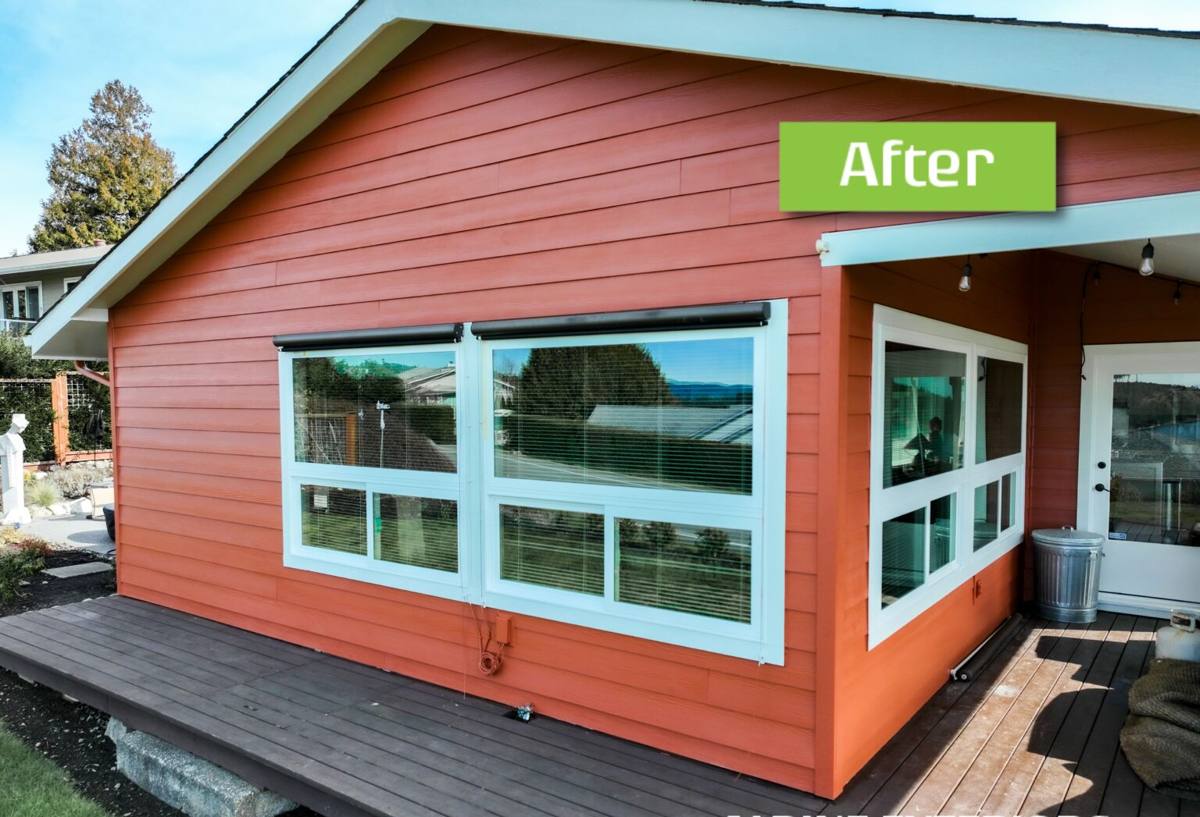
What Salt Air, Rain, and Moss Actually Do to a House
Salt air
Airborne salt is corrosive to metal and can accelerate the breakdown of some paints and coatings over time, especially on the sides of a house that face open water or prevailing wind. Fasteners, flashing, and trim hardware all need to be chosen with that in mind — this isn't optional in a location like California Creek, it's baseline.
Driving rain
Wind off Semiahmoo Bay and Drayton Harbor pushes rain into laps, seams, and penetrations that would stay dry in a calmer setting. Every horizontal joint, window head, and utility penetration is a place water can be forced upward or sideways if the flashing and lap details aren't done correctly.
Moss and algae
Shade, moisture, and mild temperatures are exactly what moss wants, and low-lying, tree-adjacent lots near the creek often have all three in abundance. Moss holds moisture against a wall surface far longer than open air would, which is hard on paint, caulk, and any substrate that isn't dimensionally stable.
None of these three factors is dramatic on its own. Together, year after year, they're what separates a siding job that looks good for five years from one that still looks good in twenty-five.
What a Correct Siding Installation Involves Here
A proper installation in this environment is built in layers, and each layer has to do its job for the whole system to work.
- Weather-resistant barrier: A continuous, correctly lapped water-resistive barrier behind the siding, with all seams and penetrations sealed before a single board goes up.
- Flashing at every transition: Windows, doors, deck ledgers, roof-to-wall intersections, and any pipe or vent penetration get dedicated flashing detail — not just caulk.
- Correct clearances: Siding held up off decks, patios, and grade per manufacturer spec, so splashback and standing moisture don't sit against the bottom course.
- Fastener selection: Corrosion-resistant fasteners driven to the correct depth and pattern — overdriven or underdriven nails are one of the most common causes of early siding failure, and salt air makes the wrong fastener choice worse, not better.
- Factory-finished material: Pre-finished panels and trim so the protective coating is baked on evenly at the factory, not field-applied under variable weather.
Skip or shortcut any one of these and the siding itself — whatever brand it is — becomes the weak point in the wall instead of the protection for it.
Why James Hardie for a Property Like This
James Hardie fiber cement is engineered specifically for climate zones, and the HZ5 formulation used across the wetter parts of the Pacific Northwest is built around moisture and temperature cycling — the exact stress a California Creek home is under most of the year. It's non-combustible, it doesn't swell, rot, or delaminate the way wood-based or wood-adjacent products can when they take on repeated moisture, and it holds paint and factory finish far better over time than most alternatives.
The ColorPlus factory finish matters more here than in a drier climate. A field-applied paint job on any siding product is only as good as the weather conditions it was applied in and the maintenance schedule that follows it. A factory-cured finish, backed by its own finish warranty, takes that variable off the table before the crew ever shows up.
We don't install vinyl, LP SmartSide, cedar, primed spruce, Cemplank, or Allura. Each of those products has legitimate strengths, but each also has a real-world trade-off — moisture sensitivity, field-finish dependency, expansion and contraction behavior, or a maintenance burden — that we're not willing to put our name behind on a coastal Whatcom County home. Hardie is the one product line we've found holds up to spec, year after year, in exactly this kind of exposure.
How Our Process Works
- On-site assessment: We look at wall orientation relative to wind and water, existing moisture or moss patterns, trim and window conditions, and drainage at grade before we ever talk product.
- Scope and product plan: We spec the correct Hardie panel or lap profile, trim package, and color for the house, and identify every flashing and penetration detail that needs attention.
- Tear-off and inspection: Old siding comes off and we inspect sheathing and framing underneath for hidden moisture damage before closing anything back up — this is often where problems from a prior installation surface.
- Weather barrier and flashing: New barrier installed continuous and correctly lapped, with dedicated flashing at every window, door, and penetration.
- Siding installation: Panels and trim installed to manufacturer spec — correct fastener pattern, correct clearances at grade and roofline, correct joint treatment.
- Final detail and walkthrough: Caulking, touch-up, and a walkthrough so you know exactly what was done and why.
Comparing Siding Approaches for This Environment
| Factor | James Hardie Fiber Cement | Vinyl | Wood / Engineered Wood |
|---|---|---|---|
| Salt air exposure | Engineered for it; factory finish resists breakdown | Can become brittle over time in coastal wind exposure | Moisture and salt accelerate finish and substrate wear |
| Driving rain / moisture | Dimensionally stable, doesn't swell or rot | Sheds water but seams and fasteners are stress points | Prone to swelling, delamination, or rot if moisture gets in |
| Moss and algae | Factory finish resists staining better long-term | Can stain and is hard to refinish | Holds moisture, feeds moss and mildew growth |
| Fire resistance | Non-combustible | Combustible | Combustible |
| Finish maintenance | Factory-cured ColorPlus, long repaint interval | Color molded in but fades; can't easily repaint | Field-applied finish, regular repainting needed |
Cost Factors for a California Creek Home
Every house is different, but the main variables that move a siding project's cost here are consistent:
| Factor | Why it matters |
|---|---|
| Home size and wall complexity | More corners, gables, and dormers mean more cutting, trim, and labor time |
| Condition underneath | Hidden moisture or sheathing damage found during tear-off adds repair scope |
| Trim and accessory scope | Corner boards, window trim, fascia, and soffit work add to the total |
| Panel profile and color | Lap width, texture, and ColorPlus color selection affect material cost |
| Access and site conditions | Tight lots, slopes, or landscaping near the foundation affect setup time |
We give a firm, itemized quote after the on-site assessment — not a ballpark over the phone — because guessing at any of these factors from a distance does homeowners a disservice.
Signs Your Current Siding Is Already Losing the Battle
- Persistent moss or dark staining that comes back within months of cleaning
- Soft spots, bubbling, or visible swelling, especially near the bottom courses or trim
- Paint that's peeling or chalking faster than a normal repaint cycle would suggest
- Visible gaps or separation at seams, corners, or window trim
- Rusty streaking from fasteners bleeding through the finish
- Rooms that feel damp or drafty along exterior walls
If any of these sound familiar, it's worth having the wall looked at before more moisture gets behind the cladding — the underlying sheathing is far more expensive to fix than the siding itself.
Why It Matters That We Already Work This Area
A crew that installs siding across a wide range of inland conditions and only occasionally handles a waterfront job can miss the details that matter most here — the extra flashing at a windward wall, the fastener spec that accounts for salt exposure, the clearance that keeps moss from getting a foothold at grade. Working regularly in Semiahmoo and the surrounding Whatcom County waterfront means we're not guessing at how this climate treats a house; we're applying what consistently holds up and skipping what doesn't. That local pattern recognition is worth as much as the product spec itself.
If your California Creek home needs new siding or you want a second opinion on a quote you've already received, we're happy to take a look and walk you through exactly what your house needs — no pressure, no obligation. Fill out the form below for a free estimate.