 Semiahmoo Siding
 Roofing Built for Blaine Harbor's Waterfront Conditions
Homes around Blaine Harbor sit close enough to the water that the roof takes a different kind of beating than a house ten miles inland. Salt-laden air off the water accelerates corrosion on any exposed metal fastener or flashing edge. Driving rain, pushed sideways by wind coming off the strait, finds its way into laps and seams that would stay dry on a calmer site. And Whatcom County's long, wet shoulder seasons give moss and algae months at a stretch to gain a foothold on north-facing slopes and shaded valleys. An asphalt shingle roof installed without those specifics in mind will look fine for a year or two and then start showing problems that a roof built for this exact setting wouldn't have.
This page is about one job, done right, for this one part of Semiahmoo: asphalt shingle roofing on Blaine Harbor homes. Not a general overview of shingle types, not a county-wide pitch — what your roof actually needs given where it sits, what a correct installation looks like, and why local experience on this particular stretch of coastline matters more than it would somewhere drier and calmer.
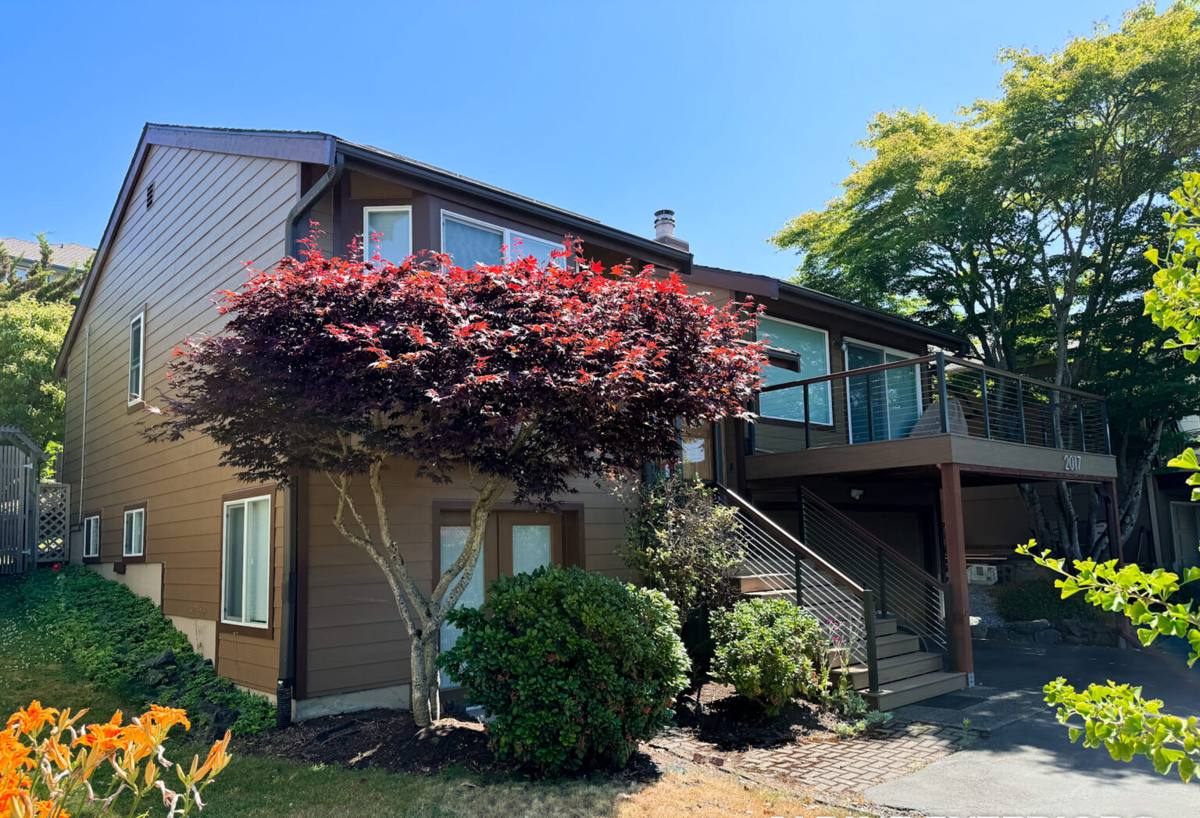
What Blaine Harbor's Climate Does to a Shingle Roof
Salt Air and Metal Fatigue
Asphalt shingles themselves tolerate salt air reasonably well, but the metal components around them — nail heads, drip edge, step flashing, valley metal — are where salt exposure shows up first. Standard electro-galvanized fasteners can start showing surface corrosion within a few years this close to the water. Once a fastener head corrodes, it loses holding power and the shingle above it becomes vulnerable to wind lift. This is a materials-selection problem as much as an installation problem, and it's one of the first things we account for differently on a harbor-adjacent job than on a job further inland.
Wind-Driven Rain
Rain that falls straight down mostly runs off the surface of a shingle and never tests the underlayment or flashing. Rain that's being pushed sideways by wind behaves differently — it can work up under shingle tabs, probe the edges of valley metal, and find gaps around penetrations like plumbing vents and chimneys. Blaine Harbor's exposure to wind off the water means wind-driven rain is a regular event here, not an occasional storm scenario. A roof system built for this needs sealed, properly lapped underlayment and flashing detail that assumes water will get past the shingle surface at some point — because here, it will.
Moss, Algae, and Shade
The marine layer and regular precipitation that make this area green also make it good moss habitat. North-facing roof slopes, and any section shaded by mature trees, stay damp longer after a rain event than a sun-exposed slope does. Moss doesn't just look bad — it holds moisture against the shingle surface, works its way under tab edges as it grows, and can lift shingles enough to let water in underneath. Roofs here need either shingles with algae-resistant granules, a plan for periodic moss treatment, or both.
What a Correct Asphalt Shingle Job Looks Like Here
A roof that's going to hold up in this environment isn't just "shingles nailed to plywood." The details that matter most in a harbor climate are usually the ones a homeowner can't see once the job is finished:
- Underlayment: A synthetic or high-quality felt underlayment installed with proper overlap, not just stapled down as an afterthought — this is the roof's real waterproofing layer, and the shingles are the wear surface on top of it.
- Ice and water shield at vulnerable points: Even in a maritime climate that doesn't see much snow, self-adhering membrane at eaves, valleys, and around penetrations protects against wind-driven rain intrusion, not just ice damming.
- Corrosion-resistant fasteners and flashing: Stainless or heavier-gauge coated fasteners and flashing in the areas most exposed to salt air, rather than the minimum-spec hardware that might be fine further from the water.
- Proper nailing pattern and count: Correct nail placement per shingle, matched to the wind exposure of this specific site, not just manufacturer minimums written for a calmer inland install.
- Ventilation that actually balances: Intake at the eaves and exhaust at the ridge sized to work together — mismatched ventilation traps moisture in the attic, which shortens the life of the roof deck from underneath.
- Valley and flashing detail sized for real water volume: Not just code minimum, but detail that accounts for the amount of water this roof will actually see in a wet Whatcom County winter.
Our Process for a Blaine Harbor Roofing Project
1. On-Site Assessment
We start by walking the roof and the attic, not just estimating from the ground. We're looking at deck condition, existing ventilation, the state of current flashing, moss and algae patterns, and any signs of past water intrusion. This tells us whether we're looking at a straightforward re-roof or whether there's deck repair or ventilation work that needs to happen first.
2. Material Selection for This Site
We talk through shingle options with your specific exposure in mind — sun-facing versus shaded slopes, how much wind the roof takes off the water, and whether algae-resistant granules are worth the modest upcharge given your tree cover and orientation. This isn't a one-size answer; a south-facing roof with little shade has different priorities than a shaded north slope near mature trees.
3. Tear-Off and Deck Inspection
Full tear-off lets us actually see the deck, not guess at its condition from above. Any soft, delaminated, or water-damaged sheathing gets replaced before anything new goes down — installing new shingles over a compromised deck just hides a problem that will resurface.
4. Underlayment, Flashing, and Ventilation
This is where the climate-specific work happens: correct underlayment lap and fastening, upgraded flashing at valleys and penetrations, corrosion-resistant hardware, and a ventilation check to make sure intake and exhaust are balanced for the roof's size and shape.
5. Shingle Installation
Shingles go down to manufacturer spec at minimum, with nailing patterns adjusted for wind exposure where the site calls for it. We keep courses straight and exposure consistent — sloppy alignment isn't just cosmetic, it can affect how well each course sheds water into the one below it.
6. Final Walkthrough
We walk the finished roof with you, cover what maintenance (if any) it needs going forward, and make sure you know what a healthy roof looks like versus early warning signs to watch for.
Shingle Options: Trade-Offs for a Harbor Property
| Shingle Type | Best Fit For | Key Trade-Off Near the Water |
|---|---|---|
| Standard 3-tab | Budget-conscious re-roofs, secondary structures | Lower wind rating and shorter lifespan under coastal exposure than architectural options |
| Architectural (laminated) | Most primary homes in this area | Better wind resistance and thicker profile hold up well to driving rain; the standard choice we recommend for harbor-adjacent homes |
| Algae-resistant (copper/zinc granules) | Shaded slopes, homes with heavy tree cover | Slightly higher upfront cost, meaningfully less moss/algae staining over time |
| Impact-rated | Homes wanting extra durability, insurance considerations | Higher cost; benefit is more about impact and hail resistance than wind or rain, so it's a secondary consideration here |
Repair, Replacement, or Maintenance?
Not every roofing call from a Blaine Harbor homeowner ends in a full tear-off. Where the roof is in its useful life, isolated repair — a damaged section after a windstorm, a failed flashing detail, a localized moss problem — makes more sense than replacement. We'll give you an honest read on which category your roof falls into rather than defaulting to the bigger job. Signs that point toward repair rather than replacement:
- Damage or wear limited to one section or slope, with the rest of the roof in good shape
- Roof is less than roughly half to two-thirds through its expected lifespan
- No signs of widespread deck damage or systemic ventilation problems
- Moss or algae staining without evidence of lifted or displaced shingles underneath
Signs that point toward full replacement:
- Granule loss and curling across multiple slopes, not just one exposed area
- Repeated leaks in different locations rather than one recurring spot
- Roof age at or past its expected service life for the material and exposure
- Deck damage found during inspection that goes beyond a small repairable area
Why Local Blaine Harbor Experience Matters
A crew that mostly works drier, calmer inland roofs can still install a technically correct shingle roof — but "technically correct by the book" and "correct for this site" aren't always the same thing. Knowing which slopes on a harbor-facing home take the worst of the wind-driven rain, which fastener and flashing upgrades are worth the cost here versus optional elsewhere, and how aggressively moss actually grows on a shaded Whatcom County slope in a normal winter — that comes from having done this work on this coastline, not from a spec sheet. We work this area regularly, which means we're not guessing at how these houses perform; we're applying what we've already seen hold up and what doesn't.
Maintaining Your Roof After Installation
A well-installed shingle roof in this climate still benefits from basic upkeep. None of this is complicated, but it's easy to let slide:
- Keep gutters clear so water isn't backing up under the eave edge during heavy rain
- Trim back tree limbs that overhang the roof to reduce shade, debris, and moss pressure
- Have moss treated before it spreads widely, rather than after it's visibly lifting shingles
- After major windstorms, do a visual check (or have us check) for lifted or missing shingles
- Watch for granules collecting in gutters, which can signal accelerating wear
Get an Honest Read on Your Roof
If you're dealing with a moss problem that keeps coming back, a roof that's getting up in years, or damage from the last big windstorm off the water, we're glad to take a look and give you a straight answer — repair, maintenance, or replacement — with no pressure either way. Reach out for a free estimate and we'll walk your roof with your specific spot on the harbor in mind.