 Semiahmoo Siding
 Why Blaine's Marine Climate Is Hard on Windows
Blaine sits right on the water, and homes near Semiahmoo deal with a climate that's tougher on windows than most people realize. It's not extreme cold or heat that causes the damage here — it's the steady, year-round combination of salt-laden air, wind-driven rain, and a moss and mildew season that can run for months. Windows that were fine when they were installed start showing their age faster in this kind of environment than they would twenty or thirty miles inland.
Salt Air and Metal Fatigue
Being close to Semiahmoo Bay and the broader Salish Sea coastline means a fine mist of salt is in the air more often than homeowners think. Over years, that salt works on window hardware — hinges, locks, balance mechanisms, and any exposed aluminum or steel components. Corroded hardware is one of the most common reasons a window that still looks fine from the curb won't lock properly or is hard to open.
Wind-Driven Rain
Whatcom County storms coming off the water don't just drop rain straight down — they push it sideways into siding and window openings. A window that would stay dry in a calm rain can still take on water when it's driven horizontally against the frame. This is why the flashing and sealing details around a window matter as much as the window unit itself, especially on walls that face the water or sit exposed to prevailing wind.
A Long Moss and Mildew Season
Cool, damp conditions for much of the year mean moss, algae, and mildew get a long runway to establish themselves on north-facing trim, sills, and anywhere water sits instead of draining. Wood trim around older windows is especially vulnerable — once moisture gets behind paint or caulking, rot can start well before it's visible from outside.
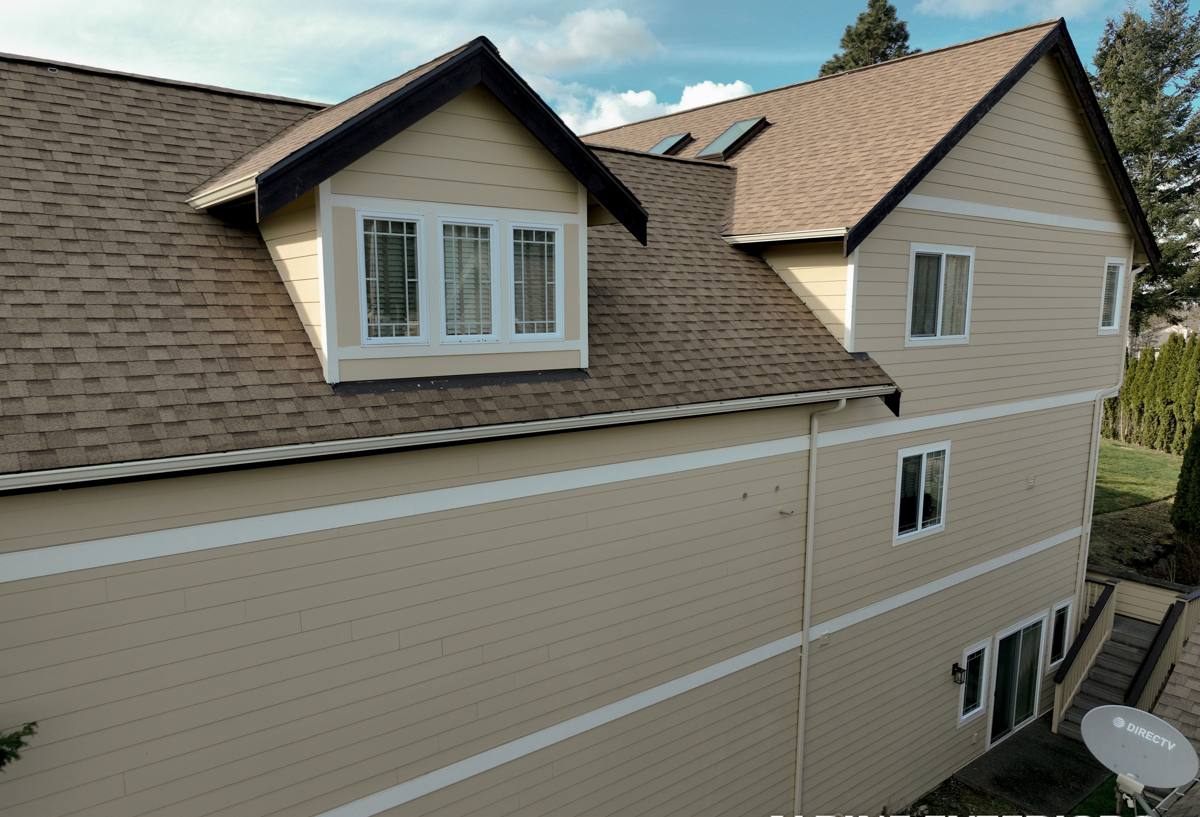
What "Energy-Efficient" Actually Means for a Blaine Home
"Energy-efficient" gets used loosely in window marketing, so it's worth being specific about what actually matters for a house in this part of Washington. Four things drive real-world performance:
- U-factor — how well the window resists heat transfer. Lower is better for keeping heat in during our long, mild-but-damp winters.
- Solar Heat Gain Coefficient (SHGC) — how much solar heat passes through the glass. Less critical here than in sunnier climates, but still worth matching to the window's sun exposure.
- Air infiltration rate — how much air leaks around the sash and frame. This is where a lot of older single-pane and early dual-pane windows fall short, and it's directly tied to comfort and heating costs.
- Glazing and gas fill — dual-pane with a low-E coating and an argon fill is the standard baseline for this climate; triple-pane is available but usually isn't necessary unless a home has unusual exposure or noise concerns.
Frame material matters just as much as the glass package, especially given the salt air and moisture load a Blaine home deals with.
| Frame Material | How It Handles This Climate | Maintenance Reality |
|---|---|---|
| Vinyl | Good moisture and salt resistance, no repainting needed | Low — occasional cleaning, check weep holes stay clear |
| Fiberglass | Excellent dimensional stability, holds up well to temperature swings and moisture | Low — durable finish, minimal upkeep |
| Wood or wood-clad | Classic look but more vulnerable to moisture intrusion near the coast if seals fail | Higher — periodic finish maintenance, closer inspection of joints |
| Aluminum | Prone to corrosion in salt air unless it's a marine-grade or well-coated product | Moderate to high — watch for pitting and hardware corrosion |
None of these are automatically wrong for every home — a wood-clad window on a covered, protected elevation can perform fine for years. The point is matching the material to where it's going on the house, not picking one finish for the whole project by default.
Warning Signs Your Current Windows Are Underperforming
Most homeowners don't replace windows because one shattered — they replace them because the windows quietly stopped doing their job. Here's what to look for on a walk around a Blaine home:
- Noticeable draft near the frame when it's windy outside
- Condensation forming between the panes (a sign the seal has failed)
- Fogging or a cloudy haze in the glass that won't clean off
- Windows that stick, won't stay open, or are hard to lock
- Soft or discolored wood trim at the sill or corners
- Visible gaps in caulking or trim that weren't there a few years ago
- Rooms near windows that feel noticeably colder than the rest of the house
- A heating bill that's crept up without an obvious explanation
Any one of these on its own might not mean much. Two or three together, especially on the side of the house that faces prevailing wind and rain, usually means it's worth having someone take a real look rather than just re-caulking and hoping.
What a Correct Installation Involves
The window unit itself is only part of the job. In a climate like this, how it's installed matters at least as much as what's installed.
Flashing and Water Management Come First
Before a new window goes in, the opening needs to be prepped so that any water that gets behind the siding or trim has somewhere to go besides your wall framing. That means proper flashing tape or pan flashing at the sill, correctly lapped house wrap, and a drainage path that doesn't trap moisture against wood framing. This step is invisible once the job is done, which is exactly why it's the step that gets skipped by installers trying to move fast.
Air Sealing and Insulation Around the Frame
A high-performance window installed with gaps around the frame will still leak air and let comfort suffer. The space between the window frame and the rough opening needs to be sealed and insulated correctly — not overpacked with expanding foam that can bow the frame, and not left with open voids that undercut the window's rated performance.
Interior and Exterior Sealant
The visible bead of caulking around a window is the last line of defense, not the first. It needs to be a sealant rated for exterior use in a wet climate, applied to a clean, dry, properly prepped surface — otherwise it fails early and gives a false sense that the window is sealed when water is already getting past it.
How We Handle a Blaine Window Project
On-Site Assessment
We start by looking at each window opening individually, not just quoting a blanket price per unit. Exposure to wind and rain, condition of the existing trim and framing, and how the opening is currently flashed all affect what the job actually requires.
Choosing the Right Product for Each Opening
Not every window on a house needs the same spec. A window on an exposed, water-facing wall may call for a different frame material or glazing package than one on a sheltered, covered elevation. We'll walk through the honest trade-offs — cost, maintenance, and expected lifespan — rather than upselling every opening to the top-tier product.
Install Day
Old windows come out, the opening gets inspected for hidden water damage before anything new goes in, and any rot or compromised framing gets addressed rather than covered over. New flashing and sealing goes in per manufacturer specification, the window gets set, shimmed level and square, and insulated and sealed properly around the frame.
Final Check
Before we call a job done, every new window gets operated, checked for square and smooth function, and inspected inside and out for a clean, sealed finish. We'll walk it with you so you know what to look for going forward.
Cost Factors Worth Understanding
We don't publish blanket per-window pricing because it genuinely varies with the details of the job — but here's what actually drives the cost on a Blaine project:
| Factor | Why It Affects Cost |
|---|---|
| Window size and configuration | Larger units, sliders, and custom shapes cost more than standard double-hung or casement sizes |
| Frame material | Vinyl is typically the most affordable; fiberglass and wood-clad run higher |
| Number of openings | Full-house replacements typically bring a better per-unit cost than one-off replacements |
| Condition of the existing opening | Hidden rot or water damage found during removal adds repair work before the new window goes in |
| Access and elevation | Second-story or hard-to-reach openings take more time and equipment |
As a rough sense of scale, a single window replacement on a straightforward opening typically runs from the low hundreds into the low thousands of dollars, with full-house projects scaling from there — but the only way to get a real number is to have the openings looked at.
Why a Crew That Already Works Blaine and Semiahmoo Matters
A crew that regularly works this stretch of Whatcom County has already seen how the local exposure plays out on real houses — which elevations take the worst of the weather, how older homes in this area were typically built and flashed, and what corrosion and rot actually look like here versus a drier inland climate. That's not something a crew based well outside the area picks up on the first visit. It also means we're not guessing at permitting expectations or driving distance when it comes to scheduling and follow-up.
Keeping New Windows Performing for the Long Run
New windows installed correctly should need very little from you, but a little seasonal attention goes a long way in this climate:
- Rinse salt residue off frames and glass periodically, especially on water-facing sides of the house
- Keep weep holes at the bottom of the frame clear of debris so water can drain
- Check caulking annually for cracking or separation and touch up early rather than waiting
- Wipe down tracks and hardware to keep moving parts free of grit and salt buildup
- Watch nearby trim and siding for moss or mildew and address it before it spreads to the window frame
None of this is a heavy maintenance burden — it's the kind of upkeep that protects the investment you just made and keeps the windows performing the way they're supposed to for years.
If your Blaine home's windows are drafty, fogged, hard to operate, or just due for an honest look, we're happy to come out and take a look. The estimate is free, there's no pressure, and you'll get a straight answer about what your windows actually need — just fill out the form below to get started.