 Semiahmoo Siding
 Birch Bay's Waterfront Climate Asks More of Your Siding Than Most Homes Ever See
Birch Bay sits right on the water, and that changes what a home's exterior has to survive year after year. Salt-laden air off the bay accelerates corrosion on fasteners, hardware, and any siding material that isn't built to shed moisture cleanly. Driving rain off Georgia Strait and Puget Sound hits west- and south-facing walls at an angle, not straight down, which means siding here deals with wind-driven water intrusion far more than siding on a home fifty miles inland. Add in Whatcom County's long, damp shoulder seasons — moss and algae get a real head start on any surface that stays wet for weeks at a time — and you have a climate that punishes siding installed to a generic, one-size-fits-all standard.
None of this means Birch Bay homes need anything exotic. It means the siding material, the water management behind it, and the installation details all have to be right, because there's very little margin for error when a house sits this close to the water.
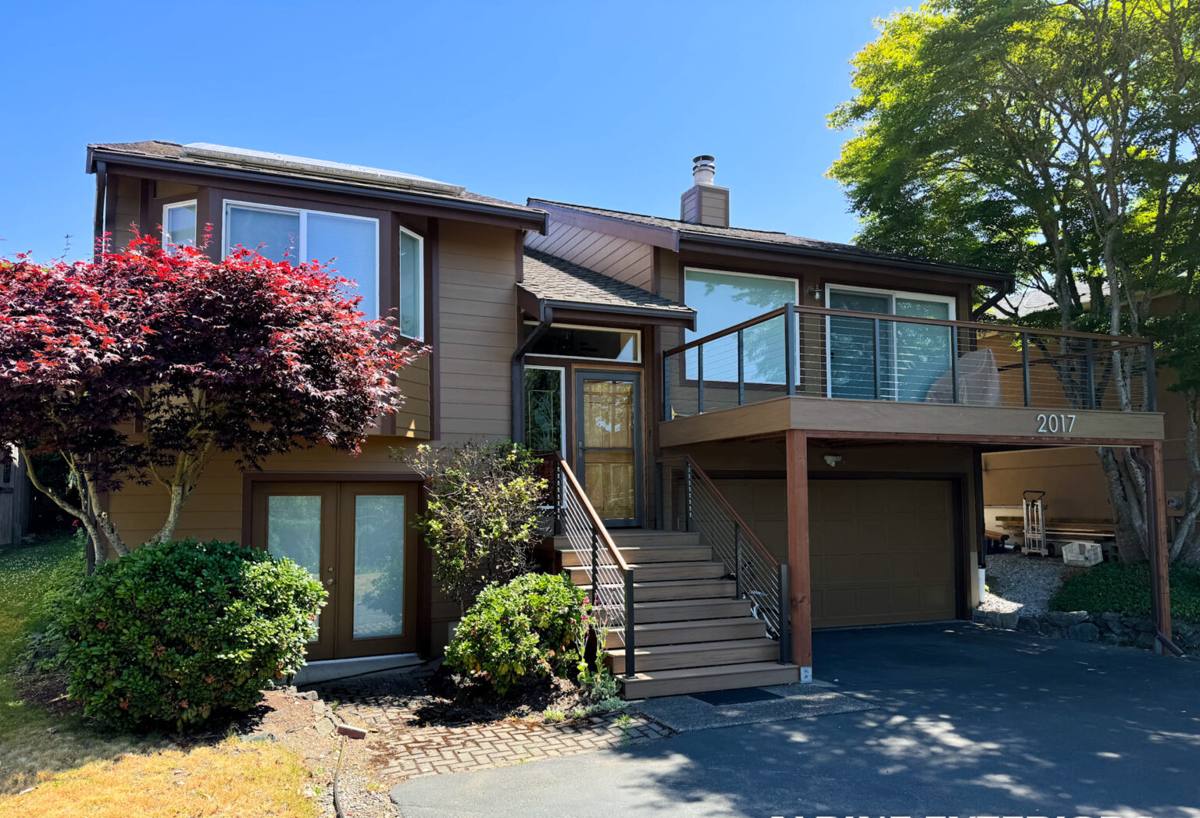
Signs a Birch Bay Home Needs Siding Replacement, Not Another Repair
Homeowners in this area often ask us to patch a problem area before realizing the underlying material is failing more broadly. Some signs point clearly toward full replacement rather than spot repair:
- Soft or spongy spots when you press on the siding, especially near the bottom courses and around window and door trim
- Persistent moss or algae growth that comes back within a season or two of cleaning
- Paint that's blistering, peeling, or needing repainting far more often than it should
- Visible warping, cupping, or buckling of panels, especially on walls that face the water or prevailing wind
- Rust streaking from fasteners or trim hardware, a common sign of salt-air corrosion
- Gaps opening up at seams, corners, or trim joints that let wind-driven rain track behind the siding
Any one of these can sometimes be handled locally, but when several show up together, it usually means moisture has been getting behind the siding for a while — and that's a job for full replacement with proper water management, not another round of caulk and paint.
Why We Install Only James Hardie Fiber Cement
We made a decision as a company to install James Hardie fiber cement siding exclusively, and we don't install vinyl, LP SmartSide, Cemplank, Allura, primed spruce, or cedar. That's not a marketing line — it's a standard we hold ourselves to because of what we've seen play out on coastal Whatcom County homes over time.
What Other Materials Get Right — and Where They Fall Short Here
Vinyl siding is inexpensive and low-maintenance in mild climates, but it's a petroleum-based product that expands, contracts, and can become brittle in cold snaps, and it isn't rated as a non-combustible material. LP SmartSide and other engineered wood products perform reasonably well when installation and caulking are perfect and stay perfect for decades — a tough bar to clear on a home exposed to constant salt air and wind-driven rain, since any breach in the wood fiber's protective coating opens the door to swelling and rot. Cedar is a beautiful, genuinely traditional Pacific Northwest material, but real cedar siding needs consistent refinishing and is vulnerable to moisture, insects, and the same moss growth that plagues every organic surface in this climate. Primed spruce carries similar exposure risk without cedar's natural rot resistance.
Why Hardie Fits Birch Bay Specifically
James Hardie fiber cement is manufactured from cement, sand, and cellulose fiber — it doesn't rot, it isn't a food source for moss or insects, and it's non-combustible. It holds paint and factory-applied ColorPlus finishes far longer than wood-based products because fiber cement doesn't expand and contract with moisture the way wood does. For a home taking on salt air and driving rain nine months a year, that stability is the whole point.
| Factor | James Hardie Fiber Cement | Vinyl / Engineered Wood / Cedar |
|---|---|---|
| Moisture behavior | Dimensionally stable, doesn't swell or rot | Can swell, warp, or rot if moisture gets behind it |
| Combustibility | Non-combustible material | Vinyl and wood-based products are combustible |
| Salt-air durability | Engineered for coastal exposure (HZ product line) | Variable; often not climate-specific |
| Finish longevity | Factory ColorPlus finish, long repaint intervals | Field-painted finishes fade and chalk sooner |
| Moss/algae resistance | Non-organic surface, doesn't feed growth | Wood-based products are more susceptible |
| Warranty structure | Strong, transferable manufacturer warranty | Varies widely by product and manufacturer |
What a Correct Siding Replacement Actually Involves
Siding is only as good as what's behind it. A large share of the siding failures we see on Birch Bay homes trace back to water management problems, not the siding material itself. Doing this job right means treating the wall assembly as a system, not just swapping panels.
Tear-Off and Inspection
We remove the old siding down to the sheathing and inspect for rot, soft spots, and existing moisture damage before anything new goes up. Skipping this step is how new siding ends up installed over a problem that keeps growing behind it.
Weather-Resistive Barrier and Flashing
A properly lapped weather-resistive barrier, correctly integrated window and door flashing, and attention to every penetration — vents, hose bibs, light fixtures — are what actually keep wind-driven rain out of the wall assembly. This is where most of the real protection comes from, and it's the step that's easiest to shortcut and hardest to inspect once the siding is up.
Installation to Manufacturer Spec
James Hardie siding has specific fastening patterns, clearances, and caulking requirements, and following them precisely is what keeps the manufacturer warranty valid and the siding performing as engineered. Proper clearance from grade, decks, and roof lines matters especially near the water, where splashback and standing moisture are more common.
Trim, Caulking, and Finish Detail
Corners, trim boards, and joints get finished with materials and sealants compatible with fiber cement, and painted or color-matched to the ColorPlus factory finish where field painting is required.
Our Process for a Birch Bay Siding Replacement
| Step | What Happens |
|---|---|
| 1. On-site assessment | We walk the exterior, check for moisture and rot, and evaluate wind/water exposure by elevation |
| 2. Product and color selection | We help you choose the right Hardie profile and HZ product line for your home's exposure |
| 3. Written estimate | Clear scope, materials, and pricing before any work begins |
| 4. Tear-off and sheathing inspection | Old siding removed, damaged sheathing identified and addressed |
| 5. Water management install | Weather-resistive barrier and flashing installed per manufacturer and code requirements |
| 6. Hardie siding install | Installed to manufacturer spec, including fastening, clearances, and joint treatment |
| 7. Final walkthrough | We review the completed work with you before calling the job done |
Choosing the Right Hardie Product Line for a Coastal Property
James Hardie's HZ5 and HZ10 product lines are engineered for different climate zones, with formulations adjusted for moisture and temperature exposure specific to each region. Birch Bay's marine exposure is a real factor in that selection — it's not just a style choice, it's a performance one. We'll talk through lap siding versus panel systems, trim profiles, and which ColorPlus finish options hold up best against sun and salt exposure on your home's specific orientation, since a wall facing the water takes a different beating than one tucked on the lee side of the house.
Cost Factors for Siding Replacement in Birch Bay
Every home is different, but the factors that move the price on a siding replacement are consistent. We'll always give you a written, itemized estimate rather than a ballpark number, but here's what typically drives cost up or down:
| Factor | Why It Matters |
|---|---|
| Existing sheathing condition | Rot or water damage found during tear-off adds repair scope |
| Home size and wall complexity | More corners, dormers, and trim detail mean more labor |
| Siding profile and product line | Panel style and HZ line selection affect material cost |
| Trim and finish work | Custom trim, corner details, and paint-grade finishing add time |
| Access and site conditions | Steep grades, waterfront lots, and limited access affect labor and equipment needs |
| Tear-off and disposal | Volume and type of old material removed factors into cost |
What to Ask Before Hiring a Siding Contractor in This Area
Coastal Whatcom County homes deserve a contractor who understands the specific demands of this environment, not just siding installation in general. Before hiring anyone for a Birch Bay siding project, it's worth asking:
- Do you install to the manufacturer's published fastening and clearance specifications, and can you explain why they matter here?
- How do you handle weather-resistive barrier and flashing details around windows, doors, and penetrations?
- What's your experience with homes exposed to salt air and wind-driven rain specifically?
- Is the manufacturer warranty transferable, and what voids it?
- Will I get a written scope and estimate before work begins?
- How do you handle sheathing repairs if rot is found during tear-off?
A contractor who can answer these clearly, without vague reassurances, is one who's actually done this work on homes like yours before.
Why Local Experience in Birch Bay Matters
Siding performance isn't uniform across Whatcom County — a home a block from Birch Bay's shoreline faces different wind and moisture exposure than one further inland, and the right flashing details, clearances, and even panel orientation can shift accordingly. A crew that already works this specific stretch of coastline has seen how salt air, moss, and driving rain actually behave on homes here, rather than applying generic assumptions from a different climate. That familiarity shows up in the small decisions made on-site — where extra flashing attention is warranted, how much clearance to leave at grade, which orientation needs the most protection — decisions that are hard to get right without local, hands-on experience.
Caring for Your New Siding After Installation
James Hardie fiber cement is low-maintenance compared to wood-based alternatives, but "low-maintenance" isn't "no-maintenance," especially in a coastal moss season. A periodic gentle rinse to keep organic growth from taking hold, prompt attention to any caulking that shows wear at trim joints, and keeping gutters clear so water isn't cascading down a wall it wasn't meant to hit will keep your siding performing the way it's engineered to for decades.
If your Birch Bay home is showing signs of siding wear, or you're simply ready to stop fighting moss, moisture, and paint failure every year, we're happy to take a look. Use the form below to request a free, no-pressure estimate — we'll walk the exterior with you and give you a straight answer on what your home actually needs.