 Semiahmoo Siding
 Why Bellingham Decks Wear Differently Than Decks Built Inland
A deck built in Bellingham does not age the same way as one built forty miles inland. The combination of salt-laden air off the water, long stretches of driving rain, and a moss season that can run from fall through spring puts a different kind of stress on wood, fasteners, and finishes than most manufacturers assume when they write their installation guides. Homeowners who move here from drier climates are often surprised at how quickly an untreated or improperly built deck starts to show problems — cupped boards, rusted screw heads bleeding through the finish, green film on the walking surface, or soft spots where water has been sitting against end grain for months at a time.
None of this means a deck can't last for decades in this area. It means the build has to account for the environment from the start, not get patched after the fact. That's the difference between a deck that needs real repair work in year five and one that's still solid in year twenty-five.
What "Salt Air" Actually Does to a Structure
Coastal air carries fine salt particles that settle on any exposed metal and accelerate corrosion, especially on fasteners, brackets, and hardware that aren't rated for it. On a deck, that's the ledger board connection, the joist hangers, and every screw holding the decking down — all hidden or semi-hidden points that are hard to inspect casually but are exactly where structural failure starts if the wrong materials were used.
What "Driving Rain" Does to a Deck
Wind-driven rain doesn't just fall straight down — it gets pushed sideways into gaps, under flashing, and behind ledger boards where a calmer climate's rain never would reach. That means flashing details and water-shedding gaps matter more here than in a lot of the country, particularly at the point where the deck framing meets the house.
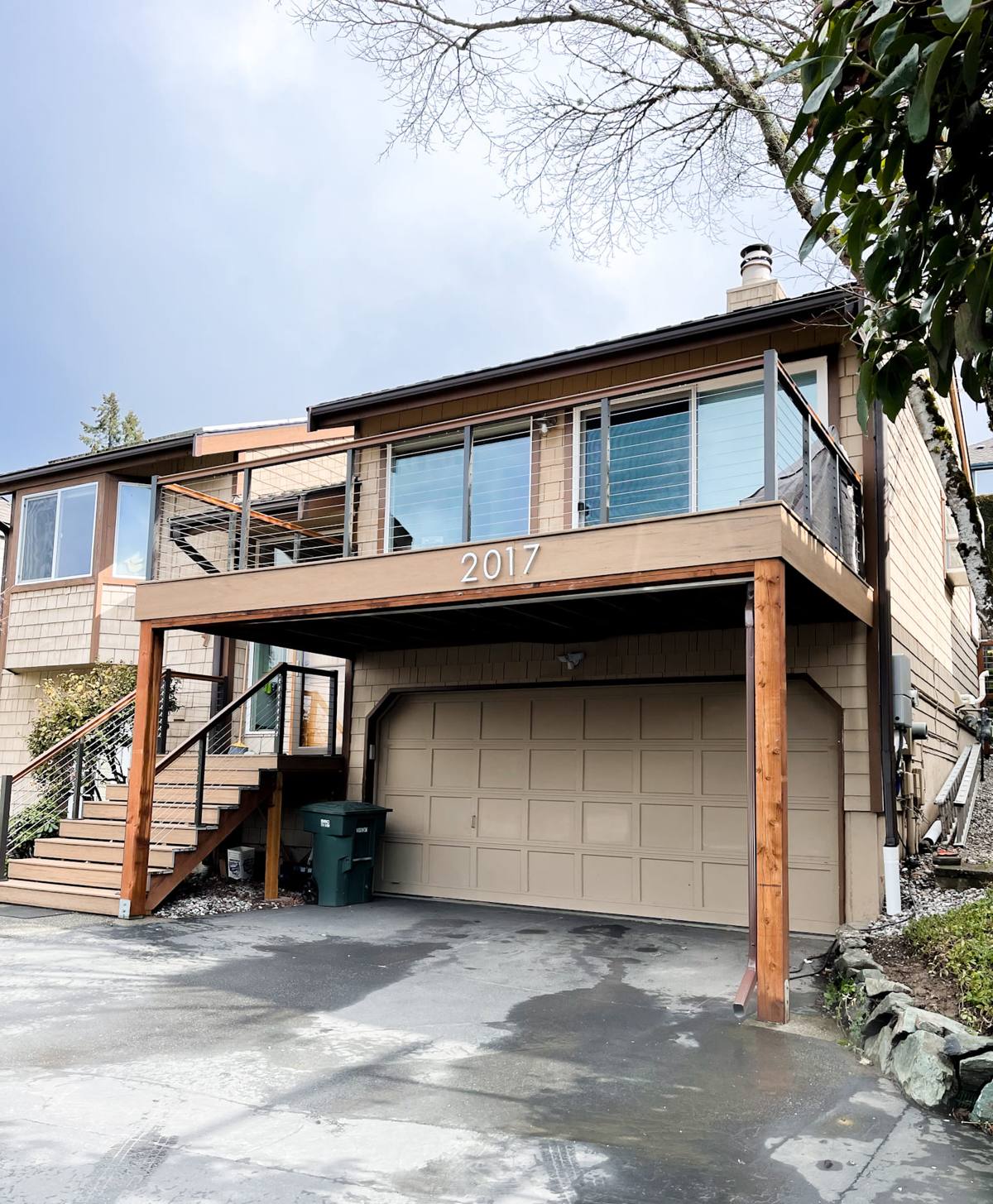
What a Correctly Built Deck Requires in This Climate
A deck built for Bellingham weather isn't a different design so much as a more disciplined one. The visible decking gets most of the attention from homeowners, but the parts that actually determine how long a deck lasts are underneath it.
Ledger Flashing
The ledger board — the piece that attaches the deck to the house — is the single most common failure point on any deck, anywhere, and it's worse in a wet climate. Correct flashing at this connection keeps water from getting behind the siding and rotting the house's rim joist, not just the deck itself. This is not an area to shortcut.
Fastener Selection
In a coastal environment, standard exterior-rated screws and hangers corrode faster than they would inland. Stainless steel or heavy hot-dip galvanized hardware rated for coastal exposure costs more up front but avoids the rust streaks and weakened connections that show up within a few years when the wrong fasteners are used.
Footings and Framing
Whatcom County's clay-heavy, moisture-retentive soils in many areas mean footings need to be sized and set to local frost depth and drainage conditions, not just poured to a generic minimum. Undersized or shallow footings are a common source of deck movement over time in wetter ground.
Choosing a Decking Material for Bellingham's Weather
There's no single "best" decking material — there's a best material for a given budget, maintenance appetite, and how close the home sits to salt air or heavy shade. Here's an honest comparison of the main options we work with:
| Material | Moisture & Moss Resistance | Maintenance | Realistic Lifespan Here | General Cost Tier |
|---|---|---|---|---|
| Pressure-treated wood | Good if sealed regularly; end grain is the weak point | Annual cleaning and periodic re-sealing | 15-20 years with upkeep | Budget |
| Cedar | Naturally rot-resistant but needs finish maintenance to hold color and resist moss | Moderate to high — sealing every 1-2 years | 20-25 years with upkeep | Mid-range |
| Capped composite | Excellent — the cap layer resists moisture absorption and moss staining much better than wood | Low — occasional washing | 25-30+ years | Mid to premium |
| PVC decking | Excellent — no wood fiber to hold moisture at all | Low | 25-30+ years | Premium |
We're honest with clients that composite and PVC cost more up front but remove most of the maintenance burden that wood carries in this climate. Wood costs less initially but only holds up if someone actually keeps up with sealing and cleaning on schedule — which, realistically, a lot of busy households don't. Neither choice is wrong; it's about matching the material to how much upkeep you actually want to do.
A Note on Uncapped Composite
Some older or budget composite products don't have a fully capped surface. In a climate this wet, uncapped composite can absorb moisture at the surface and develop staining or mold growth faster than a fully capped board. As a professional standard, we steer clients toward fully capped products for anything installed here — it's a maintenance and moisture-behavior tradeoff, not a knock on composite decking as a category.
Moss, Mildew, and Designing for Drainage
Moss doesn't grow on a deck because the deck is dirty — it grows because moisture sits on a surface long enough for spores to take hold, which in Whatcom County's wet season can be most of the year in shaded or low-airflow areas. Design choices made during the build determine how much of a moss problem a deck develops later.
Board Spacing and Airflow
Correct gapping between boards lets water drain through instead of pooling on the surface, and proper ventilation underneath the deck keeps the framing drying out between rain events instead of staying damp continuously.
Slope and Drainage Path
A deck surface should have a slight, consistent slope away from the house so water sheds off rather than collecting in low spots. Where a deck sits under trees or in a shaded side yard — common in a lot of Bellingham lots — moss pressure is higher and design margins matter more.
Under-Deck Drainage Systems
For decks with usable space underneath, an under-deck drainage system can keep that area dry and usable rather than becoming a chronically damp, moss-prone spot. This is worth discussing at the design stage rather than adding later.
Our Deck Building Process
We keep the process straightforward and communicate clearly at each stage, since a deck build affects daily life at the house for a period of time.
- On-site assessment: we look at sun exposure, drainage patterns, soil conditions, and how the deck ties into the existing house structure.
- Design and material discussion: honest conversation about material tradeoffs, layout, and budget — no upselling toward a product that doesn't fit your situation.
- Permitting: we handle the permit application and coordinate required inspections with the local jurisdiction.
- Framing and structural work: footings, ledger flashing, joists, and hardware — the part that determines longevity.
- Decking, railing, and finish work: the visible layer, installed to shed water correctly.
- Final walkthrough: we go over the finished deck and basic care with you before calling the job done.
Permits and Code Considerations in Whatcom County
Most new deck construction and many significant deck repairs require a building permit and inspection in this area. Requirements can touch on guardrail height, baluster spacing, footing depth, and setback from property lines, and they vary depending on the specific jurisdiction your property falls under within Whatcom County. Rather than guessing, we handle the permit application and inspection scheduling as part of the build so the finished deck is code-compliant from day one — this also matters for resale and insurance down the road, since an unpermitted deck can become a problem when a home is sold or refinanced.
Deck Maintenance Checklist for Bellingham Homeowners
Whatever material you choose, a little seasonal attention goes a long way in this climate. Here's what we recommend keeping on a regular schedule:
- Sweep leaves and debris off the deck surface regularly, especially in fall — trapped organic material is what feeds moss and mildew growth.
- Check that gaps between boards are clear and not clogged with debris that blocks drainage.
- Rinse or lightly scrub the surface periodically during the wet season to interrupt moss and algae before it takes hold.
- Inspect fasteners and hardware yearly for rust streaks or loosening, particularly near the ledger board connection.
- Re-seal wood decking on the schedule appropriate to the product — don't wait until it's visibly gray and cracking.
- Check under-deck areas and footings periodically for standing water or signs of soil erosion.
- Trim back overhanging branches or vegetation that keeps the deck surface shaded and damp longer than necessary.
Why Hiring a Crew That Already Works in Bellingham Matters
A lot of deck-building mistakes in this region come from good crews applying generic, one-size-fits-all methods that work fine in drier climates but fall short here. Knowing which fastener grades hold up against salt air, how to detail ledger flashing for wind-driven rain, and how much drainage margin to build in for a moss-prone shaded lot isn't something you learn from a manual — it comes from building decks in this specific environment and seeing what holds up over years, not just what passes inspection on day one.
We build decks for homes throughout the Bellingham area with that local knowledge built into every stage of the process, from footing depth to fastener choice to how the boards are spaced. The goal is a deck that still looks and performs well after a decade of Whatcom County winters, not just one that looks good the week it's finished.
If you're planning a new deck or replacing one that hasn't held up, we're happy to walk the site with you and give you a straightforward, no-pressure estimate — just fill out the form below to get started.