 Semiahmoo Siding
 Salt Air, Wind, and Moss: What Semiahmoo Resort Roofs Are Up Against
Semiahmoo Resort sits out on the water, and that location cuts both ways. The view is part of why people love it there, but a roof out on the spit near Drayton Harbor and Semiahmoo Bay takes a beating that a roof ten miles inland never sees. Salt-laden air carries corrosive salts that settle on metal flashing, fasteners, and gutter systems, slowly working at anything that isn't rated to handle it. Add in wind gusts that come straight off open water with nothing to break them up, driving rain that gets pushed sideways under shingle edges instead of just falling straight down, and a moss season that runs long in Whatcom County's mild, wet climate, and you get a roof that ages differently than one across the county.
None of this means Semiahmoo Resort roofs are doomed to fail early. It means they need repairs done with those specific stressors in mind. A patch job that would hold up fine in a drier, calmer part of the county can fail fast out here if it doesn't account for wind uplift, salt exposure, and moisture that lingers under moss mats.
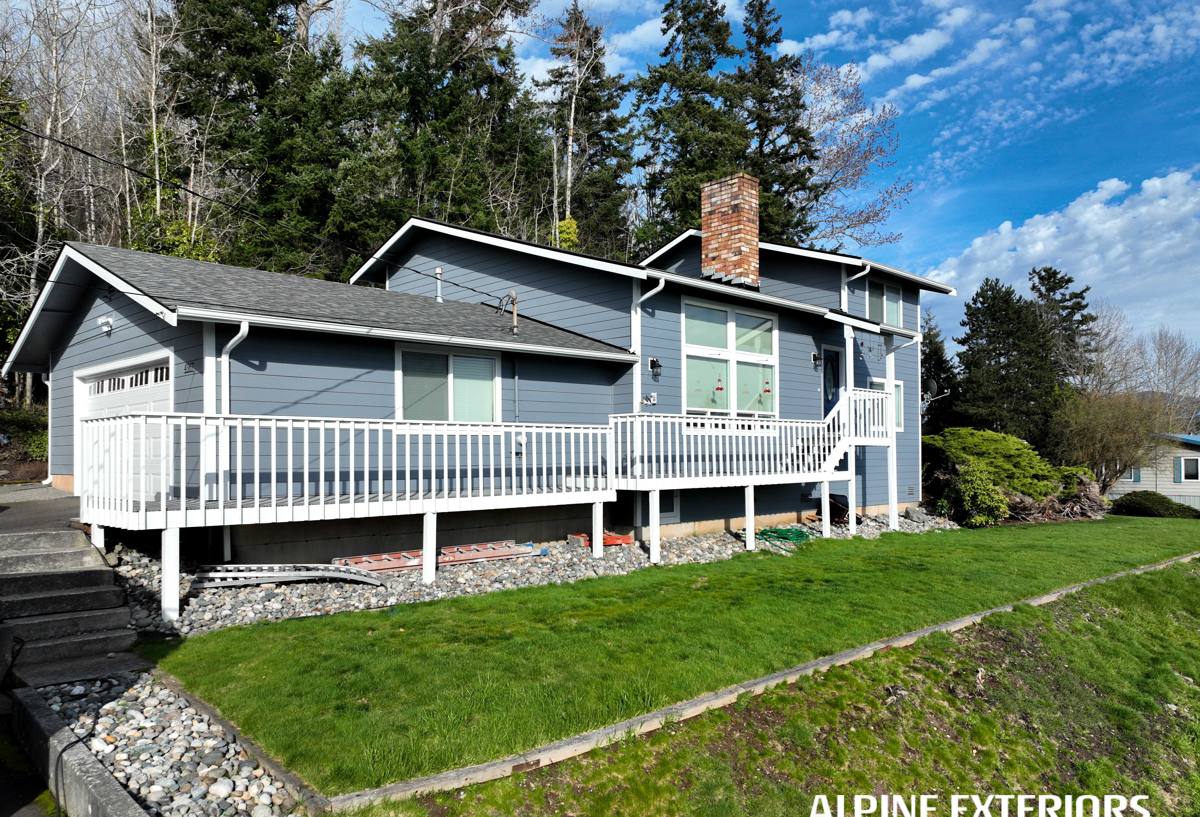
What Storm Damage Actually Looks Like on a Roof Out Here
Wind-Driven Damage
Wind off the water doesn't just rattle a few shingles — it gets underneath them. Once wind gets under a shingle edge, it can lift and crease it, break the seal strip, or tear it off completely. Ridge caps and shingles near roof edges and corners take the worst of it, since that's where uplift forces concentrate. After a windstorm, it's common to find shingles that look mostly fine from the ground but have broken seals or cracked mat underneath.
Moss and Moisture Damage
Whatcom County's moss season stretches across most of the wet months, and Semiahmoo Resort's tree cover and marine humidity keep roofs damp longer than they'd be further inland. Moss holds water against the shingle surface and roof deck, which accelerates granule loss, softens the mat, and can work its way under shingle tabs and around flashing. Left alone, a moss mat turns a minor storm event into a real leak because the roof surface underneath it never fully dries out between rains.
Flashing and Penetration Failures
Flashing around chimneys, skylights, vents, and roof-to-wall transitions is where most storm-related leaks actually originate — not the open field of shingles. Salt air speeds up corrosion on lower-grade metal flashing and fasteners, and once a flashing seal is compromised, wind-driven rain finds its way in during the next storm even if the shingles themselves are intact.
Gutter and Drainage Damage
Storms overload gutters with debris and wind-torn material at the same time water volume spikes. A gutter that's pulled away from the fascia, sagging, or clogged with moss debris backs water up under the roof edge, which can cause damage well past the gutter line itself.
What a Correct Storm Damage Repair Actually Involves
A repair that just covers the visible hole is a temporary fix, not a real one. A correct repair traces the damage back to its cause and addresses the whole path water could travel — not just the spot where it showed up inside the house.
| Damage Type | What's Driving It Here | What the Repair Should Address |
|---|---|---|
| Lifted or missing shingles | Wind uplift off open water, weakened seal strips | Matching replacement shingles, re-sealing adjacent tabs, checking underlayment beneath the gap |
| Moss-softened shingle sections | Long wet season, shade, marine humidity | Careful moss removal, deck inspection for rot, shingle replacement where the mat is compromised |
| Corroded or lifted flashing | Salt air exposure, age of original metal | Full flashing replacement (not caulk-over), correct step and counter-flashing detail |
| Gutter separation or sagging | Storm debris load, wind stress on fasteners | Re-securing or replacing hangers, clearing drainage path, checking fascia condition |
| Interior water staining | Any of the above left unaddressed for one or more storms | Tracing the actual entry point before patching — staining location rarely matches the leak source directly |
Our Process for Semiahmoo Resort Storm Repairs
- On-site inspection. We walk the roof and the attic when it's safe to do so, checking not just the obvious damage but the areas around it — flashing, adjacent shingle courses, decking condition.
- Honest scope and documentation. We tell you what's actually damaged versus what's just aged, and document everything with photos, which matters if you're filing an insurance claim.
- Material matching. We try to match existing shingle color and profile as closely as possible for a repair, and use flashing metal and fasteners suited to marine air exposure rather than standard-grade materials.
- Repair execution. We fix the root cause first — deck, flashing, underlayment — then the visible surface layer, so the repair holds through the next storm instead of just the next dry spell.
- Follow-up check. On larger repairs, we recommend a follow-up look after the next significant storm to confirm everything performed as expected.
Repair Costs: What Actually Drives the Price
Storm repair costs vary a lot based on scope, and anyone who quotes you a firm number before inspecting the roof is guessing. That said, here's how the general cost drivers break down:
| Scope of Work | What's Typically Involved | General Price Range |
|---|---|---|
| Minor flashing or shingle repair | A handful of shingles, one flashing point | Several hundred dollars |
| Section repair | A damaged slope or area with moss/rot involvement | Roughly $1,000–$4,000 |
| Extensive storm repair or partial reroof | Multiple slopes, deck repair, gutter work | Several thousand dollars and up |
| Full replacement | Roof age plus storm damage justifies a full tear-off | Varies significantly by roof size and material |
Steep or difficult roof access, the amount of deck repair needed once shingles come off, and whether flashing needs full replacement versus resealing all move the number within these ranges.
Repair or Replace? Reading the Signs
Storm damage sometimes just needs a targeted fix. Other times it's the event that exposes a roof that was already near the end of its useful life. A few honest signs it's time to talk replacement instead of another repair: the roof is already past its expected lifespan for its material, this is the second or third storm repair in a few years, moss and moisture damage has spread across multiple sections rather than staying isolated, or the decking underneath shows soft spots in more than one area. We'll always tell you straight which category your roof falls into rather than steering you toward the bigger job by default.
Insurance Considerations After a Storm
If a storm event caused the damage, your homeowner's policy may cover some or all of the repair. What helps most is documentation from before the adjuster arrives — clear photos of the damage, a written description of when it appeared relative to the storm, and an inspection report that separates storm damage from pre-existing wear. Insurance adjusters are looking for that distinction, and a vague or inflated damage claim can slow down or reduce a payout as easily as an understated one. We document what we find plainly and let that documentation speak for itself.
Why a Crew That Already Works Semiahmoo Resort Matters
Roofing work in a resort community isn't quite the same as a standalone house on a regular street. There's often coordination involved — access considerations, shared drives, or general community expectations around noise and scheduling — and a crew that's already familiar with that saves everyone friction. Beyond logistics, familiarity with how this specific stretch of Whatcom County coastline behaves matters: knowing which flashing details actually hold up against salt air over years, not just on installation day, and knowing that a roof here needs its moss addressed proactively rather than after it's already caused damage. That's the kind of judgment that only comes from doing the work in this exact area repeatedly, not from a general roofing price list.
What to Do Right After a Storm
- Do not get on the roof yourself — storm-damaged roofing and wet, salt-air-slick surfaces are a real fall hazard.
- Check the attic or top-floor ceilings for any new staining, dripping, or damp insulation.
- Photograph any visible exterior damage from the ground — missing shingles, torn gutters, debris on the roof.
- Tarp only if you can do so safely from a ladder without walking the roof surface, or leave it to a professional.
- Call for an inspection promptly — a small storm-related opening gets worse with every additional rain event, especially in a wet stretch of weather.
- Hold onto any storm damage photos and notes for your insurance file, even if you're not sure yet whether you'll file a claim.
If you've had storm damage to a roof in Semiahmoo Resort, or you just want an honest look at how your roof is holding up against the salt air and wind out there, we're glad to come take a look. The estimate is free, there's no pressure attached to it, and you'll get a straight answer about what actually needs fixing.