 Semiahmoo Siding
 Why Drayton Harbor Is a Tough Place for Siding
Homes along Drayton Harbor sit right where marine weather meets the shoreline. That means salt-laden air moving off the water, wind-driven rain that hits walls at an angle instead of falling straight down, and a long stretch of the year — fall through spring — where surfaces rarely get a chance to fully dry out. Add the shade from mature trees common in this part of Whatcom County and you get an extended moss and algae season that keeps siding damp longer than homeowners further inland ever have to deal with.
None of this is unusual for the area, but it is hard on exterior materials that weren't built with it in mind. Wood swells and checks. Vinyl can warp or fade and offers no real defense against moisture getting behind it. Even good products fail early when the installation details — flashing, gaps, fastening — aren't matched to what this specific climate demands. The siding that lasts in Drayton Harbor is the siding that was chosen and installed with salt air, driving rain, and moss season specifically in mind.
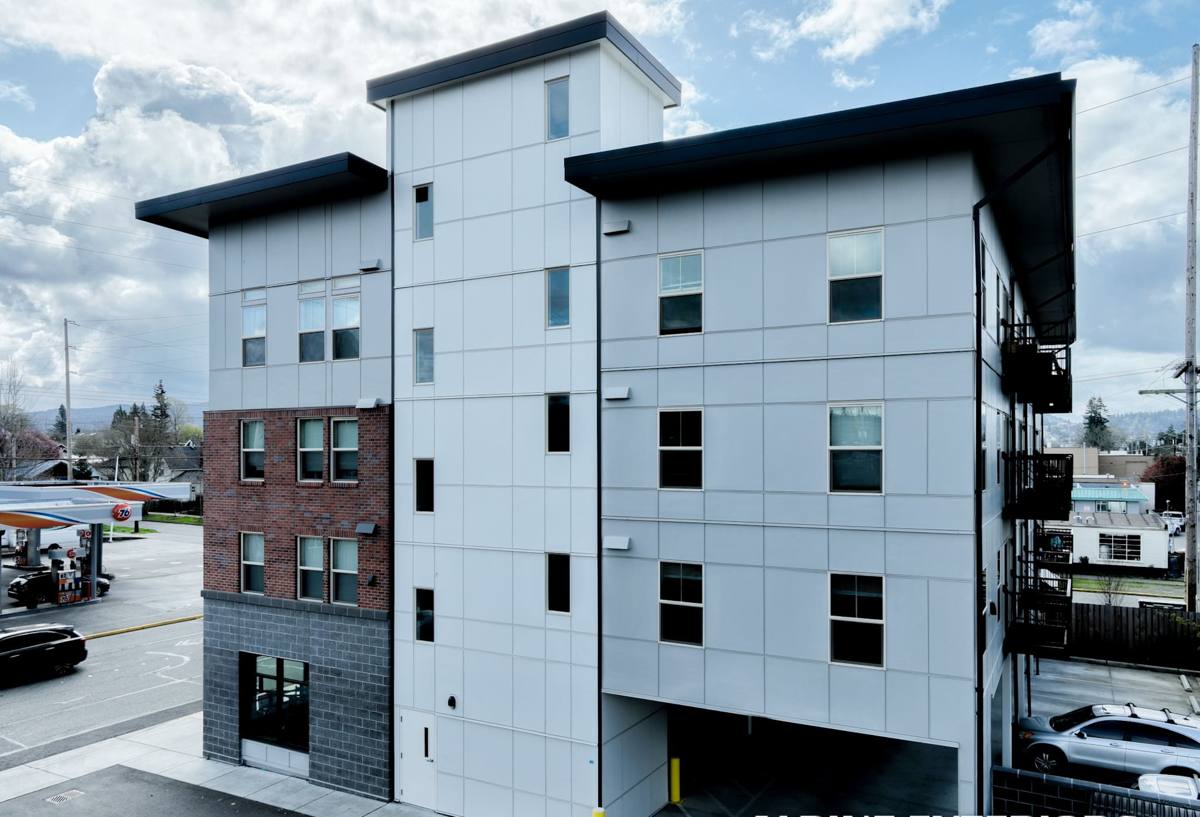
Why We Only Install James Hardie Fiber Cement Here
We install James Hardie fiber cement exclusively, and in a location like Drayton Harbor the reasoning is straightforward. Fiber cement is made from cellulose fiber, sand, and cement — it doesn't rot, it doesn't feed insects, and it isn't fazed by salt spray the way untreated wood or lower-grade composites can be. James Hardie also engineers specific product lines (their HZ system) for different climate zones, so the boards going on a Drayton Harbor home are formulated for a wet marine environment rather than a generic one-size-fits-all product.
What "Climate-Engineered" Actually Means
It's not a marketing phrase. HZ5 boards are formulated with moisture and freeze-thaw resistance suited to the Pacific Northwest, as opposed to HZ10 boards built for hot, dry, high-UV regions. Using the correct HZ designation for this coastal microclimate matters more here than it would on a home 100 miles inland — it affects how the board handles repeated wetting, and how well the factory finish holds up against salt exposure over decades.
ColorPlus Finish and Salt Air
James Hardie's ColorPlus finish is baked on at the factory under controlled conditions, which gives it better adhesion and UV resistance than most siding painted on site. In a salt-air environment, a factory finish that resists chalking and fading matters more than it would in a dry climate — repainting a whole house exposed to marine air on a short cycle gets expensive fast, and ColorPlus is built to push that timeline out considerably.
What a Correct Installation Involves
Fiber cement is only as good as the install behind it. This is where a lot of siding problems on the water actually originate — not from the material, but from shortcuts in the details that don't show up until years later.
The Rainscreen Gap
In a high-moisture climate like this one, we install fiber cement over a rainscreen — a small drainage gap between the siding and the weather-resistant barrier — rather than nailing it flat against the wall. That gap lets any moisture that does get past the siding drain and dry out instead of sitting against the sheathing. On a home exposed to driving rain off the harbor, this detail does a lot of the real work.
Flashing and Water Management
Every window, door, and horizontal trim transition is a place water can find its way behind the siding if it's not flashed correctly. We integrate flashing with the weather-resistant barrier so water is always directed outward and down, never trapped behind the cladding. This is standard practice, but it's also the single most common thing rushed on lower-bid siding jobs — and the first thing that fails in a wet climate.
Fastening and Gaps
James Hardie specifies exact fastener types, spacing, and butt-joint gaps for a reason: fiber cement needs room to expand and contract with moisture and temperature without buckling or cracking the caulk joints. We follow Hardie's published fastening schedule rather than a generic "close enough" approach, because in a marine climate the boards are cycling through wet and dry conditions more often than they would inland.
Our Process for Drayton Harbor Homes
- On-site assessment: We look at current siding condition, moisture damage, moss/algae buildup, and how the home is oriented to prevailing wind and rain.
- Substrate check: Before any new siding goes up, we confirm the sheathing underneath is sound — covering rot or hidden water damage with new siding just delays a bigger problem.
- Weather-resistant barrier and rainscreen install: This layer is what actually protects the wall assembly; the siding is the visible finish, but this is the working part of the system.
- Fiber cement installation to Hardie spec: Correct fastening, gapping, and flashing at every penetration and transition.
- Final detailing: Caulking, trim, and touch-up finishing so the whole system reads clean and performs as one unit, not a patchwork of separate steps.
Comparing Siding Options for a Marine Climate
Homeowners near Drayton Harbor often ask how fiber cement stacks up against other common siding materials once salt air and moisture are part of the equation. Here's an honest breakdown of the factors that matter most in this specific setting.
| Factor | Vinyl | Cedar / Wood | James Hardie Fiber Cement |
|---|---|---|---|
| Moisture resistance | Doesn't rot, but water can pool behind it | Absorbs moisture, prone to rot without diligent upkeep | Doesn't rot; performs well when installed with proper drainage |
| Salt air durability | Can chalk and become brittle over time | Weathers and checks faster near salt spray | Engineered for coastal/marine exposure (HZ5) |
| Moss/algae resistance | Surface growth in shaded, damp areas | Prone to moss retention in grain and joints | Smooth factory finish sheds growth more easily |
| Finish longevity | Color molded in, fades with age | Needs repainting/staining on a regular cycle | ColorPlus factory finish resists fading and chalking |
| Fire resistance | Can melt/deform near heat sources | Combustible | Non-combustible |
What Ongoing Maintenance Looks Like
Fiber cement is low-maintenance, not no-maintenance. Homeowners in this area still need to stay ahead of the moss season and keep an eye on the usual wear points.
- Rinse siding periodically to clear salt residue and organic buildup, especially on shaded north- and west-facing walls
- Trim back vegetation and tree branches that keep siding shaded and damp longer than necessary
- Check caulking at trim, window, and door joints every year or two and re-caulk if it's cracked or pulling away
- Watch gutters and downspouts — overflow running down the wall is one of the most common causes of localized siding staining and premature wear
- Address any impact damage (chips, cracks) promptly so moisture can't get behind the board at that point
Signs Your Current Siding Needs Attention
Because of how much moisture this area sees, siding problems tend to show up as specific, recognizable signs rather than sudden failure. Worth a closer look if you're noticing soft or spongy spots when pressed, paint that's bubbling or peeling in patches rather than evenly, persistent moss or algae that comes back within weeks of cleaning, visible gaps or separation at seams and trim, or a musty smell along interior walls that share an exterior with older siding. Any one of these on its own isn't necessarily an emergency, but together they usually mean water is getting past the siding somewhere, and it's worth having it looked at before it turns into a sheathing or framing repair.
Why Local Installation Experience Matters
Siding installed correctly in a dry, inland climate can still fail early on the water if the crew doesn't adjust for what Drayton Harbor actually throws at a house. That means sizing up rainscreen gaps for the amount of wind-driven rain the site gets, choosing the right HZ product line for a marine environment instead of a default, and paying closer attention to flashing details because there's less margin for error when a wall assembly rarely gets a fully dry stretch. A crew that already works in and around Whatcom County's coastal communities has seen how homes here actually perform over time — which details hold up and which ones get exposed after a few wet winters — and builds that into every job rather than learning it on your house.
If you're weighing a siding replacement or want a second opinion on a home near Drayton Harbor, we're happy to take a look and walk through what your specific home needs. Fill out the form below for a free, no-pressure estimate.