 Semiahmoo Siding
 Why California Creek Homes Need a Different Siding Approach
California Creek sits close enough to the water that homes here take on a different kind of weather load than houses just a few miles inland. Salt-laden air, wind-driven rain off the Strait, and long stretches of gray, damp weather all work on exterior siding year-round. A product or installation method that holds up fine in a drier part of Whatcom County can fail faster here, especially on walls that face the water or sit in the shade of tall firs where moisture lingers.
That's the lens we use on every siding job in this neighborhood: not "what siding looks good," but "what siding, installed which way, actually survives this specific microclimate for decades." For most homes in California Creek, the answer is James Hardie fiber cement, installed with the flashing and clearance details that this environment demands.
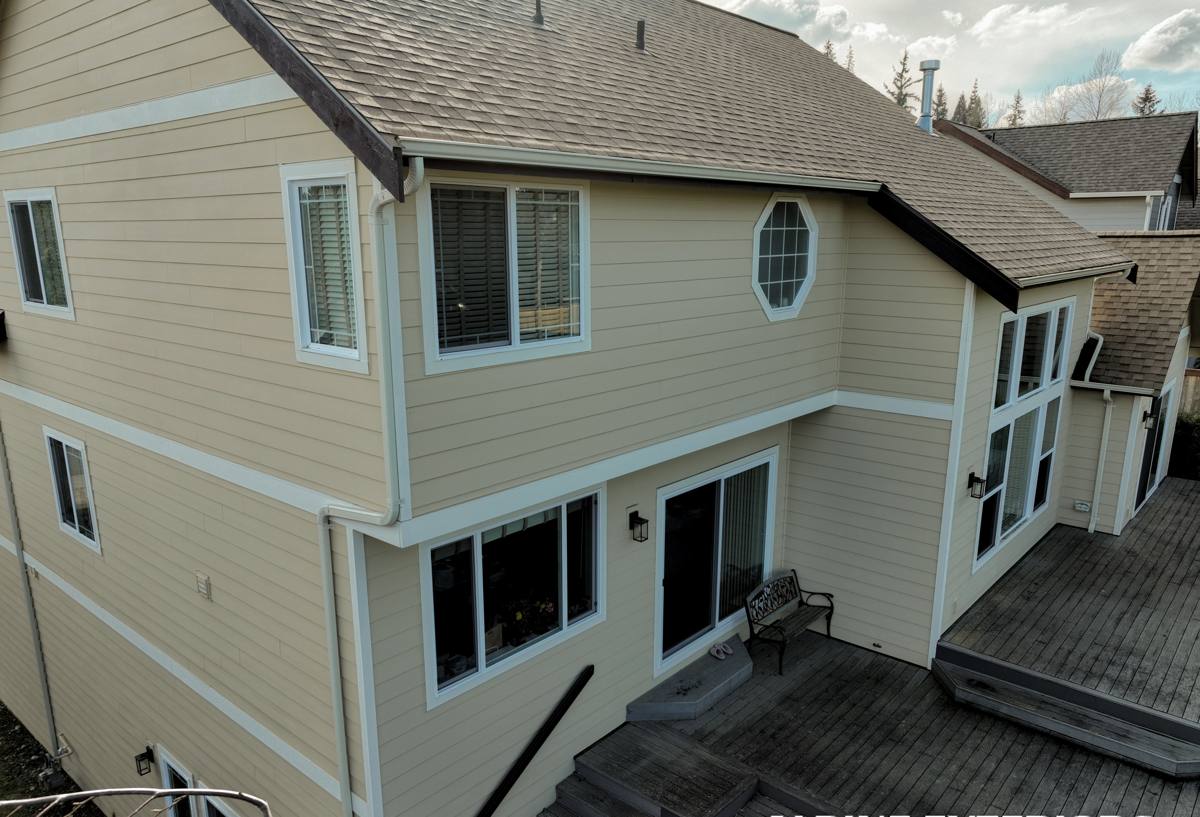
The Climate Factors That Actually Matter Here
Salt Air
Airborne salt doesn't just affect metal fasteners and hardware — it accelerates the breakdown of paint films and lower-grade composite materials, leading to chalking, fading, and surface erosion faster than manufacturers' general warranty language assumes. Siding on this coastline needs a factory finish that's actually formulated to resist it, not just a coat of field-applied paint.
Driving Rain
Wind off the water pushes rain sideways into wall assemblies, not just straight down. That means lap joints, butt joints, and trim intersections take on real hydrostatic pressure during storms. Siding that relies on caulk alone to keep water out, rather than proper shingling, overlap, and drainage behind the cladding, will eventually let moisture in — usually behind the siding where you can't see it until there's a problem.
Moss and Sustained Dampness
Whatcom County's long wet season means north-facing and shaded walls stay damp for extended stretches. Moss and algae growth on siding isn't just cosmetic — sustained moisture against a wall surface is exactly the condition that causes rot in wood-based products and accelerates failure in anything not designed to shed water quickly and dry out between rain events.
Why We Only Install James Hardie Fiber Cement
We made a standing decision as a company to install James Hardie fiber cement siding exclusively — not vinyl, not LP SmartSide, not Cemplank, not Allura, not primed wood species like spruce or cedar. That's not a marketing position; it's a response to what we've seen hold up in this exact climate versus what struggles.
Wood-based siding, even engineered products, relies on a wood strand core. In a salt-air, high-moisture environment, any breach in the factory coating or field-cut edge sealing gives moisture a path into that core, and swelling or edge deterioration follows. Vinyl siding is inexpensive and low-maintenance in mild climates, but it can distort in strong, sustained wind exposure and its color is baked into thin material that fades and becomes brittle with UV and salt exposure over time, with no realistic way to refinish it short of replacement.
Fiber cement, by contrast, is cement, sand, and cellulose fiber — it has no wood core to rot and doesn't combust. James Hardie's ColorPlus factory finish is baked on in a controlled environment specifically to resist fading and chipping better than field-applied paint, and Hardie's HardieZone system engineers panel formulations for specific climate demands rather than using one generic mix everywhere.
What We Give Up, In Fairness
Fiber cement costs more up front than vinyl and is heavier and more labor-intensive to install correctly — it has to be cut with proper dust control, fastened per manufacturer spec, and caulked and flashed correctly at every penetration. It's not the cheapest or fastest material on the market. We think the trade-off is worth it for a home that has to stand up to this coastline for 30-plus years, but it's a real trade-off, not a free lunch.
Hardie Products That Fit This Neighborhood
James Hardie makes several siding profiles, and the right one depends on the home's style and exposure:
- HardiePlank lap siding — the most common choice for traditional and craftsman-style homes, available in several exposure widths and textures.
- HardieShingle — for homes wanting a shingle-style look on gables or full elevations, without the moisture vulnerability of real wood shingles.
- HardiePanel vertical siding — often used as an accent or on modern-style homes, paired with battens.
- HardieTrim — fiber cement trim boards used around windows, corners, and fascia so the whole exterior envelope is consistent, non-combustible material.
For a coastal-influenced area like California Creek, we also pay close attention to Hardie's climate-specific formulation guidance so the product installed matches the moisture and temperature demands of a Pacific Northwest marine exposure rather than a generic national spec.
What a Correct Installation Actually Involves
Most fiber cement problems we get called to inspect aren't product failures — they're installation shortcuts. On a home exposed to driving rain and salt air, the details matter more, not less.
Substrate and Weather Barrier
Correct installation starts underneath the siding: a continuous, properly lapped weather-resistant barrier, correctly integrated flashing at every window, door, and penetration, and attention to any existing sheathing damage before new siding goes up. Covering a compromised wall with new siding just hides the problem.
Clearances and Drainage
Fiber cement needs proper clearance from grade, roof lines, decks, and horizontal surfaces so water has somewhere to go and the bottom edge of the siding can dry out. This is one of the most commonly skipped details on lower-cost installs, and it's one of the main causes of edge swelling and paint failure at the base of a wall.
Fastening and Joints
Manufacturer-specified fastener type, spacing, and embedment matter for wind and moisture performance — especially important given how much direct wind exposure some California Creek lots get. Butt joints should be flashed or sealed per Hardie's specifications, not just caulked and hoped for.
Finish Integrity
Field-cut edges need sealing per manufacturer instructions before installation, since a raw cut edge is the one place the factory ColorPlus finish isn't already protecting the panel.
Our Process, Start to Finish
- On-site assessment — we look at wall exposure, existing moisture damage, trim condition, and drainage paths specific to your lot and orientation.
- Product and profile selection — matched to your home's style and the wall's actual exposure to wind, sun, and rain.
- Substrate repair — any rot, damaged sheathing, or failed flashing gets addressed before new siding goes on, not covered up.
- Installation to Hardie spec — correct clearances, fastening, flashing, and joint treatment throughout.
- Final walkthrough — trim, caulking, and touch-up finish are reviewed with you before we call the job done.
Cost Factors to Understand
| Factor | Why It Affects Price |
|---|---|
| Home size and wall exposure | More linear footage and more complex elevations (dormers, multiple gables) add labor time |
| Existing damage | Rot or sheathing repair discovered during tear-off adds material and labor beyond the base siding job |
| Siding profile | Lap, shingle, and panel styles differ in material and installation labor |
| Trim scope | Full HardieTrim window and corner replacement costs more than reusing sound existing trim |
| Access and site conditions | Steep lots, limited staging area, or multi-story walls near the water increase equipment and labor needs |
We give straightforward, itemized estimates so you can see exactly what's driving the number, rather than a single lump figure.
Homeowner Maintenance Checklist for Fiber Cement in This Climate
- Rinse siding periodically to clear salt residue, especially on water-facing elevations
- Inspect caulk joints at trim and penetrations annually, and re-caulk if you see cracking or gaps
- Watch shaded, north-facing walls for moss or algae buildup and clean gently before it spreads
- Keep gutters and downspouts clear so water isn't sheeting down wall surfaces
- Maintain clearance between siding and grade, decks, or landscaping as it grows or settles
- Repaint or touch up only with products compatible with ColorPlus finish, and only when actually needed
Why Local Experience in California Creek Matters
A crew that only works inland jobs may not think twice about clearance details or fastener corrosion resistance that matter on a water-exposed wall. Working regularly in and around Semiahmoo means we're used to sizing up how a specific lot's wind exposure, tree cover, and proximity to the water changes the install plan — not applying the same generic approach everywhere in Whatcom County. That local pattern recognition is part of what keeps a siding job performing 20 years out instead of just looking good on install day.
If you're planning a siding project for your California Creek home, we're happy to walk your property, look at your current siding or sheathing condition, and give you a straightforward, no-pressure estimate — just fill out the form below to get started.