 Semiahmoo Siding
 Why Blaine Harbor Decks Wear Out Faster Than Inland Decks
A deck built two miles inland in Whatcom County and a deck built in Blaine Harbor are not fighting the same fight. Blaine Harbor sits right on the water, close to Semiahmoo Bay, where salt-laden air moves through every day of the year. That air carries fine salt particles that settle into wood grain, metal fasteners, and even the underside of composite boards. Add the driving, sideways rain that comes off the water during fall and winter storms, and you get moisture pushed into joints and end grain that a typical deck detail was never built to handle.
Then there's moss. Whatcom County's long wet season gives moss and algae months to establish themselves on any deck surface that doesn't get regular sun and airflow, especially on the shaded or water-facing side of a home. Moss holds moisture against the board surface long after the rain stops, which is exactly the condition that rots wood and stains composite decking. None of this means a deck in Blaine Harbor can't last — it means it has to be built and detailed differently than a deck going in somewhere dry and inland.
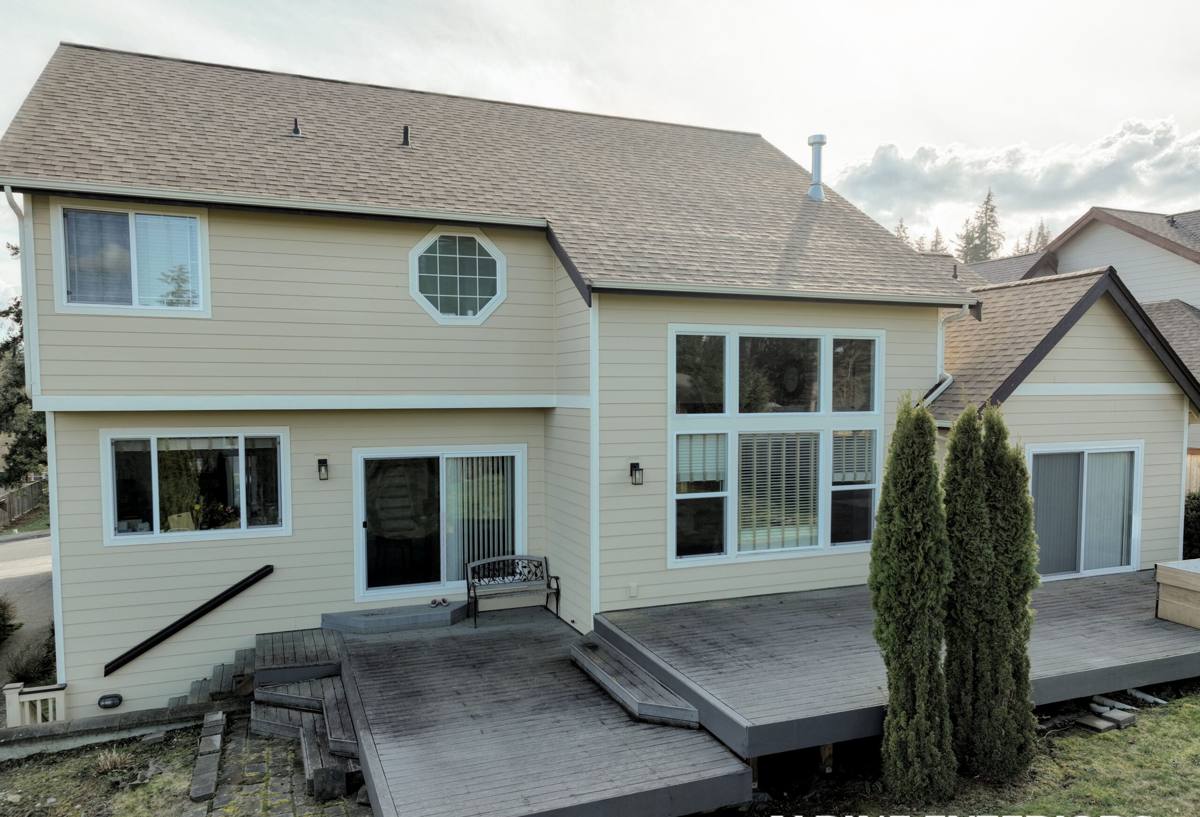
How Salt Air, Rain, and Moss Actually Damage a Deck
Salt Air and Metal Fatigue
Salt accelerates corrosion in fasteners, joist hangers, and structural hardware. Once a fastener starts corroding, it loses holding strength long before it looks obviously bad from the surface. On a harbor-facing deck, this is often the real reason a structure starts to feel spongy or loose well before the decking boards themselves show their age.
Wind-Driven Rain and End-Grain Absorption
Most deck rot doesn't start in the middle of a board — it starts at the ends, where end grain soaks up water like a straw. Wind-driven rain off the bay pushes water into these vulnerable spots, into fastener holes, and into any gap where two pieces of decking meet. Once water gets past the surface, it stays trapped underneath, out of sight, doing damage for months before anyone notices a problem.
Moss, Shade, and Trapped Moisture
Moss doesn't just look bad — it changes how a deck surface dries. A board covered in moss stays damp for days after a rain instead of drying out in a few hours. Over one wet season, that difference is significant. Over several, it's often the deciding factor between a deck that needs a board or two replaced and one that needs to come out entirely.
Signs a Blaine Harbor Deck Needs Replacement, Not Repair
Homeowners near the harbor often ask us to "just fix a few boards." Sometimes that's the right call. Often, once we're underneath the deck, it isn't. Here's what tells us a deck has crossed the line from repairable to due for full replacement:
- Soft, spongy, or bouncy spots anywhere on the deck surface, not just at the edges
- Visible rot, splitting, or discoloration at board ends and around fastener heads
- Rust streaks running down from joist hangers, screws, or ledger bolts
- A ledger board (where the deck attaches to the house) that shows any gap, staining, or softness
- Persistent moss or black staining that returns within weeks of cleaning
- Railings or posts that flex or wiggle more than they used to
- A deck older than 15–20 years that has never had the substructure inspected
Any one of these on its own might just mean a repair. Two or three together, especially involving the framing or ledger, usually mean the cost of chasing repairs no longer makes sense compared to a properly built replacement.
What a Correct Deck Replacement Involves Here
Framing and Ledger Detail
The ledger connection — where the deck ties into the house — is the single most important structural detail on any deck, and it's the one spot where a harbor-climate mistake causes the most damage. A correct installation uses proper flashing to keep water from tracking behind the ledger and into the house framing, stainless or heavily coated structural screws rated for exterior and coastal use, and joist hangers sized and fastened to code, not just "close enough." We treat this connection as the priority on every Blaine Harbor deck, because a shortcut here is invisible until it's a expensive problem.
Decking Material Selection
Not every decking product performs the same way this close to the water. Wood species, composite formulations, and even fastener finishes all react differently to sustained salt exposure and near-constant moisture cycling. Part of doing this job right in Blaine Harbor is steering homeowners toward materials and hardware that hold up here specifically, not materials that simply look good in a showroom.
Drainage, Airflow, and Moss Prevention
A deck that can't shed water and breathe underneath will grow moss again no matter what it's built from. Correct spacing between boards, proper slope away from the house, and enough clearance underneath for air to move are what actually slow moss regrowth — more than any cleaning product applied after the fact.
Decking Material Comparison for a Harbor Climate
| Material | Salt Air Performance | Moss / Moisture Behavior | Maintenance Burden |
|---|---|---|---|
| Pressure-treated wood | Fair — needs sealed cuts and coated fasteners | Absorbs moisture readily; moss-prone without regular cleaning | Highest — sealing and cleaning every 1–2 years |
| Cedar | Good natural resistance, but surface still needs upkeep | Better shedding than treated wood, still needs airflow | Moderate — periodic sealing to hold appearance and durability |
| Composite (capped) | Very good — resists salt staining and doesn't absorb like wood | Sheds moisture well but can still show surface moss if shaded and unwashed | Low — occasional washing, no sealing |
| PVC decking | Excellent — fully synthetic, unaffected by salt | Best moisture shedding of the group | Lowest — washing only |
There's no single "correct" choice for every homeowner — budget, appearance preference, and how the deck is used all factor in. What matters is picking a material honestly, with the harbor climate factored into the decision up front, rather than discovering the trade-offs after a few wet winters.
Our Deck Replacement Process
We keep the process straightforward and communicate at each stage, because deck replacement disrupts a homeowner's outdoor space and we know that matters.
- On-site assessment: We inspect the existing deck from the top down and from underneath, including the ledger connection, checking for the rot and corrosion patterns typical of harbor-side homes.
- Honest scope discussion: We tell you plainly whether you need a full replacement, a partial rebuild, or if repair is genuinely sufficient — we don't upsell a replacement a deck doesn't need.
- Material and layout planning: We walk through decking, railing, and hardware options with the salt air and moss exposure of your specific property in mind.
- Removal and structural rebuild: Old decking, framing, and any compromised ledger connections come out and are rebuilt to current code, with coastal-appropriate flashing and fasteners.
- Decking and railing installation: Boards and railings go in with attention to spacing and drainage, not just fastening speed.
- Final walkthrough: We go over the finished deck together, including basic care guidance suited to Whatcom County's wet season.
What Drives the Cost of a Deck Replacement
| Factor | Why It Matters |
|---|---|
| Deck size and layout | Square footage and shape (straight run vs. multi-level or wraparound) drive labor and material quantities |
| Substructure condition | Rotted joists, posts, or a compromised ledger add rebuild work beyond just the visible decking |
| Decking material chosen | Wood, composite, and PVC carry different upfront material costs and long-term maintenance costs |
| Railing type and code requirements | Height, style, and any required guard spacing affect both material and install time |
| Site access | Waterfront lots with limited access or elevation changes can add time to demolition and material staging |
We give straightforward, itemized estimates so homeowners can see exactly where the cost is going, rather than a single lump number that hides the decisions behind it.
Why a Crew That Already Works Blaine Harbor Matters
Deck construction knowledge that works fine in a dry, inland climate doesn't automatically transfer to a harbor-side property. A crew that regularly works in and around Blaine Harbor already knows which fastener finishes actually hold up, how far to set boards for real-world drainage in this rainfall pattern, and which corners genuinely cannot be cut on a ledger connection this close to the water. That familiarity shows up in details a homeowner might never think to ask about, but that determine whether a deck is still solid in ten years or needs major work again in three.
It also means fewer surprises during the project itself. Weather patterns, seasonal timing, and even permitting expectations in Whatcom County are things a local crew has already worked through many times, rather than learning on your project.
A Simple Checklist Before You Commit to Replacement
- Has anyone actually inspected the framing and ledger, not just the surface boards?
- Does the estimate specify fastener and hardware type, not just "decking material"?
- Is drainage and airflow underneath the deck part of the plan, or an afterthought?
- Does the contractor have specific experience with salt-air and coastal moisture conditions?
- Is the scope written clearly enough that you know what happens if hidden rot is found once work starts?
If you're weighing repair against replacement for a deck in Blaine Harbor, we're happy to take an honest look and walk you through what we find — no pressure, no upsell, just a straight answer. Fill out the form below for a free estimate.